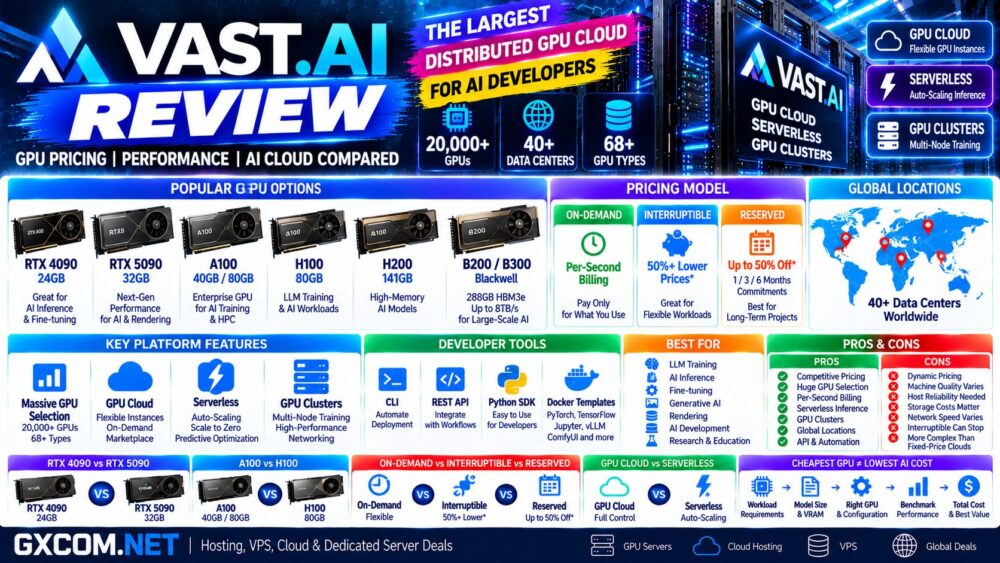
Vast.ai has evolved from a low-cost GPU marketplace into a broader AI infrastructure platform offering GPU Cloud, Serverless GPU inference, and multi-node GPU Clusters.
Instead of operating only a centralized fleet with fixed GPU prices, Vast.ai connects GPU capacity across a distributed marketplace. Prices respond to supply and demand, allowing users to compare GPUs by model, VRAM, location, reliability, performance, storage, network capabilities, and hourly cost.
The platform currently provides access to more than 20,000 GPUs across over 40 data centers and more than 68 GPU types, ranging from affordable consumer GPUs such as the RTX 3090 and RTX 4090 to enterprise accelerators including the A100, H100, H200, B200, and B300.
In this Vast.ai Review, we examine GPU pricing, performance, the marketplace model, GPU Cloud, Serverless, Interruptible and Reserved instances, security, reliability, AI workloads, and the major pros and cons to consider before renting GPU compute.
Vast.ai Review: Quick Overview
| Feature | Vast.ai |
|---|---|
| Platform | Distributed GPU Cloud Marketplace |
| GPU Cloud | Yes |
| Serverless | Yes |
| GPU Clusters | Yes |
| GPU Fleet | 20,000+ |
| GPU Types | 68+ |
| Data Centers | 40+ |
| RTX 4090 | Yes |
| RTX 5090 | Yes |
| NVIDIA A100 | Yes |
| NVIDIA H100 | Yes |
| NVIDIA H200 | Yes |
| NVIDIA B200 | Yes |
| NVIDIA B300 | Yes |
| On-Demand | Yes |
| Interruptible | Yes |
| Reserved | Yes |
| Billing | Per Second |
| Minimum to Start | $5 account credit |
| CLI / API / SDK | Yes |
| Docker Templates | Yes |
| Best For | AI training, inference, fine-tuning, rendering and GPU development |
What Is Vast.ai?
Vast.ai is a GPU compute marketplace and AI infrastructure platform.
The key difference between Vast.ai and a conventional cloud provider is how GPU capacity is supplied and priced.
Traditional clouds generally own or directly control centralized infrastructure and publish relatively fixed instance prices.
Vast.ai instead aggregates GPU capacity from distributed infrastructure providers and allows them to compete for workloads.
The result is a marketplace where prices vary according to:
- GPU model
- GPU count
- VRAM
- Host
- Location
- Reliability
- CPU
- RAM
- Storage
- Network
- Supply and demand
This can produce very competitive GPU pricing, but it also means that two instances containing the same GPU are not necessarily equivalent.
Vast.ai Is More Than a GPU Marketplace
Vast.ai currently organizes its AI infrastructure into three major deployment models:
- GPU Cloud
- Serverless
- GPU Clusters
GPU Cloud provides direct instance control, Serverless automatically scales inference workers, and Clusters target large-scale multi-node AI training.
This makes the platform significantly broader than the early concept of simply renting spare GPUs from a marketplace.
Vast.ai GPU Cloud
GPU Cloud is the traditional Vast.ai experience.
Users search available infrastructure and filter instances according to the hardware and pricing requirements of their workload.
Current filters and selection criteria can include:
- GPU model
- GPU count
- VRAM
- Hourly price
- DLPerf
- Reliability
- CPU
- RAM
- Storage
- Network bandwidth
- CUDA version
- Location
- Verified machines
- Secure Cloud
Once an appropriate machine is found, users can deploy using the web console, CLI, Python SDK, or REST API.
Vast.ai GPU Pricing
Vast.ai does not have one permanent price for each GPU.
Marketplace prices change according to supply and demand.
That means asking “How much does an H100 cost on Vast.ai?” does not have one permanent answer.
The correct comparison is the live marketplace rate at the time the workload is deployed.
Vast.ai currently states that H100 capacity can be available from approximately $0.90 per GPU-hour under favorable marketplace conditions, while actual offers vary continuously.
Users should therefore treat advertised “from” prices as the lowest currently available offers rather than guaranteed long-term rates.
Why Vast.ai GPU Prices Change
GPU pricing is influenced by several factors:
- GPU supply
- Demand
- GPU architecture
- VRAM
- Host reliability
- Machine configuration
- Location
- Storage
- Bandwidth
- Rental type
For example, two RTX 4090 offers can have the same 24GB GPU but different CPUs, RAM, SSD performance, upload bandwidth, download bandwidth, reliability scores, and geographic locations.
Comparing only the hourly GPU price can therefore be misleading.
Vast.ai On-Demand Instances
On-Demand is the standard option for workloads that should remain running until the customer stops them.
Vast.ai currently describes On-Demand as the preferred option for production workloads.
Advantages include:
- Per-second billing
- No planned interruption
- Flexible start and stop
- No long-term commitment required
This is generally the safer rental type for interactive development, inference services, and workloads that cannot tolerate preemption.
Vast.ai Interruptible Instances
Interruptible instances trade availability guarantees for lower pricing.
According to Vast.ai, these instances can currently be more than 50% cheaper than equivalent On-Demand capacity.
The trade-off is that the machine can be reclaimed.
Interruptible infrastructure is therefore better suited to fault-tolerant workloads such as:
- Batch processing
- Checkpointed training
- Rendering
- Experiments
- Distributed workloads that can recover
It is generally less appropriate for a production service that must remain continuously available.
Vast.ai Reserved Instances
Reserved pricing is designed for workloads that need predictable GPU capacity over longer periods.
Current Vast.ai options include commitments of approximately:
- 1 month
- 3 months
- 6 months
Vast.ai currently advertises discounts of up to approximately 50% for applicable Reserved capacity.
Reserved instances can make sense for continuous training, research projects, persistent AI infrastructure, and other workloads where GPU utilization is predictable.
On-Demand vs Interruptible vs Reserved
| Factor | On-Demand | Interruptible | Reserved |
|---|---|---|---|
| Commitment | Low | Low | Higher |
| Interruption Risk | Low | Higher | Low |
| Pricing | Standard market rate | Lower | Discounted commitment |
| Best For | Production / development | Fault-tolerant jobs | Steady workloads |
| Billing | Per second | Per second | Commitment based |
Vast.ai GPU Selection
One of Vast.ai's biggest advantages is GPU variety.
The current platform offers more than 68 GPU types covering multiple NVIDIA generations.
Popular options include:
- RTX 3090
- RTX 4090
- RTX 5090
- RTX A-Series
- NVIDIA L-Series
- NVIDIA A100
- NVIDIA H100 PCIe
- NVIDIA H100 SXM
- NVIDIA H100 NVL
- NVIDIA H200
- NVIDIA B200
- NVIDIA B300
This allows users to select hardware according to the actual workload instead of being limited to a small set of cloud instance types.
RTX 4090 on Vast.ai
The RTX 4090 remains one of the most popular GPUs for price-sensitive AI workloads.
It provides:
- 24GB GDDR6X VRAM
- Ada Lovelace architecture
- 16,384 CUDA cores
- 1,008GB/s memory bandwidth
It can be particularly attractive for:
- LLM inference
- Quantized language models
- LoRA fine-tuning
- Stable Diffusion
- ComfyUI
- Computer vision
- Rendering
The main limitation is its 24GB VRAM capacity.
RTX 5090 on Vast.ai
RTX 5090 instances provide a newer Blackwell-generation consumer GPU option with 32GB of VRAM.
The additional memory can make the RTX 5090 more practical than the RTX 4090 for models and inference configurations that exceed 24GB.
However, price-to-performance should be measured against the actual workload rather than assuming that the newer GPU automatically provides better value.
NVIDIA A100 on Vast.ai
A100 remains widely used for AI training, fine-tuning, inference, scientific computing, and HPC.
Its larger memory configurations make it relevant when RTX-class GPUs cannot provide enough VRAM.
A100 can be particularly useful for:
- LLM fine-tuning
- Deep learning
- Large datasets
- Multi-GPU training
- Scientific computing
NVIDIA H100 and H200
H100 and H200 target much larger AI workloads.
Vast.ai currently offers multiple H100 variants, including PCIe, SXM, and NVL infrastructure, along with H200 capacity.
These GPUs are relevant for:
- Large language model training
- Generative AI
- Large-model inference
- Distributed training
- High-throughput AI
- HPC
For more options, see our
NVIDIA H100 GPU Server Deals
comparison.
B200 and B300 on Vast.ai
Vast.ai expanded its marketplace with NVIDIA B200 and B300 GPUs in 2026.
B300 represents the Blackwell Ultra generation and provides 288GB of HBM3e memory with approximately 8TB/s of memory bandwidth.
This class of accelerator is designed for extremely memory-intensive workloads including:
- Large-scale inference
- Reasoning models
- Distributed training
- Large language models
- High-memory AI workloads
The availability of B200 and B300 also demonstrates how broad the Vast.ai marketplace has become compared with its earlier focus on inexpensive consumer GPUs.
Vast.ai Serverless
Vast.ai Serverless is designed primarily for workloads such as AI inference where demand changes over time.
Instead of manually maintaining a fixed number of GPU instances, Serverless can automatically scale GPU workers according to workload demand.
Current features include:
- Automatic GPU worker scaling
- Scale-to-zero
- Predictive optimization
- Multiple GPU worker types
- Python SDK deployment
- Logs and metrics
- Jupyter access
- SSH access
- Reserve worker pools
This is especially relevant for inference APIs where traffic can change dramatically throughout the day.
Vast.ai Serverless Pricing
Vast.ai states that Serverless does not add a separate surcharge to the underlying GPU pricing model.
Billing remains usage-based and supports On-Demand, Interruptible, and Reserved capacity.
Scale-to-zero can reduce idle GPU costs because workers can be released when demand disappears.
This creates a very different economic model from renting an H100 or RTX 4090 continuously for an inference endpoint that receives only occasional requests.
Vast.ai GPU Clusters
Vast.ai also offers multi-node GPU clusters for workloads that cannot fit efficiently onto a single machine.
Clusters are designed for large-scale training and can use high-speed networking such as InfiniBand on applicable infrastructure.
Typical workloads include:
- Distributed LLM training
- Large AI models
- HPC
- Research
- Multi-node machine learning
Cluster performance depends heavily on the GPU interconnect and network architecture, not simply the total number of GPUs.
Vast.ai Templates
Vast.ai provides templates that simplify deployment of common AI environments.
Users can choose official templates, community templates, or create their own Docker-based environments.
Typical software includes:
- PyTorch
- TensorFlow
- Jupyter
- CUDA
- vLLM
- ComfyUI
- LLM frameworks
- Generative AI tools
Templates reduce setup time but users should still verify CUDA, driver, framework, and GPU architecture compatibility.
CLI, API and Python SDK
Vast.ai has become increasingly developer-focused.
Infrastructure can currently be controlled through:
- Web console
- CLI
- REST API
- Python SDK
This allows teams to automate GPU discovery, provisioning, scaling, and termination rather than manually selecting instances through the dashboard.
For larger AI workloads, API-driven provisioning can be one of Vast.ai's most useful features.
Benchmark Before You Deploy
Vast.ai introduced a particularly useful benchmarking workflow in 2026.
Its CLI can test the same workload across multiple GPU types such as H100, A100, RTX 5090, and RTX 4090.
The tool rents real instances, runs the benchmark, reports performance and cost efficiency, and then tears the instances down.
This helps answer a much more useful question than simply asking which GPU is fastest:
Which GPU delivers the best performance per dollar for this specific workload?
Vast.ai Reliability
Reliability requires more attention on a distributed marketplace than on a cloud where every instance comes from one standardized data center fleet.
Vast.ai provides host and machine reliability information that can be used when filtering offers.
Buyers should evaluate:
- Host reliability
- Verified status
- Machine availability
- Network performance
- Storage performance
- Maximum instance duration
For experimental workloads, the cheapest machine may be sufficient.
For production infrastructure, reliability and security can be more important than saving a few cents per GPU-hour.
Secure Cloud
Vast.ai offers Secure Cloud infrastructure for workloads requiring stronger operational and security controls.
The current GPU Cloud platform highlights isolated environments, direct SSH access, private networking capabilities, audit options, and SOC 2 compliance.
Users handling business-sensitive workloads should distinguish Secure Cloud capacity from less standardized marketplace infrastructure rather than treating every offer as equivalent.
Storage Costs Matter
GPU hourly price is only one component of total AI infrastructure cost.
Depending on the instance and workload, users may also need to account for:
- Container disk
- Persistent storage
- Data transfer
- Model downloads
- Dataset storage
- Idle resources
A GPU that appears extremely cheap can become less attractive if storage, bandwidth, or slow data loading reduces GPU utilization.
The correct metric is therefore:
Total Workload Cost ≠ GPU Hourly Price Alone.
Vast.ai for LLM Training
Vast.ai can be attractive for LLM training because the marketplace provides access to both inexpensive consumer GPUs and high-end data-center accelerators.
Smaller fine-tuning workloads may run efficiently on RTX 4090 or RTX 5090 systems, while larger models may require A100, H100, H200, B200, or B300 capacity.
Interruptible pricing can further reduce training costs when checkpointing is implemented correctly.
For more GPU options, see our
Best GPU Servers for LLM Training and AI Inference
guide.
Vast.ai for AI Inference
Inference workloads have different requirements from training.
Important metrics include:
- Time to first token
- Tokens per second
- Concurrent requests
- VRAM
- Batch size
- Latency
- Cost per request
For predictable traffic, a persistent GPU Cloud instance may make sense.
For highly variable demand, Vast.ai Serverless can reduce idle capacity by automatically scaling GPU workers.
Vast.ai Performance
There is no meaningful single benchmark for “Vast.ai performance.”
The platform contains thousands of machines with different:
- GPUs
- CPUs
- RAM
- PCIe configurations
- Storage devices
- Network connections
- Locations
Two machines with identical RTX 4090 GPUs can therefore deliver different end-to-end workload performance.
This makes benchmarking particularly important before committing to a long-running instance.
Have We Independently Benchmarked Vast.ai?
This review evaluates Vast.ai using current published platform specifications, pricing information, infrastructure documentation, product features, and marketplace capabilities.
Unless GXCOM.NET explicitly publishes benchmark methodology and measured test results, Vast.ai performance claims should not be interpreted as independent GXCOM.NET benchmarks.
For serious AI workloads, test your own model on several candidate GPU types and machines.
Useful measurements include:
- Tokens per second
- Training throughput
- GPU utilization
- VRAM utilization
- Storage throughput
- Network throughput
- Job completion time
- Total cost per completed workload
Vast.ai vs RunPod
| Factor | Vast.ai | RunPod |
|---|---|---|
| Core Model | Distributed GPU marketplace | GPU cloud platform |
| Pricing | Dynamic marketplace | More standardized cloud pricing |
| GPU Variety | Very broad | Broad |
| Consumer GPUs | Strong availability | Available |
| Enterprise GPUs | Yes | Yes |
| Serverless | Yes | Yes |
| Interruptible | Yes | Pricing model differs |
| Host Variability | Higher | More standardized experience |
| Best For | Price discovery and broad GPU choice | Streamlined GPU cloud workflows |
Neither platform is automatically cheaper for every workload because GPU type, utilization, storage, region, and current availability all matter.
Read our
RunPod Review
for a detailed look at the alternative platform.
Vast.ai vs GPU Mart
| Factor | Vast.ai | GPU Mart |
|---|---|---|
| Infrastructure Model | GPU marketplace/cloud | GPU hosting |
| Dynamic Marketplace Pricing | Yes | No |
| Monthly GPU Servers | Reserved options | Strong focus |
| Hourly GPU | Core model | Selected plans |
| Serverless | Yes | Not core product |
| Dedicated GPU Hosting | Marketplace dependent | Strong focus |
| Best For | Flexible on-demand AI compute | Persistent GPU servers |
Vast.ai is generally structured around flexible usage-based compute, while GPU Mart focuses more heavily on persistent GPU VPS and dedicated GPU hosting.
Vast.ai Pros and Cons
| Pros | Cons |
|---|---|
| Competitive marketplace pricing | Prices change continuously |
| 20,000+ GPUs | Machine quality can vary |
| 68+ GPU types | More complex than simple fixed-price clouds |
| Consumer and enterprise GPUs | Cheapest host may not be best |
| RTX 4090 and RTX 5090 | Interruptible instances can be reclaimed |
| A100, H100 and H200 | Storage and network need separate evaluation |
| B200 and B300 | Marketplace availability changes |
| Per-second billing | Production workloads require careful host selection |
| Interruptible discounts | Distributed infrastructure is less standardized |
| Serverless | — |
| GPU Clusters | — |
| CLI, API and SDK | — |
Who Should Consider Vast.ai?
Vast.ai is particularly relevant for:
- AI developers
- Machine learning engineers
- LLM developers
- Researchers
- AI startups
- Generative AI projects
- Fine-tuning
- AI inference
- Batch processing
- Rendering
- GPU experimentation
- Cost-sensitive AI workloads
It is especially useful when users are willing to compare multiple machines and GPU types to optimize performance per dollar.
Who May Prefer an Alternative?
Teams that want completely standardized hardware, fixed instance configurations, highly predictable pricing, or a deeply integrated hyperscale cloud ecosystem may prefer a more conventional cloud provider.
Likewise, users who simply want one persistent monthly GPU server without comparing marketplace listings may find traditional GPU hosting easier to manage.
Is Vast.ai Cheap?
Vast.ai can offer very competitive GPU pricing because providers compete within a marketplace rather than following one centralized fixed-price catalog.
However, the cheapest hourly offer is not automatically the lowest-cost infrastructure.
Consider:
GPU Price + Performance + Reliability + Storage + Network + Runtime = Real AI Compute Cost.
A faster GPU costing more per hour can actually cost less if it completes the workload substantially faster.
For current alternatives, see our
Cheap GPU Rental Deals
comparison.
Vast.ai Review: Final Thoughts
Vast.ai has developed into a broad AI infrastructure platform rather than remaining simply a marketplace for inexpensive spare GPUs.
Its current ecosystem includes more than 20,000 GPUs, over 68 GPU types, GPU Cloud, Serverless inference, multi-node clusters, per-second billing, API-driven deployment, and hardware ranging from RTX-class consumer GPUs to H100, H200, B200, and B300 accelerators.
The marketplace model is both its greatest strength and its main trade-off.
Competition between providers can create very attractive prices and unusually broad hardware selection, but infrastructure is less standardized than a centralized cloud. Users need to compare reliability, CPU, RAM, storage, networking, location, and security rather than selecting by GPU model and hourly price alone.
For AI developers willing to optimize infrastructure around their actual workload, Vast.ai offers considerable flexibility.
Before renting, use this decision path:
Workload → Model Size → VRAM → GPU → Reliability → Storage + Network → On-Demand / Interruptible / Reserved → Benchmark → Total Cost.