

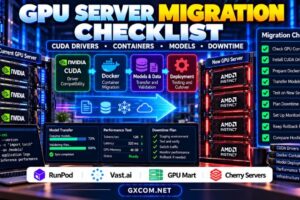
GPU Server Migration Checklist: CUDA Drivers, Containers, Models and Downtime
A GPU server migration checklist helps AI teams move workloads between cloud instances, dedicated servers, and hosting providers without unnecessary downtime. Unlike ordinary website migrations, GPU infrastructure changes can introduce CUDA driver conflicts, incompatible containers,…
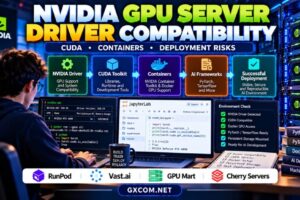
NVIDIA GPU Server Driver Compatibility: CUDA, Containers and Deployment Risks
NVIDIA GPU server driver compatibility is essential for reliable AI training, inference, and containerized deployment. A powerful GPU cannot run your workload correctly when its driver, CUDA runtime, container configuration, or machine learning framework is…

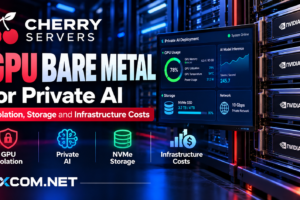
Cherry Servers GPU Bare Metal for Private AI: Isolation, Storage and Infrastructure Costs
Private AI infrastructure is becoming an important consideration for businesses that want greater control over model deployment, sensitive datasets, and long-running inference workloads. While shared GPU cloud platforms offer flexibility, dedicated GPU servers provide a…
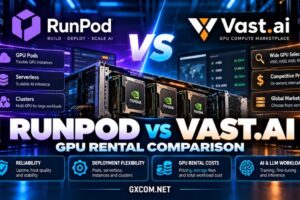
RunPod vs Vast.ai: GPU Rental Reliability, Deployment Flexibility and AI Costs
Renting a GPU is no longer simply about finding the lowest hourly rate. For AI developers, unreliable instances, storage charges, slow deployments, and interrupted training jobs can make an apparently inexpensive GPU surprisingly costly. In…
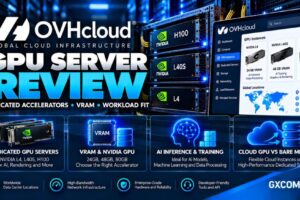
OVHcloud GPU Server Review: Dedicated Accelerators, VRAM and Workload Fit
Renting a GPU server is no longer just about finding the fastest NVIDIA accelerator. For AI inference, machine learning, video processing, and graphics workloads, the right decision depends on GPU memory, deployment flexibility, CPU resources,…

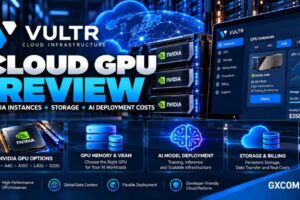
Vultr Cloud GPU Review: NVIDIA Instances, Storage and AI Deployment Costs
Renting an NVIDIA GPU in the cloud can eliminate the upfront expense of buying specialized hardware. However, choosing a GPU instance involves more than comparing accelerator models or advertised hourly rates. GPU memory, storage persistence,…
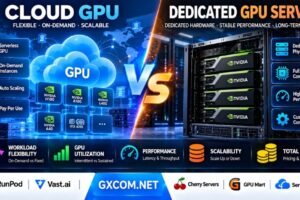
Cloud GPU vs Dedicated GPU Server: AI Workload Flexibility, Utilization and Total Cost
Should you rent GPUs from a cloud platform or choose a dedicated GPU server for artificial intelligence? The answer depends on more than GPU specifications or advertised hourly prices. AI workloads have very different resource…
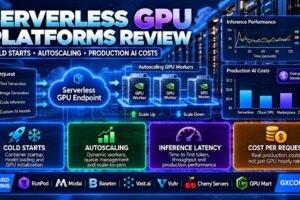
Serverless GPU Platforms Review: Cold Starts, Autoscaling and Production AI Costs
This serverless GPU platforms review compares the technologies, deployment models, and operating costs behind modern AI inference infrastructure. We examine GPU cold starts, autoscaling behavior, concurrency, latency, utilization, and the cost of serving real production…

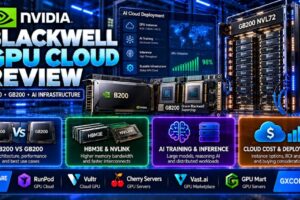
NVIDIA Blackwell GPU Cloud Review: B200, GB200 and AI Infrastructure Buying Considerations
This NVIDIA Blackwell GPU cloud review examines the B200, GB200 Grace Blackwell Superchip, and GB200 NVL72 from an AI infrastructure buying perspective. For organizations deploying large language models, reasoning systems, generative AI applications, and distributed…
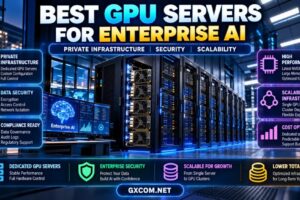
Best GPU Servers for Enterprise AI: Private Infrastructure, Security and Scalability
Choosing the best GPU servers for enterprise AI requires a different approach from selecting hardware for small experiments or short-term AI development. Enterprise organizations must consider private infrastructure, sensitive data protection, GPU performance, regulatory obligations,…

Best GPU Servers for AI Startups: Cloud vs Dedicated Infrastructure Compared
Finding the best GPU servers for AI startups is about more than choosing a powerful NVIDIA or AMD accelerator. Early-stage AI companies must balance model performance, GPU memory, infrastructure costs, deployment speed, and the ability…
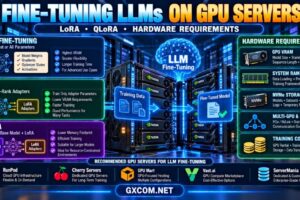
Fine-Tuning LLMs on GPU Servers: LoRA, QLoRA and Hardware Requirements
Choosing the right GPU infrastructure for large language model fine-tuning requires a different approach from ordinary LLM inference. Training workloads must account for model weights, gradients, optimizer states, activations, sequence length, and batch size. As…
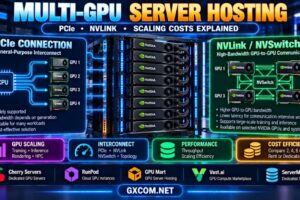
Multi-GPU Server Hosting: PCIe, NVLink and Scaling Costs Explained
Choosing the right multi-GPU server hosting solution involves more than counting graphics cards. A server with four or eight GPUs may offer substantial compute capacity, but actual performance depends on GPU memory, PCIe connectivity, NVLink…
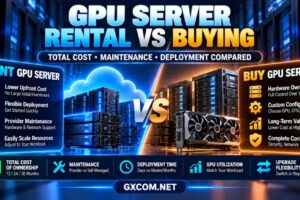
GPU Server Rental vs Buying: Total Cost, Maintenance and Deployment Compared
Choosing between GPU server rental vs buying is one of the most important infrastructure decisions for businesses running AI training, large language models, 3D rendering, scientific computing, and GPU-intensive applications. Buying a GPU server provides…
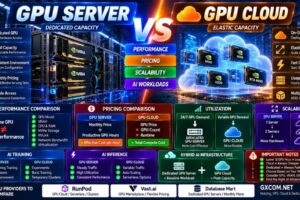
GPU Server vs GPU Cloud: Performance, Pricing and Which Is Better for AI?
AI infrastructure can be deployed in two very different ways: rent a dedicated GPU server for continuous access to the hardware, or use GPU cloud infrastructure that can be provisioned when workloads need it. Both…