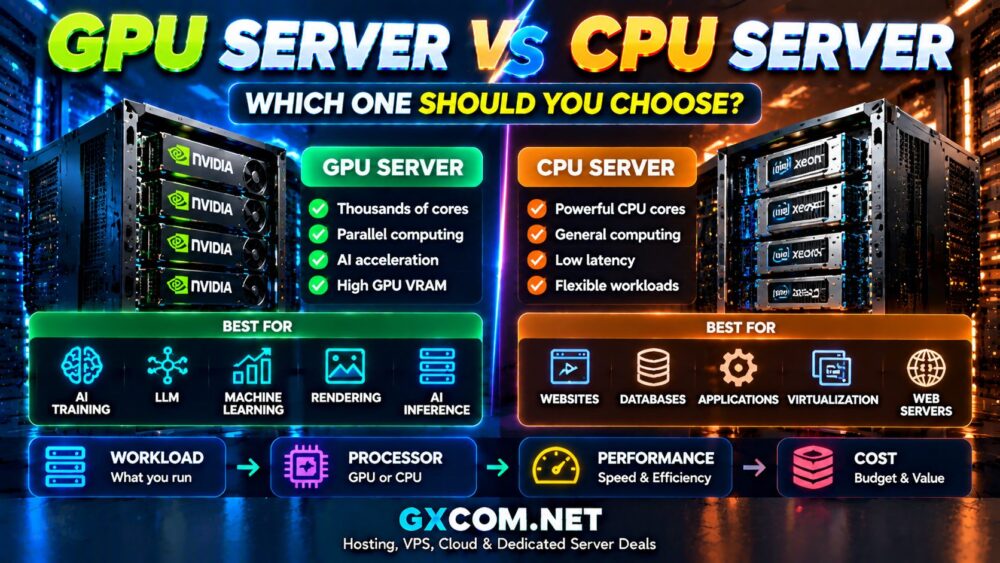
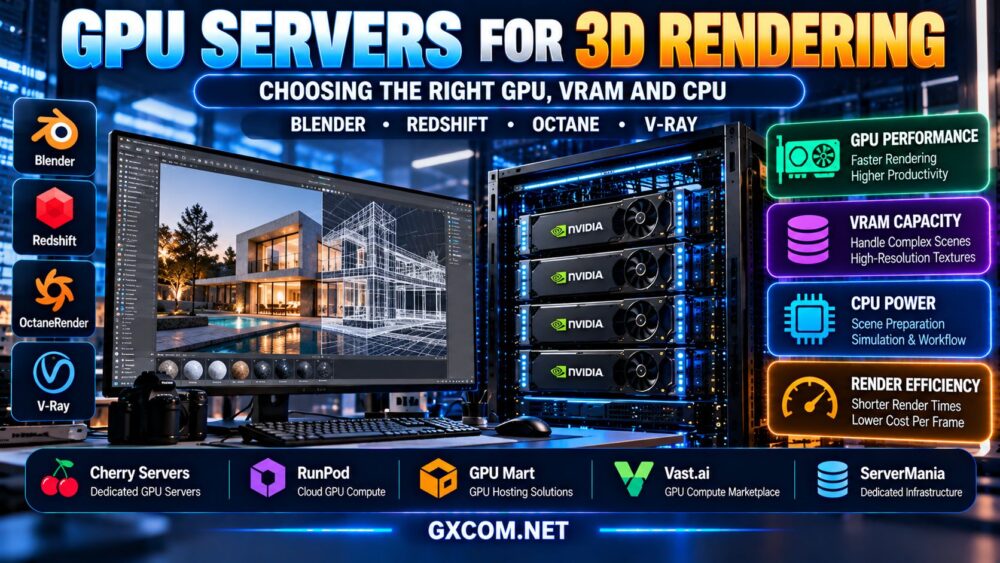
Choosing between GPU server rental vs buying is one of the most important infrastructure decisions for businesses running AI training, large language models, 3D rendering, scientific computing, and GPU-intensive applications.
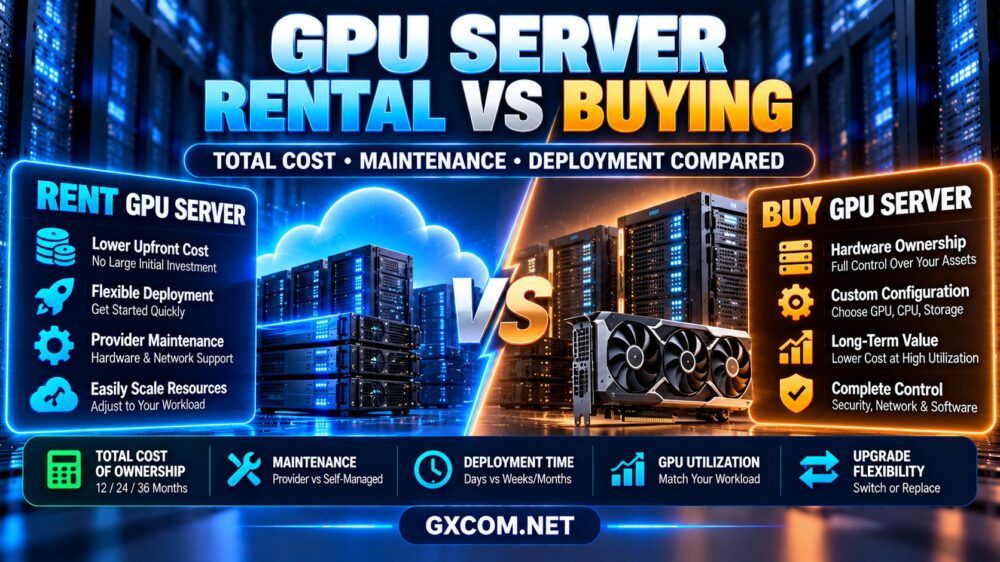
Buying a GPU server provides hardware ownership and long-term control. Renting GPU infrastructure can reduce upfront investment, accelerate deployment, and make it easier to change hardware as workloads evolve. However, neither option is automatically cheaper.
The right decision depends on GPU utilization, total cost of ownership, electricity, cooling, maintenance, deployment time, and how quickly your hardware requirements may change.
This guide compares GPU server rental and ownership, explains how to calculate costs over 12, 24, and 36 months, and identifies hosting options worth evaluating before committing to expensive infrastructure.
GPU Server Rental vs Buying: Key Differences
Renting a GPU server generally means paying a hosting or cloud infrastructure provider for access to GPU computing resources. Depending on the service, customers may receive an entire dedicated physical server, a GPU-enabled virtual machine, or access to GPU capacity through a cloud marketplace.
Buying a GPU server means purchasing the hardware and arranging a suitable operating environment, either on-premises or through colocation.
| Factor | Renting GPU Servers | Buying GPU Servers |
|---|---|---|
| Initial investment | Usually lower | Usually higher |
| Hardware ownership | Provider owns infrastructure | Customer owns hardware |
| Deployment speed | Depends on available capacity | Requires procurement and setup |
| Maintenance | Provider handles physical hardware; scope varies | Customer or contracted operator handles hardware |
| Hardware upgrades | Can move to other available configurations | Requires purchasing or replacing equipment |
| Operating expenses | Rental fees and possible add-ons | Power, cooling, space, support, networking |
| Residual hardware value | None for the renter | Potential resale value |
| Best suited to | Variable demand and flexible deployment | Stable workloads with suitable facilities |
For a broader overview of available GPU infrastructure, see our NVIDIA GPU server providers guide.
Understanding the Three Main GPU Deployment Models
1. Cloud GPU Rental
Cloud GPU services allow customers to provision GPU computing resources without purchasing physical equipment.
This approach is useful for temporary experiments, model development, batch processing, and workloads that do not require continuous operation.
However, billing may continue while resources remain allocated, and storage or networking can generate additional charges.
2. Dedicated GPU Server Rental
A dedicated GPU server generally provides access to a physical machine allocated to one customer.
It may be appropriate for sustained workloads, custom software environments, or organizations that want predictable access to specified hardware.
Dedicated rental contracts may have minimum terms, provisioning requirements, and hardware availability constraints.
3. Buying and Operating GPU Hardware
Purchasing GPU hardware provides ownership and control over equipment selection, operating systems, networking, and maintenance arrangements.
However, the customer must also provide or purchase suitable power, cooling, rack space, physical security, network connectivity, and technical support.
These operating costs should be included when comparing ownership against hosted infrastructure.
How to Calculate GPU Server Total Cost of Ownership
Total cost of ownership (TCO) includes more than the advertised hardware purchase price or monthly server rental fee.
GPU Server Rental Cost Formula
Rental TCO = compute rental + storage + data transfer + software + management + other service charges
For continuously rented dedicated servers, calculate the recurring service cost over the intended deployment period and add any setup, licensing, backup, or network expenses.
For cloud GPU instances, estimate the actual billable hours and account for storage or services that remain active between compute sessions.
GPU Server Ownership Cost Formula
Ownership TCO = hardware + deployment + power + cooling + facilities + networking + maintenance + software − residual value
Financing charges, insurance, spare components, and downtime costs may also matter for larger deployments.
Residual value is uncertain because used GPU hardware prices depend on demand, condition, age, and technological changes.
Illustrative GPU Server Cost Comparison
The following example uses hypothetical figures to demonstrate the calculation method. These are not current GPU server prices or quotations from any provider.
Assume a business is evaluating an equivalent GPU configuration under two deployment models:
- Dedicated GPU server rental: hypothetical $900 per month.
- Purchased GPU server hardware: hypothetical $18,000 upfront.
- Ownership operating expenses: hypothetical $200 per month.
- Resale value: excluded initially for a conservative comparison.
| Deployment Period | Rental TCO | Ownership TCO |
|---|---|---|
| 12 months | $10,800 | $20,400 |
| 24 months | $21,600 | $22,800 |
| 36 months | $32,400 | $25,200 |
Under these assumptions, rental costs less over 12 and 24 months, while ownership costs less over 36 months.
However, the comparison changes if electricity prices, equipment costs, rental rates, utilization, hardware replacement, financing, or resale value change.
The example also assumes equivalent performance and availability, which must be verified in a real purchasing decision.
GPU Utilization: The Biggest Factor in Rental Economics
GPU utilization describes how actively GPU resources are used during the period they are available.
For example, an organization that needs GPU computing for occasional experiments may not benefit from purchasing expensive hardware that remains idle most of the time.

Conversely, a business running predictable GPU workloads continuously may find dedicated rental or ownership more economical than paying on-demand rates indefinitely.
Before choosing a deployment model, measure:
- Actual GPU-active hours.
- Idle time between workloads.
- GPU memory usage.
- Compute utilization during jobs.
- Peak concurrent GPU requirements.
- Storage and data transfer requirements.
Do not confuse a server being powered on with the GPU performing useful computation. An idle GPU instance can still generate infrastructure costs.
When Renting GPU Servers Makes More Sense
Short-Term AI Experiments
Research teams may need GPU capacity for experiments lasting days or weeks rather than years.
Cloud GPU rental can reduce the risk of purchasing hardware before model requirements are fully understood.
Changing Hardware Requirements
AI models and software frameworks evolve quickly. Renting can make it easier to evaluate alternative GPU generations or memory configurations, subject to provider availability.
Unpredictable Demand
Some workloads have irregular demand. Cloud GPU capacity may be more suitable when the business can release resources after processing jobs.
Platforms such as RunPod and Vast.ai are relevant candidates for comparing flexible GPU compute access, although pricing, availability, storage persistence, and instance policies differ.
Faster Infrastructure Deployment
Renting can avoid lengthy hardware procurement and data center preparation. Actual provisioning time depends on the provider and whether the required GPU configuration is available.
For buyers focused on minimizing initial expenditure, our affordable GPU servers guide covers additional purchasing considerations.
When Buying GPU Servers Makes More Sense
Consistent Long-Term Workloads
Hardware ownership becomes more attractive when GPU demand is sustained, predictable, and high enough to justify the capital investment.
Organizations should still compare the ownership cost against long-term dedicated rental agreements rather than only on-demand cloud prices.
Existing Data Center Infrastructure
Businesses with available rack space, power capacity, cooling, networking, and technical staff may have a lower incremental cost of deploying owned hardware.
Specialized Hardware Requirements
Some workloads require particular GPU combinations, networking interfaces, storage systems, or physical configurations that may be difficult to source from standard cloud products.
Control Over Hardware Lifecycle
Ownership allows organizations to decide when equipment is upgraded, repaired, repurposed, or retired.
However, this control also brings responsibility for failures, replacement parts, and hardware obsolescence.
Maintenance and Hidden Operating Costs
GPU servers can create significant infrastructure demands, particularly when multiple high-power accelerators operate under sustained load.
Ownership expenses may include:
- Electricity consumed by GPUs, CPUs, memory, storage, and networking.
- Cooling and facility overhead.
- Rack space or colocation fees.
- Hardware failures and replacement components.
- Remote hands and technical support.
- Software licensing and system administration.
- Physical security and insurance.
- Backup and disaster recovery arrangements.
Rental customers should also review what is included in their contract. Physical hardware replacement may be the provider's responsibility, while operating system administration, application support, and backups may remain customer obligations.
Power and Cooling: An Often Overlooked Cost
Electricity consumption can materially affect GPU ownership economics.
Estimate energy usage using the measured or expected power draw of the entire server, not only the GPU's advertised power specification.
Energy consumption (kWh) = average system power (kW) × operating hours
For example, a system averaging 1.2 kW over 720 hours consumes 864 kWh before accounting for additional facility overhead.
Multiplying that consumption by the applicable electricity rate gives an estimate of direct energy expense.
Cooling and data center overhead should be calculated separately or incorporated using an appropriate facility efficiency measure. Avoid double-counting electricity already included in colocation or hosting charges.
GPU Server Rental Providers Worth Comparing
Before buying hardware, compare the full cost and capabilities of several infrastructure models.
| Provider | Infrastructure Approach | Important Evaluation Criteria |
|---|---|---|
| Cherry Servers | Dedicated and bare metal infrastructure | GPU availability, hardware configuration, contract terms |
| RunPod | Cloud GPU computing | GPU availability, billable time, storage and deployment |
| GPU Mart | GPU-oriented hosting products | Exact GPU offering, management, operating system support |
| Vast.ai | GPU compute marketplace | Host reliability, instance terms, pricing and data handling |
| ServerMania | Dedicated infrastructure | Current GPU-equipped options, provisioning and support |
Cherry Servers: Dedicated Infrastructure Evaluation
Cherry Servers is a relevant candidate for organizations comparing dedicated infrastructure against buying and operating physical servers.
Review current GPU-equipped configurations, network capacity, deployment locations, contract conditions, and hardware support before calculating long-term rental TCO.
RunPod: Flexible GPU Compute
RunPod is worth evaluating when workload duration and GPU requirements vary.
Compare available GPU configurations, storage persistence, deployment options, and the total billable time required for a project.
For a deeper platform overview, read our RunPod GPU cloud review.
GPU Mart: GPU-Focused Hosting Options
GPU Mart is another candidate for comparing GPU-oriented hosting products.
Verify whether the selected offering provides dedicated GPU hardware, virtualized GPU access, or another allocation model. Operating system compatibility and management coverage should also be confirmed.
Vast.ai: GPU Marketplace Flexibility
Vast.ai offers a marketplace-style approach to GPU compute access.
When comparing offers, examine host characteristics, GPU memory, storage arrangements, availability, data handling, and the potential operational trade-offs of marketplace infrastructure.
ServerMania: Dedicated Server Procurement Comparison
ServerMania is relevant when evaluating dedicated server infrastructure and longer-term hosting arrangements.
Confirm current GPU-equipped product availability rather than assuming every dedicated server configuration includes accelerators.
Compare hardware specifications, service commitments, support responsibilities, and deployment costs against purchasing a similar physical server.
GPU Rental vs Buying for AI Training
AI training can create sustained GPU demand, but requirements vary significantly by model size, dataset, training method, and distributed computing architecture.
For short experiments, renting can avoid a substantial upfront hardware commitment.
For recurring training workloads, dedicated GPU infrastructure may offer more predictable access to resources.
Buying hardware may be economical when utilization is high and the organization can manage the infrastructure effectively.
However, training performance depends on GPU memory, compute capability, interconnects, storage throughput, and software efficiency.
Our NVIDIA AI GPU servers guide provides additional context for selecting accelerator hardware.
GPU Rental vs Buying for 3D Rendering
Rendering workloads can be well suited to flexible GPU capacity because projects often have defined deadlines and variable processing demand.
Renting additional GPU resources may help complete rendering jobs without purchasing enough hardware to handle occasional peak demand.
However, software licensing, file transfer, rendering engine compatibility, and data storage can affect total project costs.
Studios with steady rendering pipelines may prefer owned workstations, dedicated GPU servers, or a combination of local and rented infrastructure.
Deployment Time, Data Security and Operational Control
Cost is not the only factor in the rental-versus-buying decision.
Businesses should evaluate:
- How quickly the infrastructure must become operational.
- Where sensitive data can be processed and stored.
- Whether specialized software or drivers are required.
- How backups and recovery will be managed.
- What happens when hardware becomes unavailable.
- How workloads can migrate to different GPU configurations.
Owning hardware does not automatically provide better security. Security depends on architecture, access controls, maintenance, operational practices, and the physical environment.
Likewise, renting from a provider does not eliminate the customer's responsibility for protecting applications and data.
Hybrid GPU Infrastructure: Renting and Buying Together
Some organizations benefit from combining owned GPU equipment with rented compute capacity.
For example, a business may use owned servers for predictable baseline workloads and rent cloud GPU resources during peak demand or temporary projects.
This approach can reduce the need to purchase hardware sized for occasional spikes.
However, hybrid deployments introduce additional considerations such as data transfer, workload scheduling, software compatibility, and network connectivity.
How to Decide: GPU Server Rental or Buying?
- Measure utilization: Estimate productive GPU hours and idle periods.
- Define hardware requirements: Identify GPU memory, compute, storage, and networking needs.
- Calculate rental TCO: Include compute, storage, traffic, management, and software.
- Calculate ownership TCO: Include equipment, power, cooling, facilities, maintenance, and residual value.
- Compare time horizons: Evaluate at least 12, 24, and 36 months where relevant.
- Consider deployment time: Account for procurement, provisioning, and technical setup.
- Review upgrade risk: Estimate how likely hardware requirements are to change.
- Test representative workloads: Compare actual performance rather than relying only on GPU model names.
Frequently Asked Questions
Is it cheaper to rent or buy a GPU server?
It depends on utilization, rental rates, purchase costs, operating expenses, and the time horizon. Renting often reduces upfront investment, while ownership may become economical for sustained workloads.
Is GPU cloud rental better for AI startups?
It can be attractive for startups with uncertain demand or changing hardware requirements. However, continuously running workloads should also be compared against dedicated rental and ownership costs.
What is the difference between cloud GPU and dedicated GPU server rental?
Cloud GPU services may provide virtualized or otherwise allocated GPU compute resources, while dedicated GPU server rental generally provides access to an entire physical server. Product definitions and resource isolation vary.
How long does a GPU server last?
Physical service life varies with hardware quality, workload, environment, and maintenance. Economic usefulness may be shorter than physical lifespan when newer GPUs provide substantially better performance or efficiency.
Does buying a GPU server eliminate monthly costs?
No. Electricity, cooling, networking, facilities, maintenance, and software can continue generating recurring expenses.
Can I rent GPU servers without a long-term contract?
Some cloud GPU services offer flexible provisioning, while dedicated GPU rental products may have minimum terms. Confirm the selected provider's current contract and billing conditions.
Should I buy GPUs for LLM training?
That depends on model size, training frequency, GPU memory needs, available capital, and infrastructure expertise. Renting can be useful for experimentation, while ownership may suit predictable high-utilization workloads.
Final Verdict: Choose Based on Utilization and Total Cost
The GPU server rental vs buying decision should be based on workload requirements, productive utilization, deployment flexibility, and total cost of ownership—not hardware purchase price or hourly rental rates alone.
Renting is often attractive when demand is uncertain, hardware requirements change, or rapid deployment matters. Buying may become more economical when workloads are predictable, utilization is high, and suitable infrastructure is already available.
Cherry Servers, RunPod, GPU Mart, Vast.ai, and ServerMania provide different infrastructure approaches worth evaluating, subject to current product availability and service terms.
WORKLOAD → GPU UTILIZATION → RENTAL COST → OWNERSHIP TCO → MAINTENANCE → DEPLOYMENT → LONG-TERM VALUE
Calculate the full cost over your intended deployment period and choose the infrastructure model that delivers the resources your applications actually need.