Artificial intelligence workloads are becoming larger, more demanding, and more expensive to run. Once you have selected an NVIDIA GPU such as H100, A100, or L40S, another important decision remains: should you deploy it on a dedicated GPU server or rent GPU resources from the cloud?
The NVIDIA GPU Server vs GPU Cloud decision can significantly affect performance, scalability, infrastructure control, and total AI computing cost.
A dedicated NVIDIA GPU server provides predictable hardware resources and greater control, while GPU cloud infrastructure offers rapid deployment, flexible scaling, and usage-based billing. Neither approach is automatically better for every AI project.
This guide compares dedicated NVIDIA GPU servers with GPU cloud platforms for AI training, large language models, inference, machine learning, and other GPU-intensive workloads.
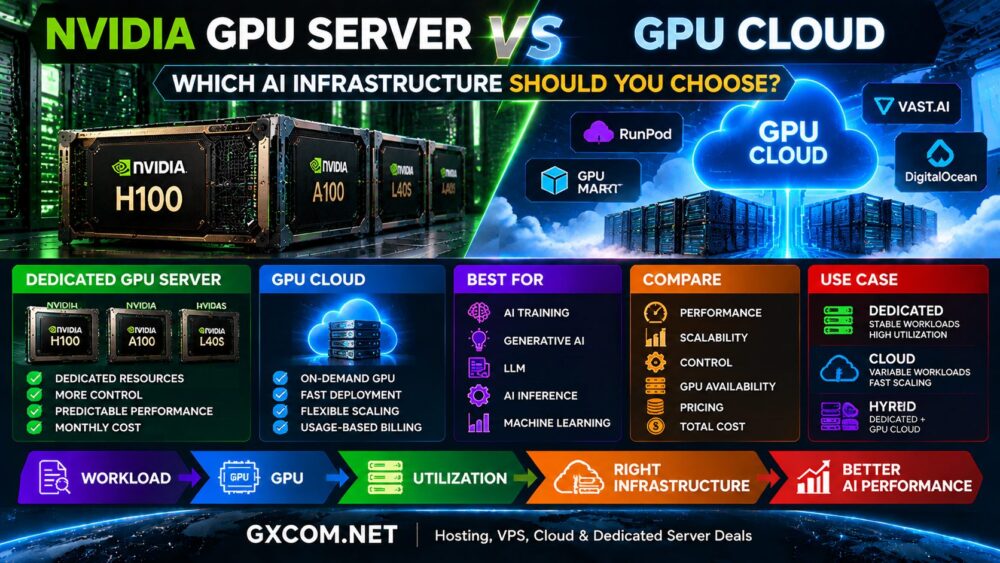
NVIDIA GPU Server vs GPU Cloud at a Glance
| Factor | Dedicated NVIDIA GPU Server | GPU Cloud |
|---|---|---|
| Hardware Resources | Dedicated | Platform dependent |
| Deployment | Usually slower | Fast |
| Scaling | Hardware limited | Flexible |
| Billing | Often monthly | Often usage based |
| Infrastructure Control | High | Platform dependent |
| Best For | Stable workloads | Variable workloads |
| Capacity Planning | Required | More flexible |
What Is a Dedicated NVIDIA GPU Server?
A dedicated NVIDIA GPU server is a physical server where GPU resources are allocated to a single customer rather than shared through a general-purpose cloud environment.
Depending on the provider, dedicated GPU servers may include accelerators such as:
- NVIDIA H100
- NVIDIA A100
- NVIDIA L40S
- RTX-class GPUs
- Other NVIDIA data center GPUs
The server typically combines the GPU with dedicated CPU resources, system RAM, NVMe storage, networking, and an operating system environment controlled by the customer or hosting provider.
For an overview of NVIDIA server options, see our
Best NVIDIA GPU Servers
guide.
What Is GPU Cloud?
GPU cloud services provide access to GPU computing resources through cloud infrastructure without requiring users to purchase and maintain physical GPU servers.
Depending on the platform, customers may launch GPU instances for a few hours, days, or longer periods and pay according to usage.
GPU cloud infrastructure can be useful for:
- AI development
- Machine learning experiments
- LLM fine-tuning
- AI inference
- Temporary training workloads
- Research
- Rapidly changing projects
Platforms such as RunPod, Vast.ai, and DigitalOcean illustrate different approaches to cloud-based GPU computing, ranging from specialized GPU clouds and marketplaces to broader developer cloud infrastructure.
Dedicated GPU Server vs GPU Cloud: Performance
Dedicated servers offer predictable access to the installed GPU hardware. The customer knows which GPUs, CPUs, memory, storage, and network resources are available to the workload.
This predictability can be valuable for sustained AI workloads where infrastructure utilization remains consistently high.
Cloud GPU performance depends more heavily on the platform and instance configuration. A high-quality cloud GPU instance can deliver excellent performance, but buyers should still check:
- Exact GPU model
- Dedicated or virtualized GPU allocation
- CPU resources
- System memory
- Storage throughput
- Network performance
- Multi-GPU connectivity
The GPU name alone does not describe the performance of the complete AI system.
NVIDIA GPU Server vs GPU Cloud for AI Training
AI training often requires sustained GPU utilization for hours, days, or even longer.
For continuous training workloads, dedicated infrastructure can become attractive because the hardware remains available without repeatedly launching cloud instances.
GPU cloud infrastructure can be more practical when training demand is irregular.
For example, a team may require eight high-end GPUs during a major training run but need almost no GPU capacity between experiments. Paying for permanent hardware that remains idle can reduce cost efficiency.
The decision therefore depends heavily on utilization.
NVIDIA GPU Server vs GPU Cloud for LLMs
Large language models can require substantial GPU memory and multiple accelerators, making infrastructure architecture particularly important.
For LLM workloads, compare:
- GPU memory
- Number of GPUs
- Inter-GPU communication
- System RAM
- NVMe performance
- Network bandwidth
- Storage capacity
- Scaling requirements
A dedicated multi-GPU server may work well for stable LLM workloads, while cloud infrastructure can make it easier to temporarily scale resources for training, fine-tuning, or model testing.
NVIDIA GPU Server vs GPU Cloud for AI Inference
Inference has different infrastructure requirements from training.
A production AI application may need to serve requests continuously, making predictable availability and utilization important. If demand remains stable, dedicated GPU infrastructure can provide a straightforward capacity model.
However, many AI applications experience variable traffic.
Cloud infrastructure can provide greater flexibility when inference demand changes significantly during the day or when applications need additional capacity during traffic spikes.
Teams should compare cost per request, latency, utilization, and scaling behavior rather than simply comparing GPU hourly prices.
H100 Dedicated Server vs H100 Cloud
NVIDIA H100 is a good example of how deployment model affects infrastructure decisions.
| Factor | Dedicated H100 | Cloud H100 |
|---|---|---|
| Access | Reserved hardware | On-demand or reserved |
| Deployment | Provider dependent | Usually fast |
| Scaling | Fixed configuration | More flexible |
| Billing | Often monthly | Often hourly / usage based |
| Best For | Sustained workloads | Variable workloads |
If you are specifically evaluating H100 infrastructure, read our
NVIDIA H100 Server Hosting
guide.
GPU Cloud vs Dedicated Server: Scalability
Scalability is one of the strongest arguments for GPU cloud infrastructure.
A dedicated server has a fixed number of installed GPUs. If a four-GPU server suddenly needs eight GPUs, additional physical capacity must be provisioned.
Cloud infrastructure can make scaling easier because users can deploy additional GPU instances when capacity is available.
However, cloud scalability should not be interpreted as unlimited GPU availability. High-demand accelerators can experience regional or provider-level capacity constraints.
Infrastructure Control
Dedicated GPU servers generally provide greater control over the complete environment.
Depending on the hosting model, users may control:
- Operating system
- NVIDIA drivers
- CUDA environment
- Containers
- Storage configuration
- Network configuration
- Security policies
Cloud platforms may abstract some of these infrastructure layers in exchange for easier deployment and management.
Neither approach is inherently superior. The correct choice depends on how much infrastructure control the application actually requires.
NVIDIA GPU Server vs GPU Cloud Cost
Cost is one of the most misunderstood parts of the comparison.
A cloud GPU can appear cheaper because there is no large upfront hardware purchase or long-term server commitment. However, continuously running an expensive cloud GPU for months can produce substantial operating costs.
Dedicated servers usually involve more predictable monthly costs but can waste money when utilization is low.
| Usage Pattern | Infrastructure to Evaluate |
|---|---|
| A few hours per week | GPU Cloud |
| Temporary AI project | GPU Cloud |
| Unpredictable demand | GPU Cloud |
| Continuous high utilization | Dedicated GPU Server |
| Stable production workload | Compare both based on total cost |
These are starting points rather than universal rules. Provider pricing, GPU type, storage, bandwidth, and workload efficiency can change the calculation.
For a wider cost analysis, see our
AI Server Cost Guide.
Hidden GPU Cloud Costs
GPU hourly pricing is only one part of the cloud bill.
Potential costs include:
- GPU compute
- CPU and RAM
- Persistent storage
- Snapshots
- Data transfer
- Public IP resources
- Idle instances
- Managed services
AI teams should calculate the total cost of running the complete workload rather than multiplying an advertised GPU hourly price by the expected runtime.
Hidden Dedicated GPU Server Costs
Dedicated infrastructure also has costs beyond the GPU itself.
Depending on whether the server is rented or owned, these can include:
- Monthly server rental
- Hardware purchase
- Power
- Cooling
- Networking
- Maintenance
- Hardware replacement
- Technical administration
Renting a dedicated GPU server can shift much of the physical infrastructure responsibility to the hosting provider.
GPU Cloud Providers
The GPU cloud market includes several different service models.
RunPod
RunPod focuses on GPU computing for AI developers and provides flexible access to GPU resources. This model can work well for development, model experimentation, training, and inference workloads that do not require permanent dedicated infrastructure.
Vast.ai
Vast.ai operates a GPU marketplace where users can compare GPU resources from multiple hosts. This can be attractive for price-sensitive projects, although users should compare host reliability, storage, networking, and complete instance specifications.
DigitalOcean
DigitalOcean integrates GPU infrastructure with a broader developer cloud environment. This can appeal to teams that need GPU computing alongside virtual machines, networking, storage, databases, and application infrastructure.
What About Dedicated GPU Hosting?
Dedicated GPU hosting providers such as GPU Mart focus more heavily on persistent GPU server infrastructure.
This model can be attractive when an organization needs predictable GPU resources for continuous AI workloads without purchasing and operating physical servers internally.
When comparing dedicated hosting, check the complete configuration, including GPU model, CPU, RAM, NVMe storage, network speed, bandwidth allowance, contract length, and upgrade options.
Security and Data Control
AI infrastructure can process proprietary datasets, customer information, model weights, and other sensitive business assets.
Dedicated infrastructure can provide stronger isolation and greater control over server configuration. Cloud platforms can also provide robust security capabilities, but the exact controls depend on the provider and service architecture.
Organizations with strict compliance requirements should evaluate security policies, data location, access controls, encryption, isolation, and regulatory requirements before selecting either deployment model.
Hybrid GPU Infrastructure
The choice does not always have to be dedicated server or cloud.
Some organizations can benefit from a hybrid model:
- Dedicated GPUs for baseline production workloads
- GPU cloud for temporary training jobs
- Cloud capacity for traffic spikes
- Dedicated infrastructure for sensitive workloads
- Cloud GPUs for development and experimentation
This approach can combine predictable baseline capacity with flexible access to additional computing resources.
How to Choose Between NVIDIA GPU Server and GPU Cloud
Start with the workload rather than the infrastructure.
| Question | Why It Matters |
|---|---|
| How many GPU hours do you need? | Determines utilization |
| Is demand predictable? | Affects scaling requirements |
| Which GPU is required? | Determines performance and cost |
| How much GPU memory is needed? | Limits model deployment |
| Do you need multiple GPUs? | Affects architecture and networking |
| How sensitive is the data? | Affects security design |
| How long will the workload run? | Affects total cost |
Common Infrastructure Selection Mistakes
Choosing the Biggest GPU First
Not every AI workload requires H100-class infrastructure. The workload should determine the GPU.
Looking Only at Hourly Pricing
Storage, bandwidth, idle time, CPU resources, and workload duration can significantly change total cloud cost.
Ignoring Utilization
Dedicated hardware that remains idle is expensive. Cloud GPUs running continuously can also become expensive.
Ignoring Scaling Requirements
Infrastructure that works during development may become difficult to scale when the application reaches production.
Final Thoughts
The NVIDIA GPU Server vs GPU Cloud decision ultimately comes down to workload patterns, utilization, scalability, control, and total cost.
Dedicated NVIDIA GPU servers can be attractive for continuous workloads that require predictable resources, infrastructure control, and sustained GPU utilization.
GPU cloud platforms provide a different advantage: flexibility. They allow AI teams to deploy GPU resources quickly, experiment with different accelerators, and scale infrastructure without purchasing permanent hardware.
For many organizations, the most effective strategy may even combine both models.
Start with the workload, determine the required GPU and memory, estimate utilization, evaluate software and scaling requirements, and then compare the total cost of dedicated and cloud infrastructure.
The right path is simple:
Workload → GPU → Utilization → Infrastructure → Performance → Cost.