

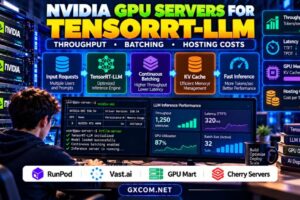
NVIDIA GPU Servers for TensorRT-LLM: Throughput, Batching and Hosting Costs
Choosing NVIDIA GPU servers for TensorRT-LLM requires more than comparing GPU memory and hourly rental prices. Large language model inference depends on throughput, request concurrency, batching efficiency, memory management, and latency targets. A powerful accelerator…
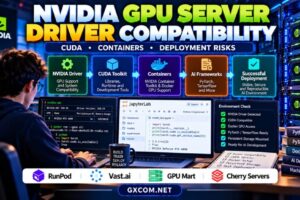
NVIDIA GPU Server Driver Compatibility: CUDA, Containers and Deployment Risks
NVIDIA GPU server driver compatibility is essential for reliable AI training, inference, and containerized deployment. A powerful GPU cannot run your workload correctly when its driver, CUDA runtime, container configuration, or machine learning framework is…

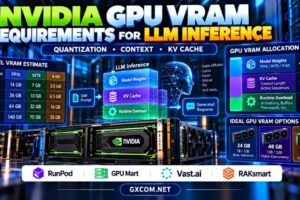
NVIDIA GPU VRAM Requirements for LLM Inference: Quantization, Context and KV Cache
Understanding NVIDIA GPU VRAM requirements for LLM inference is essential before renting an AI server. A language model that fits into GPU memory during loading may still fail when users submit longer prompts or multiple…
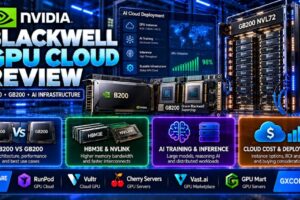
NVIDIA Blackwell GPU Cloud Review: B200, GB200 and AI Infrastructure Buying Considerations
This NVIDIA Blackwell GPU cloud review examines the B200, GB200 Grace Blackwell Superchip, and GB200 NVL72 from an AI infrastructure buying perspective. For organizations deploying large language models, reasoning systems, generative AI applications, and distributed…

Vast.ai GPU Marketplace Review: Host Reliability, GPU Selection and Hidden Costs
This Vast.ai GPU marketplace review examines host reliability, GPU selection, instance interruptions, storage and networking considerations, and the hidden costs that can affect AI training and inference workloads. Vast.ai offers access to GPU computing through…

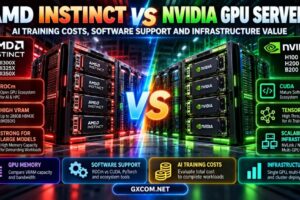
AMD Instinct vs NVIDIA GPU Servers: AI Training Costs, Software Support and Infrastructure Value
AMD Instinct vs NVIDIA GPU is an increasingly important comparison for businesses choosing AI training servers, cloud GPU instances, and dedicated infrastructure. AMD Instinct accelerators offer high-memory computing options and the ROCm software ecosystem, while…
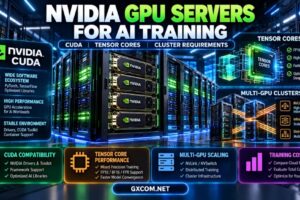
NVIDIA GPU Servers for AI Training: CUDA, Tensor Cores and Cluster Requirements
NVIDIA GPU servers for AI training provide the computing infrastructure behind many machine learning experiments, large language model fine-tuning projects, and distributed deep learning workloads. However, selecting a training server requires more than choosing the…
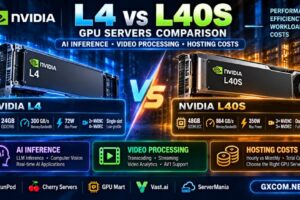
NVIDIA L4 vs L40S GPU Servers: AI Inference, Video Processing and Hosting Costs
NVIDIA L4 vs L40S is an important comparison for businesses choosing GPU servers for AI inference, video processing, computer vision, and generative AI. Both accelerators use NVIDIA’s Ada Lovelace architecture, but they differ significantly in…

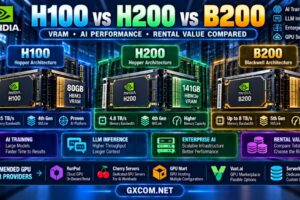
NVIDIA H100 vs H200 vs B200 Servers: VRAM, AI Performance and Rental Value Compared
Choosing between NVIDIA H100, H200, and B200 GPU servers is an important infrastructure decision for organizations running large language models, AI training pipelines, and high-throughput inference services. Although all three accelerators target demanding data center…
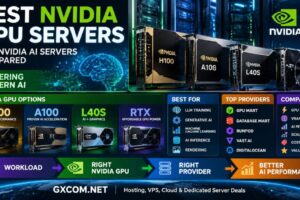
Best NVIDIA GPU Servers: Top NVIDIA AI Servers Compared
Artificial intelligence has transformed GPU servers from specialized computing systems into essential infrastructure for machine learning, large language models, generative AI, inference, rendering, and high-performance computing. NVIDIA dominates much of this market with a broad…
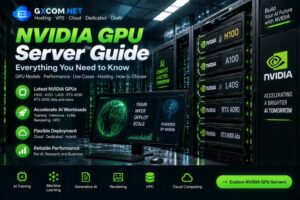
NVIDIA GPU Server Guide: Everything You Need to Know
NVIDIA GPU servers have become essential infrastructure for artificial intelligence, machine learning, cloud computing, scientific research and high-performance applications. With powerful accelerators such as NVIDIA H100, A100, L40S and RTX GPUs, these servers provide the…

GPU Server Deals: Best GPU Hosting Offers and Discounts
GPU servers have become essential infrastructure for artificial intelligence, machine learning, cloud rendering, scientific computing and high-performance applications. However, renting GPU hardware can be expensive, especially when using powerful NVIDIA GPUs for AI workloads. GPU…