Cloud high availability vs disaster recovery is a critical comparison for businesses deciding how to protect applications against downtime and data loss. High availability (HA) keeps services running through routine component failures. Disaster recovery (DR) restores workloads after more serious disruptions, including regional outages, corruption, or destructive incidents.
Both require planning, but their architectures, recovery targets, and infrastructure costs differ. The right choice depends on business impact rather than a provider’s uptime slogan.
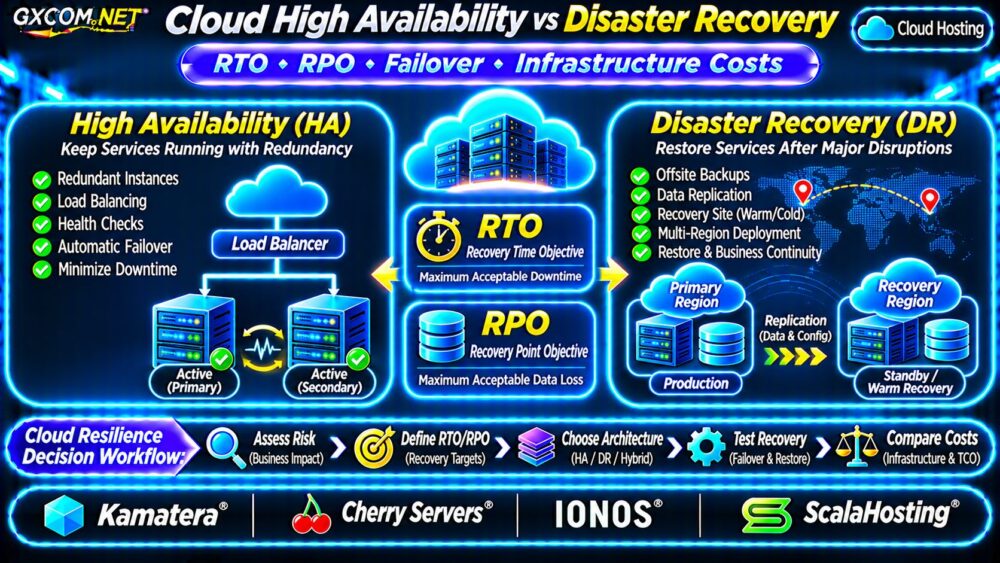
High Availability vs Disaster Recovery: Key Differences
HA reduces interruptions using redundant application instances, health checks, load balancing, and resilient dependencies. A failed server can be replaced or bypassed while healthy capacity continues serving requests.
DR prepares an alternate recovery path when the primary environment becomes unusable. That may involve restoring backups, activating a standby site, or switching to another region.
| Decision | High Availability | Disaster Recovery |
|---|---|---|
| Primary objective | Maintain service continuity | Restore disrupted service |
| Typical event | Instance or component failure | Major outage or data loss |
| Common methods | Redundancy and failover | Backups and recovery sites |
| Success measure | Availability and error rates | Achieved RTO and RPO |
Neither approach automatically protects against every threat. Replication can propagate accidental deletions, so independent recoverable backups remain important.
What Do RTO and RPO Mean?
Recovery time objective (RTO) is the maximum acceptable delay between a disruption and restoration of service. Recovery point objective (RPO) is the maximum acceptable age of recoverable data, expressed as time.
For example, an RTO of two hours requires a recovery process capable of restoring service within that target. An RPO of fifteen minutes means the business plans to lose no more than fifteen minutes of recent changes.
These are objectives, not guarantees. Measure actual outcomes through recovery exercises, including application dependencies and database consistency.
Set Targets From Business Impact
Estimate lost transactions, contractual obligations, customer disruption, and the cost of manual reconciliation. A brochure website may tolerate longer recovery than a payment-processing application.
Avoid buying near-zero recovery targets when the business cannot justify their additional cost and complexity.

Four Cloud Resilience Architectures
1. Backup and Restore
Keep tested backups outside the primary failure domain and rebuild infrastructure when needed. This approach minimizes standby compute spending but can require substantial restoration time.
2. Pilot Light
Maintain essential data and core recovery components in a second location while provisioning other services during an incident. Automation helps reduce startup delays.
3. Warm Standby
Run a smaller, functional copy of the application in a recovery location. Scale it up and redirect traffic after a disaster. Continuous replication and baseline standby capacity increase recurring expenses.
4. Active-Active
Serve production traffic from multiple locations. This can improve continuity but requires careful handling of data consistency, traffic routing, shared dependencies, and conflicting writes.
For broader infrastructure choices, read our Cloud Hosting vs VPS Comparison.
Why Multi-Zone HA Is Not Always Multi-Region DR
Deploying two instances in separate availability zones can protect against certain localized failures. It does not necessarily protect against a region-wide incident or an account-level security event.
Multi-region recovery adds geographic separation but introduces replication traffic, operational complexity, and potential data-residency constraints.
Check whether the provider offers genuinely independent failure domains. Two servers in the same facility should not be described as regional disaster recovery.
Calculate HA and DR Infrastructure Costs
Consider a hypothetical application with a $40 monthly primary server. A second application server costs $40, a load balancer costs $15, and shared backup storage costs $10. The illustrative HA infrastructure total is $105 monthly.
Adding a $30 warm standby, $12 in replication and transfer charges, and $8 in extra monitoring raises the combined estimate to $155 monthly.
Over thirty-six months, that equals $5,580 if usage and prices remain unchanged, compared with $3,780 for the illustrated HA-only configuration. The additional $1,800 buys recovery resources, not a guaranteed recovery time.
Real budgets must also include database replicas, storage, public IPs, licensing, DNS or traffic management, testing labor, and restoration fees. Our Cloud VPS Bandwidth Costs Guide explains network-related charges.
How to Validate Failover and Recovery
Test HA by removing one application instance from service and verifying that traffic reaches healthy capacity. Observe health-check intervals, session behavior, database connectivity, and error rates.
Test DR separately in an isolated environment: restore a known backup, activate standby dependencies, verify data integrity, and measure elapsed recovery time.
Document DNS propagation assumptions, credential access, recovery ownership, and a safe failback procedure. Never conduct disruptive tests against production without approval, backups, and a rollback plan.
Our VPS Snapshot Backup and Recovery Guide covers complementary backup planning.
For workload relocation planning, consult our Cloud Server Migration Guide before changing regions or providers.
Cloud Hosting Providers Worth Comparing
These GXCOM.NET-approved affiliate providers represent different infrastructure and management choices. Verify available regions, backup products, network terms, and support scope for each specific plan.
Kamatera: Configurable Cloud Resources
Kamatera is a candidate for teams building their own redundant virtual infrastructure. Compare server configurations, location options, and the operational work needed to implement failover.
Cherry Servers: Infrastructure Control
Cherry Servers merits evaluation when storage, networking, and server configuration flexibility matter. Confirm whether the chosen deployment can meet geographic separation requirements.
IONOS: Cloud Budget Planning
IONOS provides another infrastructure comparison point. Assess the exact product’s deployment controls, backup arrangements, and recurring costs rather than assuming built-in DR.

ScalaHosting: Managed Operations Alternative
ScalaHosting is relevant when businesses prefer managed hosting responsibilities. Clarify which availability, backup, and application recovery tasks the selected service actually covers.
For general supplier research, see our Best VPS Providers Guide.
Cloud Resilience Purchasing Checklist
- Define separate availability, RTO, and RPO targets.
- Identify shared failure domains and dependencies.
- Confirm backup independence and restoration testing.
- Price compute, replication, storage, and network transfer.
- Document failover, failback, and responsible personnel.
- Test recovery before relying on contractual promises.
Frequently Asked Questions
Can High Availability Replace Disaster Recovery?
No. HA handles many component failures, while DR addresses recovery after broader disruptions or data loss. Most important workloads need elements of both.
Does Replication Guarantee Zero Data Loss?
No. Replication delay, inconsistent writes, corruption, and operational mistakes can still cause loss. Validate the actual RPO and retain independent backups.
Final Verdict
Choose cloud high availability for routine service continuity and disaster recovery for restoring an unusable environment. Start with business-defined RTO and RPO, then compare architectures and total costs.
Evaluate Kamatera, Cherry Servers, IONOS, and ScalaHosting against documented product capabilities, recovery testing requirements, and management responsibilities. A credible resilience plan is measured by what it can recover, not by marketing terminology.