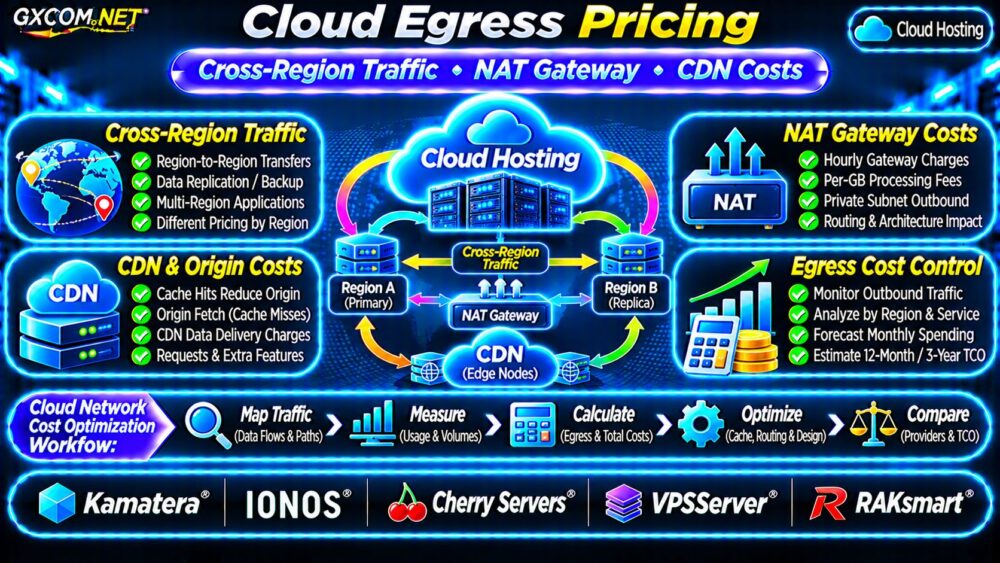
Cloud egress pricing can turn an affordable hosting deployment into an unexpectedly expensive infrastructure project. Compute instances may cost relatively little, while outbound internet traffic, cross-region transfers, NAT Gateway processing, and CDN origin requests generate additional charges.
Understanding where data travels is essential for accurate budgeting. This guide explains common cloud network billing models, provides practical cost calculations, and shows how to compare hosting providers without overlooking network expenses.
What Is Cloud Egress Pricing?
Cloud egress generally refers to data leaving a defined network boundary. Internet downloads are a common example, but transfers between regions, availability zones, and services may follow different billing rules.
Providers distinguish between inbound traffic, outbound traffic, private networking, and inter-region transfers. These categories are not universally priced the same way.
For example, sending a 20GB application backup to another region may trigger different charges from delivering 20GB of website content to public users.
Always identify the source, destination, network path, and applicable billing category.
Internet Egress vs Cross-Region Traffic
Internet egress typically covers data delivered from cloud infrastructure to external destinations. Common workloads include software downloads, media delivery, API responses, and file transfers.
Cross-region traffic occurs when data moves between geographically separate cloud regions. Database replication, disaster recovery, and distributed applications can generate substantial transfer volumes.
| Traffic Type | Typical Example | Billing Question |
|---|---|---|
| Internet egress | Website downloads | What is the outbound rate? |
| Cross-region | Database replication | Are regional transfer fees charged? |
| Cross-zone | Application-to-database traffic | Does zone placement affect cost? |
| Private networking | Internal service communication | Is private transfer included? |
For general VPS traffic allowances, read our Cloud VPS Bandwidth Costs Guide.
How NAT Gateway Costs Accumulate
A NAT Gateway allows resources in private subnets to initiate outbound connections without directly accepting unsolicited inbound internet connections.
In AWS, NAT Gateway pricing can include hourly resource charges and data-processing charges. Internet data transfer or other applicable networking charges may also apply.
Consider a hypothetical gateway costing $0.045 per hour plus $0.045 per GB processed. Over a 720-hour month, the hourly component equals $32.40.
Processing 2,000GB would add $90, producing $122.40 before any separate transfer charges.
Illustrative NAT cost = gateway hours × hourly rate + processed GB × processing rate.

These are example inputs, not verified current prices or a universal AWS rate.
Why Network Routing Matters
Traffic routed through a NAT Gateway in another availability zone can introduce additional transfer considerations. Poor placement may increase both costs and operational complexity.
For supported services, private endpoints or alternative network paths may reduce unnecessary NAT processing. Compare endpoint charges before changing the architecture.
CDN Costs and Origin Traffic
A content delivery network caches eligible content closer to visitors. Successful cache hits reduce requests reaching the origin server.
However, CDN delivery is not automatically free. Providers may charge for data delivery, requests, advanced features, and origin-related transfers.
Suppose visitors request 10TB of cacheable content monthly and the CDN achieves an illustrative 80% byte hit ratio. Approximately 2TB would still require origin delivery, assuming a simplified workload.
Actual origin traffic depends on cache rules, invalidations, dynamic requests, and response sizes.
Optimize Cache Efficiency
Set appropriate cache headers, compress eligible assets, optimize images, and avoid unnecessary cache invalidations.
Measure cache hit ratios and origin egress separately. A CDN should be evaluated using combined CDN and origin costs, not bandwidth savings alone.
Calculate a Complete Cloud Egress Bill
Consider a fictional application with 3,000GB of internet egress, 800GB of cross-region transfer, and 1,500GB processed through a NAT service.
| Expense | Example Calculation | Cost |
|---|---|---|
| Internet egress | 3,000GB × $0.04 | $120 |
| Cross-region transfer | 800GB × $0.02 | $16 |
| NAT processing | 1,500GB × $0.03 | $45 |
| NAT hourly charge | 720 hours × $0.04 | $28.80 |
| Combined total | Illustrative only | $209.80 |
This simplified example assumes separately billable categories. Real invoices depend on the provider’s charging boundaries, discounts, traffic paths, and applicable tiers.
Review our Cloud VPS Bandwidth Pricing Overview when comparing traffic-inclusive hosting models.
Seven Ways to Reduce Cloud Network Costs
- Map data flows: Identify high-volume sources and destinations.
- Reduce unnecessary replication: Transfer only required changes where feasible.
- Improve CDN caching: Reduce avoidable origin requests.
- Review NAT usage: Evaluate private endpoints and routing alternatives.
- Optimize application payloads: Compress responses and remove redundant data.
- Monitor traffic anomalies: Investigate unexpected downloads or automated requests.
- Compare hosting models: Evaluate included transfer allowances against usage-based pricing.
Security and resilience requirements must remain part of every optimization decision. Avoid removing necessary redundancy solely to reduce transfer charges.
Compare Five Cloud Hosting Providers
Cloud networking models differ considerably. These GXCOM.NET-approved affiliate providers are relevant candidates for infrastructure cost comparisons.
Kamatera: Configurable Cloud Infrastructure
Kamatera is worth evaluating for configurable cloud deployments. Compare regional availability, network allowances, and applicable transfer charges.
IONOS: Cloud Budget Predictability
IONOS provides another cloud infrastructure comparison option. Review product-specific bandwidth terms and the complete monthly invoice.
Cherry Servers: Network-Intensive Workloads
Cherry Servers may appeal to applications with substantial transfer requirements. Examine network configurations, traffic allowances, and infrastructure options.
VPSServer: Virtual Server Transfer Planning
VPSServer can be considered when comparing Cloud VPS resources. Verify outbound transfer allowances, region-specific terms, and excess-traffic policies.
RAKsmart: Bandwidth-Oriented Infrastructure
RAKsmart offers another comparison point for VPS and infrastructure buyers. Confirm the selected product’s port speed, transfer accounting, and network conditions.
For broader architecture choices, see our Cloud Hosting vs VPS Comparison.
Estimate Long-Term Network Spending
A hypothetical $200 monthly network bill equals $2,400 annually and $7,200 over three years, assuming unchanged usage and pricing.
Reducing eligible charges by 20% would save $40 monthly, or $1,440 over thirty-six months. Include implementation labor and any replacement service charges when estimating savings.
Our Cloud Server Migration Guide explains additional considerations when changing hosting environments.
Cloud Egress Pricing Checklist
- Confirm internet outbound pricing and included allowances.
- Check cross-region and cross-zone transfer rules.
- Calculate NAT hourly and processing charges.
- Measure CDN delivery and origin traffic separately.
- Configure billing alerts and investigate unusual usage.
- Compare total network costs before selecting a provider.
Frequently Asked Questions
Is Incoming Cloud Traffic Always Free?
No. Many services price inbound and outbound traffic differently, but exceptions and additional processing charges may apply.
Does a CDN Eliminate Cloud Egress Fees?
No. CDN delivery, cache misses, and origin transfers can still generate charges.
Are NAT Gateway Charges Included in Internet Egress?
Not necessarily. Some platforms bill NAT processing and hourly usage separately from applicable data transfer.
Final Verdict
Understanding cloud egress pricing requires tracing actual network paths rather than comparing compute prices alone.
Measure internet traffic, regional replication, NAT processing, and CDN origin usage before optimizing infrastructure. Compare Kamatera, IONOS, Cherry Servers, VPSServer, and RAKsmart using documented network terms and realistic long-term budgets.