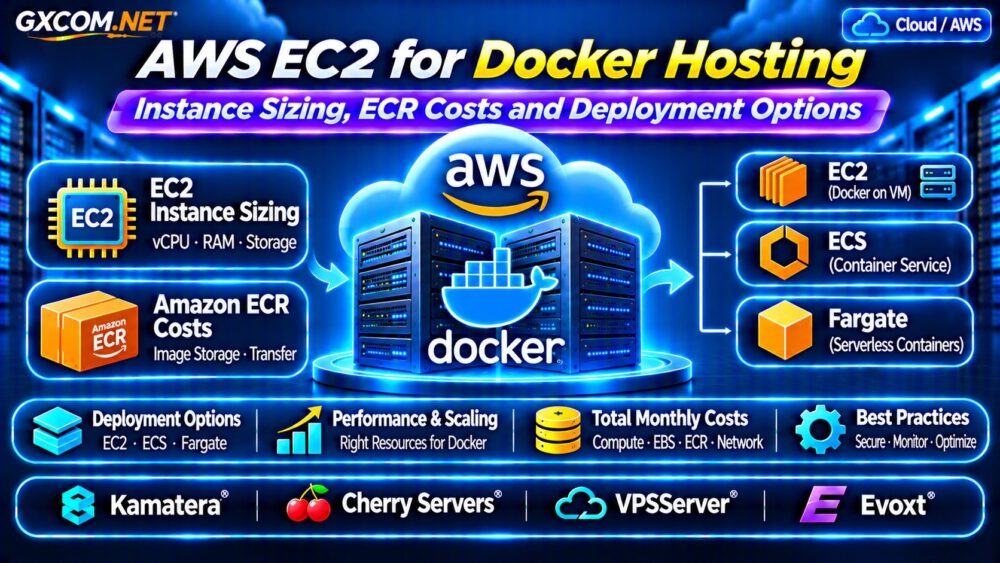
AWS EC2 for Docker hosting gives developers control over container runtimes, operating systems, networking, and deployment workflows. However, choosing an instance is only one part of the bill. Amazon Elastic Container Registry (ECR), EBS storage, outbound traffic, and operational management also affect total costs.
This guide explains how to size an EC2 server, estimate container registry expenses, compare deployment options, and decide when another cloud VPS may be more practical.
Can You Host Docker Containers on AWS EC2?
Yes. An EC2 instance is a virtual server on which you can install Docker Engine, run containers, and manage applications using Docker Compose or custom deployment scripts. You control patching, container updates, firewall rules, monitoring, and recovery.
EC2 works well for teams needing operating system access or specialized configurations. It also requires more administration than a fully managed container platform.
EC2 Instance Sizing: CPU and RAM
Start with measured application demand rather than choosing the cheapest instance. Containerized APIs, background workers, databases, and reverse proxies compete for the same host resources.
For a small development deployment, a two-vCPU instance with several gigabytes of RAM may be a reasonable test configuration. Production requirements depend on request volume, application language, memory limits, and workload peaks.
Allow Headroom for the Host
Reserve memory for Linux, Docker, monitoring agents, and filesystem caching. Four containers configured with 1 GB memory limits do not automatically fit safely on a 4 GB host.
Monitor CPU utilization, memory pressure, container restarts, and response-time percentiles. Burstable instance families also require attention to CPU credit behavior.
For a broader sizing framework, read our Cloud Server Capacity Planning Guide.
Choosing EC2 Storage for Docker
Use EBS volumes for persistent application data when appropriate, and distinguish durable storage from a container’s writable layer. Databases and uploaded files should not depend solely on ephemeral container filesystems.
General-purpose gp3 volumes let you provision capacity and, within applicable limits, additional IOPS and throughput. Snapshots, provisioned performance, and volume capacity can contribute separate charges.
See our AWS EC2 EBS Storage Costs Guide before sizing persistent volumes.
What Does Amazon ECR Cost?
Amazon ECR stores container images so EC2, ECS, and other compatible workloads can retrieve versioned artifacts. Private repository costs can include stored image data, data transfer, and applicable ancillary services.

Storage usage depends on retained image layers, image sizes, and cleanup policies. Repeated deployments that retain numerous old tags can increase the repository footprint.
As an illustrative calculation, 50 GB of billable image storage at an assumed $0.10 per GB-month equals $5 monthly before transfers or other charges. This is not a verified regional quotation.
Control Registry Expenses
Use ECR lifecycle policies to remove unneeded images, keep Docker layers lean, and avoid rebuilding unnecessarily large base images. Review repository metrics and billing reports regularly.
Data transfer behavior varies by source, destination, region, and service configuration. Do not assume every image pull is free.
Docker Compose Directly on EC2
For a single-server application, Docker Compose can coordinate a web service, reverse proxy, worker, and supporting containers through one configuration file.
This approach is straightforward and offers considerable flexibility. However, you must handle deployment automation, secrets, logging, host updates, backup scheduling, and failure recovery.
Keep production secrets outside images and source repositories. Use restrictive security groups, least-privilege IAM permissions, and encrypted connections where applicable.
EC2 vs ECS vs Fargate Deployment Options
Amazon ECS is a container orchestration service. With an EC2 capacity model, you manage the underlying instances while ECS schedules tasks. With AWS Fargate, AWS manages the underlying compute capacity for supported ECS workloads.
Direct Docker on EC2 offers simple host-level control. ECS on EC2 adds orchestration but still requires capacity management. Fargate reduces server administration while introducing task-based resource billing and service-specific constraints.
| Option | Infrastructure responsibility | Typical fit |
|---|---|---|
| Docker on EC2 | Manage host and containers | Small controlled deployments |
| ECS on EC2 | Manage EC2 capacity | Multi-container applications |
| ECS on Fargate | Manage tasks, not hosts | Teams minimizing host operations |
There is no universally cheapest choice. Compare utilization, minimum running capacity, administration time, and networking costs.
Understand the Full AWS Docker Bill
EC2 instance-hours are only the starting point. Include EBS volumes and snapshots, ECR storage, public IPv4 addresses where charged, load balancing, logging, and outbound data transfer.
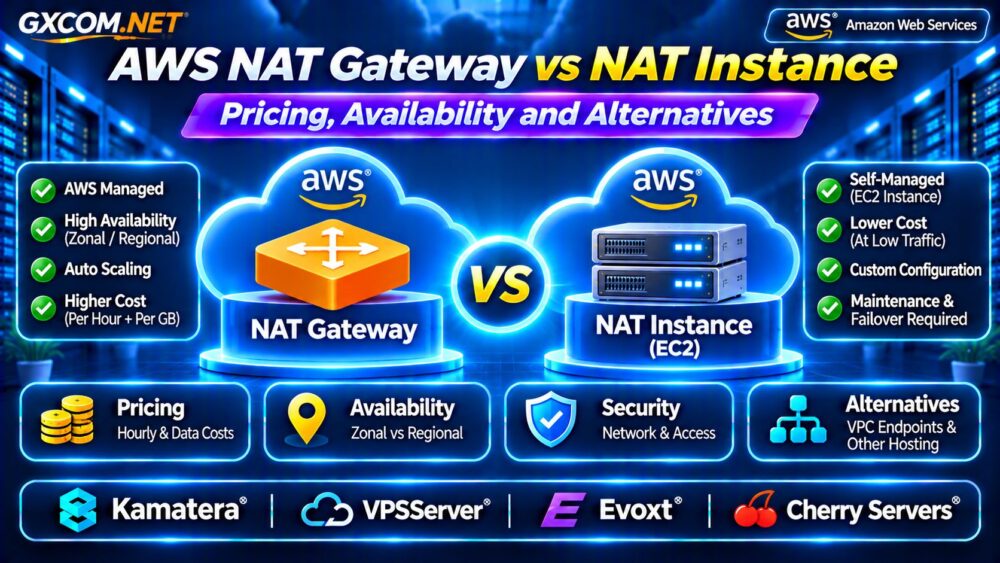
Private subnet architectures can introduce NAT Gateway processing and hourly charges. Review our AWS NAT Gateway vs NAT Instance Comparison when planning outbound connectivity.
For example, a hypothetical $35 monthly compute allocation plus $8 storage, $5 registry usage, and $12 networking totals $60. Actual bills depend on region, usage, and pricing terms.
When Is a Cloud VPS a Better Alternative?
A conventional cloud VPS may suit teams running a few persistent Docker services without requiring ECS integration, AWS-specific networking, or extensive orchestration.
Compare total resources, bandwidth allowances, storage performance, backup options, and administrator time. Lower advertised compute pricing does not guarantee lower total ownership cost.
Our AWS EC2 vs VPS Hosting Comparison examines these infrastructure tradeoffs.
Four Approved Infrastructure Providers to Compare
Kamatera: Configurable Cloud Servers
Kamatera is worth considering when you need configurable CPU and RAM for self-managed Docker hosts. Confirm supported operating systems, storage charges, and management responsibilities.
Cherry Servers: Dedicated Compute Options
Cherry Servers may suit predictable container workloads that benefit from dedicated infrastructure. Compare provisioning models, network allowances, and operational requirements.
VPSServer: VPS-Based Docker Hosting
VPSServer provides another infrastructure option for Docker applications that need conventional virtual servers. Check available resources, backup coverage, and upgrade procedures.
Evoxt: Smaller Docker Deployments
Evoxt can be evaluated for smaller self-managed container projects where monthly budget matters. Verify RAM, CPU allocation, storage, and available regions before ordering.
Production Docker Deployment Checklist
- Benchmark realistic CPU and memory demand.
- Store persistent data outside disposable container layers.
- Restrict network access and protect deployment credentials.
- Configure health checks, logs, backups, and alerts.
- Set ECR image retention policies and review billing.
- Test restoration and container redeployment procedures.
Frequently Asked Questions
Is EC2 Required to Use Amazon ECR?
No. ECR is a container registry and can serve compatible deployment environments subject to authentication and network access requirements.
Is Fargate Always More Expensive Than EC2?
No. Relative costs depend on task utilization, instance efficiency, operating hours, and the value of reduced infrastructure management.
Can Docker Compose Run Production Applications?
Yes, for suitable workloads with adequate monitoring, security, backups, and recovery procedures. Complex high-availability systems may benefit from orchestration.
Final Verdict
AWS EC2 for Docker hosting offers strong control, but correct instance sizing and full-cost accounting are essential. Compare direct EC2 deployments with ECS and Fargate, then evaluate Kamatera, Cherry Servers, VPSServer, and Evoxt if a simpler self-managed server better matches your application.