AWS NAT Gateway vs NAT Instance is an important comparison for businesses trying to reduce Amazon VPC networking costs without compromising application availability. Private-subnet EC2 instances often need outbound internet access for software updates, external APIs, and package downloads. Network Address Translation (NAT) enables that connectivity without assigning public IP addresses directly to those instances.
A managed NAT Gateway simplifies operations but introduces hourly and data processing charges. A self-managed NAT Instance may reduce infrastructure spending for smaller workloads, although maintenance and failover become your responsibility.
What Is an AWS NAT Gateway?
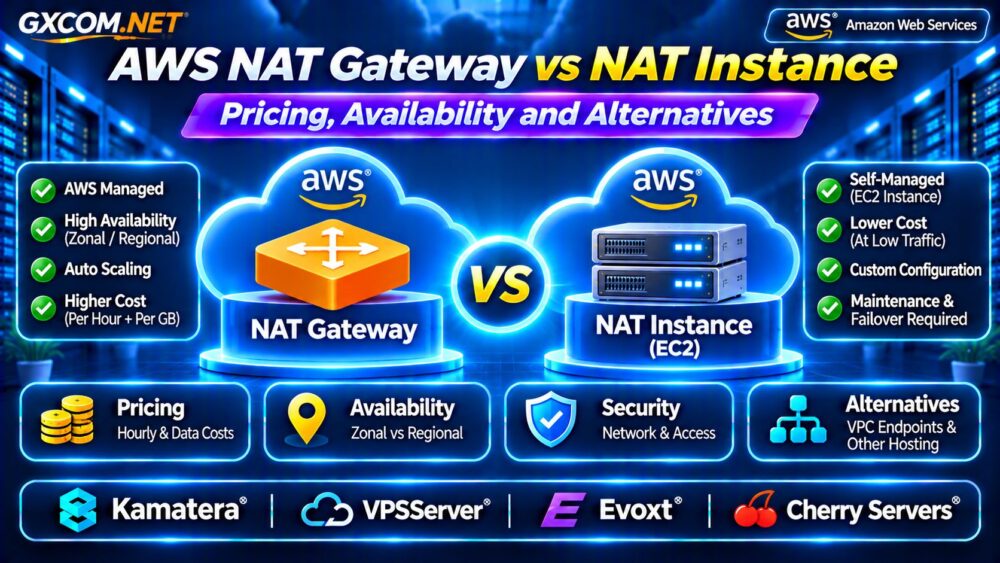
An AWS NAT Gateway is a managed network translation service that allows resources in private subnets to initiate outbound connections. It does not permit unsolicited inbound internet connections through the gateway.
AWS handles the underlying NAT service infrastructure, scaling, and maintenance. Customers remain responsible for routing, network design, security policies, and cost monitoring.
Gateway expenses depend on availability configuration, operating hours, processed traffic, and potentially additional networking resources.
What Is an AWS NAT Instance?
A NAT Instance is an EC2 virtual machine configured to forward and translate network traffic for private-subnet resources.
Administrators select the instance type, configure the operating system, enable packet forwarding, and maintain NAT software. AWS also requires source/destination checks to be disabled because the instance forwards traffic belonging to other resources.
Unlike managed NAT Gateways, NAT Instances require operating system updates, monitoring, security configuration, and replacement procedures.
AWS NAT Gateway Pricing Explained
Managed NAT Gateway pricing generally includes hourly availability charges and data processing fees. Applicable public IPv4 and data transfer charges can increase the total.
For example, AWS publishes an Ohio regional rate of $0.045 per gateway-hour and $0.045 per GB processed.
One continuously provisioned gateway operating for 730 hours and processing 100 GB would cost approximately:
- Hourly charges: 730 × $0.045 = $32.85.
- Data processing: 100 × $0.045 = $4.50.
- Subtotal: $37.35 monthly.
This example excludes public IPv4, applicable transfer charges, and taxes. Prices vary by region and configuration.
NAT Instance Pricing and Hidden Expenses
A NAT Instance avoids the managed gateway’s separate per-GB NAT processing fee. Instead, you pay for EC2 compute, storage, public IPv4 addressing, and applicable data transfers.
For an illustrative budget, suppose a small instance costs $8 monthly, public IPv4 costs $3.65, and storage costs $1. The infrastructure subtotal would be $12.65.

These are hypothetical amounts, not a verified EC2 quotation. Administration, monitoring, backups, and redundant instances can substantially increase total ownership costs.
Compare broader compute expenses in our AWS EC2 vs VPS Hosting Guide.
Regional vs Zonal NAT Gateway Availability
AWS now supports both zonal and regional NAT Gateway configurations.
Zonal gateways operate within individual Availability Zones. For zone-independent connectivity, administrators commonly deploy a gateway in each relevant zone and configure corresponding routes.
Regional NAT Gateways automatically expand across supported Availability Zones based on workload presence. This simplifies routing and provides managed multi-AZ availability.
However, regional gateway hourly charges apply per covered Availability Zone. A single regional gateway identifier does not necessarily mean a single-AZ bill.
Regional expansion can also take time when workloads appear in a new zone. Review service behavior and supported regions before deployment.
NAT Instance High Availability Challenges
A single NAT Instance can become a network failure point. If the EC2 instance stops responding, private workloads depending on it may lose outbound connectivity.
Higher availability requires additional instances, health monitoring, route replacement automation, and failover testing.
During failure, existing connections may be interrupted. Recovery automation should therefore be tested against realistic application traffic.
For infrastructure resilience concepts, see our High-Availability Cloud Servers Guide.
Bandwidth, Security and Maintenance
NAT Gateway offers managed bandwidth scaling, while NAT Instance throughput depends on EC2 instance networking capacity, CPU resources, and software configuration.
Security responsibilities also differ. NAT Instances require host patching, firewall rules, access restrictions, and monitoring.
NAT Gateways remove much of that server maintenance, although they do not replace security groups, network ACLs, application controls, or traffic inspection services.
Choose according to measured traffic, operational expertise, and acceptable failure risk.
VPC Endpoints: An Alternative to NAT Traffic
Not every private-subnet connection needs internet NAT.
Gateway endpoints can provide private access to supported AWS services such as Amazon S3 and DynamoDB without routing that traffic through a NAT Gateway.
Interface endpoints support additional services but introduce their own endpoint-hour and data processing charges.
Review traffic destinations before deploying NAT infrastructure. Moving substantial eligible AWS-service traffic to suitable endpoints can reduce gateway processing expenses.
Four Cloud Infrastructure Alternatives
Businesses reconsidering AWS networking complexity may compare other hosting environments. These providers offer infrastructure alternatives, not identical replacements for Amazon VPC NAT services.
1. Kamatera: Configurable Cloud Infrastructure
Kamatera is relevant for teams seeking configurable cloud servers and more direct control over deployment architecture.
Compare available private networking, public IP options, traffic allowances, and administration requirements before migrating workloads.
2. VPSServer: Cloud VPS Hosting
VPSServer can be evaluated for applications requiring predictable virtual server resources without an AWS-specific VPC architecture.
Review included bandwidth, network configuration, security controls, and backup policies.
3. Evoxt: Budget-Oriented VPS
Evoxt may suit smaller applications that do not require complex managed cloud networking.
Verify resource allocations, network limits, location availability, and management responsibilities for each plan.
4. Cherry Servers: Dedicated Infrastructure
Cherry Servers is relevant for organizations considering dedicated compute and greater infrastructure control.
Evaluate private networking options, redundancy, traffic pricing, and the operational effort needed to replace managed AWS services.

Five Ways to Reduce AWS NAT Costs
- Review NAT Gateway traffic and hourly usage in AWS billing reports.
- Use suitable VPC endpoints for eligible AWS-service traffic.
- Compare zonal and regional gateway availability requirements.
- Evaluate NAT Instances only when operational savings justify maintenance risks.
- Reduce unnecessary cross-AZ routing and review overall network architecture.
For related transfer expenses, see our AWS EC2 Data Transfer Costs Guide.
Frequently Asked Questions
Is a NAT Instance Always Cheaper?
No. A small instance may cost less for low traffic, but redundancy, administration, and network performance requirements can eliminate the savings.
Does Regional NAT Gateway Cover Multiple AZs?
Yes. Regional NAT Gateway supports automatic expansion across Availability Zones, with hourly charges reflecting covered zones.
Can VPC Endpoints Replace Every NAT Gateway?
No. Endpoints support specific services and connectivity patterns. General outbound internet traffic may still require NAT or another approved egress architecture.
Final Verdict
Choose managed NAT Gateway when operational simplicity, scaling, and availability outweigh additional networking charges. Consider NAT Instances for carefully managed, lower-demand environments where administration and failover are acceptable responsibilities.
For workloads that do not require AWS-specific networking, compare Kamatera, VPSServer, Evoxt, and Cherry Servers using complete infrastructure and management costs.
Explore our Cloud Hosting vs VPS Comparison before selecting an alternative deployment model.