Finding the best VPS providers for business VPN gateways requires more than selecting a cheap virtual server. A business VPN must support secure employee connections, predictable network performance, and enough bandwidth for everyday applications.
WireGuard, OpenVPN, and IPsec can run on suitable VPS infrastructure, but performance depends on CPU resources, data center location, traffic allowances, and network policies. This guide compares five hosting candidates and explains how to choose a secure, cost-effective VPN gateway.
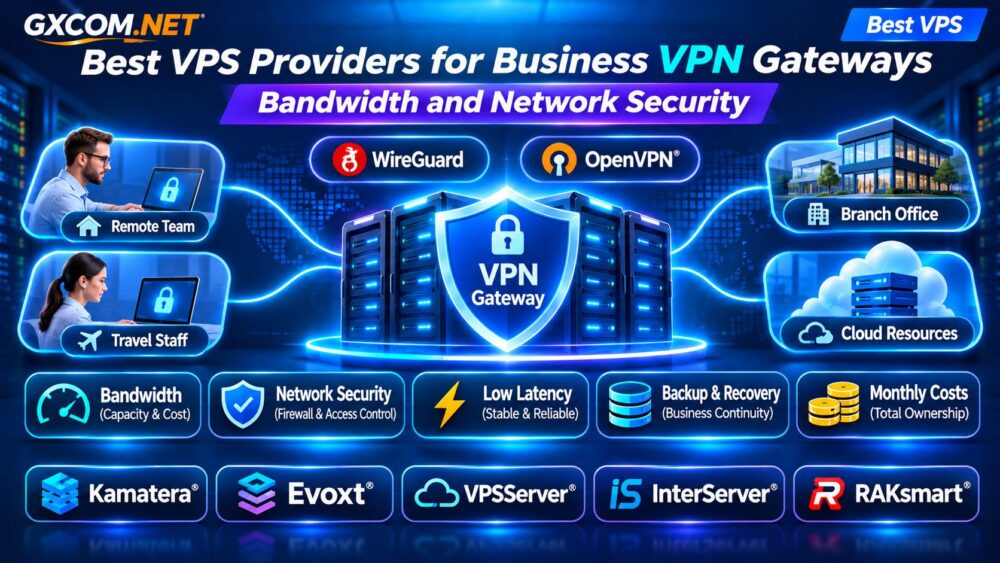
Best VPS Providers for Business VPN Gateways: Quick Comparison
| Provider | Potential Fit | Verify Before Ordering |
|---|---|---|
| Kamatera | Configurable cloud VPN gateway | Network allowances and security options |
| Evoxt | Budget-conscious VPN deployment | Regional availability and transfer limits |
| VPSServer | Cloud VPS remote access infrastructure | Public IP and traffic policies |
| InterServer | US-focused VPN gateway evaluation | Network performance and VPS terms |
| RAKsmart | Regional and bandwidth-oriented evaluation | Applicable VPS products and allowances |
These are purchasing candidates, not benchmark rankings. Verify that the selected plan permits your intended VPN deployment.
What Makes a VPS Suitable for a Business VPN?
A business VPN gateway creates encrypted connections between employees and company resources. Some organizations use it for remote access, while others connect offices or cloud networks through site-to-site tunnels.
Unlike ordinary website hosting, VPN workloads depend heavily on sustained network throughput, connection stability, and cryptographic processing.
Prioritize a reliable public IP address, suitable CPU capacity, nearby data center locations, predictable traffic billing, and administrative access to firewall settings.
Our Best VPS Providers Comparison explains broader VPS purchasing criteria.
WireGuard vs OpenVPN vs IPsec
WireGuard uses a streamlined design and modern cryptography. It is attractive for lightweight remote access and often performs efficiently on modest virtual servers.
OpenVPN offers mature client support and flexible configurations. Its performance depends on transport settings, cryptographic choices, and available CPU resources.
IPsec is commonly used for site-to-site connectivity and integration with enterprise networking equipment. Configuration complexity varies by implementation.
No protocol guarantees better security or speed in every environment. Test client compatibility, authentication, throughput, and operational requirements before standardizing.
How Much Bandwidth Does a VPN Gateway Need?
VPN capacity planning should distinguish connection speed from monthly data transfer. A VPS advertising a fast network port may still impose a monthly traffic allowance.

Consider 20 employees who each transfer an average of 2GB through the gateway on 22 working days:
20 users × 2GB × 22 days = 880GB monthly traffic.
That calculation is illustrative. Actual usage may be much higher when employees transfer large files, use remote desktops, or route video meetings through the VPN.
For full-tunnel deployments, internet traffic passes through the gateway. Split tunneling can reduce load by routing only approved business destinations through the VPN, where company security policies permit it.
Check whether inbound and outbound traffic both count toward billing. Our Cloud VPS Bandwidth Costs Guide explains common transfer charges.
CPU, RAM, and Network Latency
VPN encryption consumes processing resources. A small gateway serving occasional administrative sessions may need relatively little RAM, while dozens of active users can require more CPU capacity and network throughput.
As a starting point, test a modest VPS with 2 vCPUs and 2–4GB RAM for a small pilot. This is not a guaranteed production specification.
Measure CPU saturation, packet loss, connection stability, and throughput under simultaneous user activity. Shared-vCPU contention may reduce performance during busy periods.
Location matters too. A nearby server often provides a better interactive experience than a distant machine with more advertised resources.
Five VPS Providers Worth Evaluating
1. Kamatera: Configurable Cloud Infrastructure
Kamatera is worth considering when businesses need adjustable virtual server resources and deployment flexibility. Compare CPU, RAM, storage, networking, and available regions for your gateway architecture.
Confirm traffic billing, public IP options, and whether firewall management is included or customer-configured.
2. Evoxt: Budget-Oriented VPN VPS
Evoxt is a candidate for smaller organizations evaluating affordable VPS infrastructure. Focus on available server locations, network transfer limits, CPU performance, and operating system access.
Request confirmation that the intended WireGuard or OpenVPN configuration is permitted under the service terms.
3. VPSServer: Cloud VPS for Remote Connectivity
VPSServer can be evaluated for virtualized remote access infrastructure. Compare resource configurations, IP allocation, bandwidth policies, and upgrade procedures.
For business use, verify whether monitoring, backup, and firewall responsibilities remain entirely with your administrators.
4. InterServer: US VPS Hosting Candidate
InterServer is relevant when an organization wants to evaluate US-based VPS infrastructure for employee connectivity. Compare available virtual server resources and network terms against the locations of your users.
Do not assume that advertised port speeds represent guaranteed encrypted VPN throughput.
5. RAKsmart: Regional Network Evaluation
RAKsmart is worth investigating when geographic deployment and network capacity influence the purchasing decision. Confirm which VPS or cloud products are available in the required region.
Review public IP availability, transfer allowances, VPN usage policies, and support responsibilities before purchasing.
VPN Gateway Security Checklist
A VPN encrypts traffic but does not automatically secure the server, endpoints, or company applications. Important safeguards include:
- Keep the operating system and VPN software patched.
- Use strong authentication and MFA where supported.
- Restrict administrative access and unnecessary ports.
- Protect private keys and rotate compromised credentials.
- Apply least-privilege access and network segmentation.
- Monitor authentication events and unusual traffic patterns.
- Maintain tested configuration backups and recovery procedures.
For additional controls, review our Unmanaged Server Security Checklist.
Business VPN VPS: Monthly Cost Example
Advertised server pricing is only one component of operating cost. Consider this hypothetical monthly budget:
| Expense | Illustrative Cost |
|---|---|
| VPS infrastructure | $18 |
| Additional traffic allowance | $10 |
| Monitoring and backups | $7 |
| Administration: 2 hours at $30 | $60 |
| Total monthly cost | $95 |
These numbers are examples, not current provider quotes. Actual costs depend on network usage, administration time, and included services.
Some teams may reduce administrative work through managed infrastructure, but VPN software configuration and access policies may remain outside the hosting provider’s support scope.
When Should You Choose a VPS Instead of a VPN Appliance?
A VPS gateway can suit distributed teams, temporary projects, and organizations without a physical office network. It avoids purchasing dedicated networking hardware and can simplify geographic deployment.
A dedicated VPN appliance may be preferable when integrating with existing office firewalls, specialized network hardware, or tightly controlled on-premises infrastructure.
Evaluate whether a single gateway creates an unacceptable point of failure. Critical deployments may need redundant gateways and documented failover procedures.
Frequently Asked Questions
Is a Cheap VPS Good Enough for WireGuard?
It may be suitable for a small deployment, but benchmark encrypted throughput, latency, and CPU usage before production use.
Does Unlimited Bandwidth Mean Unlimited VPN Speed?
No. Traffic allowances, port speeds, fair-use rules, and actual network congestion are separate considerations.
Can a VPS VPN Replace Zero-Trust Access?
Not automatically. A VPN provides network connectivity, while zero-trust approaches require additional identity, device, and access controls.
Final Verdict
The best VPS for a business VPN gateway balances network reliability, encryption performance, traffic costs, and security responsibilities. Compare Kamatera, Evoxt, VPSServer, InterServer, and RAKsmart according to your employees’ locations and expected workloads.
Start with a controlled pilot, verify VPN usage policies, and calculate total monthly expenses. For broader infrastructure decisions, see our Managed vs Unmanaged VPS Guide.