AI server hosting for voice applications requires a different infrastructure strategy from ordinary chatbot deployment. Speech recognition, text-to-speech (TTS), and real-time voice agents must process audio quickly enough to support natural conversations. Even powerful GPUs can deliver disappointing experiences when network delays, model loading, or inefficient streaming pipelines slow responses.
Choosing the right hosting environment means balancing speech quality, concurrency, latency, availability, and operating costs. This guide explains the technical requirements and compares infrastructure approaches for production voice AI applications.
How Voice AI Server Architecture Works
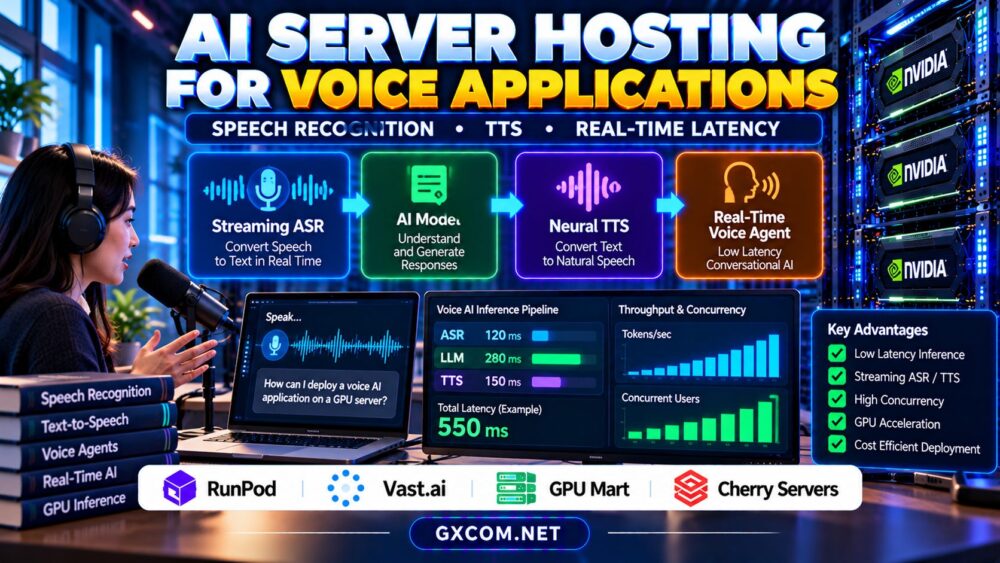
A conversational voice application typically combines automatic speech recognition (ASR), language processing, and speech synthesis. Audio enters through a microphone or communication service, becomes text, passes through an AI model, and returns as generated speech.
Each component introduces processing time. Network transport, voice activity detection, buffering, and application orchestration also contribute to the overall delay.
Some systems use integrated speech-to-speech models instead of separate ASR, language model, and TTS stages. Their deployment requirements should be evaluated independently rather than assuming identical performance characteristics.
Speech Recognition Hosting: CPU or GPU?
Automatic speech recognition converts spoken audio into text. Smaller models and limited traffic may run adequately on CPUs, while larger neural networks or higher concurrency can benefit from GPU acceleration.
Streaming ASR processes incoming audio incrementally instead of waiting for an entire recording. This can improve responsiveness, although recognition accuracy and partial-transcript stability depend on the model.
Measure recognition latency, real-time factor, memory usage, and concurrent stream capacity. Real-time factor compares processing duration with audio duration; values below one indicate processing faster than the audio’s length.
For capacity planning, see our AI inference server sizing guide.
TTS Hosting and Time to First Audio
Text-to-speech systems transform written responses into audio. For interactive applications, time to first audio is often more useful than measuring only total synthesis duration.
A streaming TTS system can begin delivering speech before the entire response is generated. However, small audio chunks may increase scheduling and transport overhead, while larger chunks can increase perceived delay.
Voice quality, supported languages, synthesis speed, and memory requirements vary by model. Evaluate these characteristics using representative text, punctuation, speaking styles, and expected user traffic.
GPU acceleration may help demanding neural TTS workloads, but a GPU is not automatically the most economical choice for every voice application.
Real-Time Voice Latency: Where Delays Accumulate
End-to-end conversational latency includes audio capture, network transmission, speech recognition, language processing, speech synthesis, and playback buffering.

Consider a hypothetical system with 150 milliseconds of ASR processing, 250 milliseconds before the language model produces a usable response, 120 milliseconds to first synthesized audio, and 100 milliseconds of combined transport and buffering.
The resulting estimate is 620 milliseconds. Actual conversations may include overlapping stages, variable network delays, and additional application processing.
Rather than optimizing one component in isolation, measure the complete user journey. Our GPU server network bandwidth guide explains networking considerations for AI infrastructure.
GPU Memory, Concurrency, and Model Placement
Voice applications may run ASR, language models, and TTS on separate services or share computing infrastructure. The appropriate architecture depends on workload intensity and memory requirements.
Combining several models on one GPU can reduce infrastructure complexity but create contention. Separate GPU instances offer clearer resource allocation at potentially higher cost.
Model precision, batch size, audio duration, and active sessions influence memory consumption. Benchmark realistic workloads before purchasing larger accelerators.
For conversational systems using substantial language models, our GPU VRAM requirements for LLM inference guide provides additional context.
Comparing AI Hosting Providers for Voice Workloads
Different hosting models suit experimentation, persistent speech services, and dedicated infrastructure. The following approved providers should be evaluated against specific deployment requirements rather than assumed to deliver identical latency or software support.
| Provider | Potential Fit | Verify Before Purchasing |
|---|---|---|
| RunPod | Containerized speech inference | GPU availability, deployment model, regional latency |
| Vast.ai | Flexible GPU rental and testing | Host reliability, network quality, persistent storage |
| GPU Mart | Longer-running speech services | GPU configuration, operating-system access, billing |
| Cherry Servers | Dedicated infrastructure evaluation | GPU availability, administration, network policies |
RunPod: Containerized Voice AI Deployment
RunPod is relevant for teams evaluating GPU-based ASR, TTS, and inference containers. Check supported deployment options, storage persistence, endpoint behavior, and geographic placement.
For further provider context, read our RunPod GPU cloud review.
Vast.ai: Experimental GPU Rental
Vast.ai provides marketplace-based GPU rental that may suit development and benchmark testing. Individual hosts can differ in hardware, network conditions, and reliability.
Production voice applications should undergo sustained latency and availability testing before relying on a selected configuration.
GPU Mart: Persistent Voice Infrastructure
GPU Mart is worth evaluating when a team needs a longer-lived server environment for speech processing. Confirm available GPUs, software installation permissions, storage arrangements, and network connectivity.
Persistent capacity may simplify deployment while creating costs during quiet periods.
Cherry Servers: Dedicated Server Evaluation
Cherry Servers is an approved infrastructure provider for dedicated hosting comparisons. Verify whether appropriate GPU-enabled configurations are available before considering it for accelerated speech inference.
Dedicated deployment can offer administrative flexibility, but maintenance and recovery responsibilities require attention.
Voice AI Hosting Costs: A Practical Model
Voice infrastructure costs depend on GPU runtime, concurrency, storage, network traffic, and additional application services. Calculate cost per completed conversation rather than relying exclusively on hourly server prices.
Suppose a hypothetical GPU instance costs $0.60 per hour and supports 120 completed conversations during a fully utilized hour. Compute spending would equal $0.005 per conversation.
This simplified calculation excludes speech service licensing, idle capacity, networking, and engineering overhead. Actual costs increase when traffic falls below the assumed utilization.
Our GPU cloud idle costs guide explains additional billing considerations.
Production Deployment Checklist
Before launching, test concurrent audio streams, recognition accuracy, time to first audio, interruption handling, and performance during traffic spikes.
Monitor GPU utilization, queue depth, failed requests, and end-to-end latency percentiles. Use regional deployment where appropriate, and verify data retention, consent, and privacy requirements for recorded speech.

Plan graceful degradation when GPU capacity is unavailable. Depending on the application, fallback options may include smaller models, queued processing, or temporarily reduced functionality.
Compare GPU Hosting for Voice AI Applications
Evaluate ASR and TTS performance, streaming latency, GPU memory, regional connectivity, and total hosting costs before selecting infrastructure.
Frequently Asked Questions
Do real-time voice agents always need GPUs?
No. Smaller speech models and modest workloads may operate on CPUs. GPU acceleration becomes more relevant for demanding models, higher concurrency, or strict latency targets.
What matters most for low-latency TTS?
Time to first audio, streaming behavior, model execution speed, network conditions, and playback buffering all influence responsiveness.
Should ASR and TTS run on the same server?
They can share infrastructure when resources permit. Separate services may improve isolation and independent scaling, but can introduce additional network and operational costs.
Final Verdict
The best AI server hosting for voice applications balances speech accuracy, natural response times, concurrency, and predictable operating costs. Compare RunPod, Vast.ai, GPU Mart, and verified Cherry Servers configurations against measured ASR, TTS, and end-to-end latency requirements. Realistic testing matters more than advertised GPU specifications alone.