Artificial intelligence has transformed GPU servers from specialized computing systems into essential infrastructure for machine learning, large language models, generative AI, inference, rendering, and high-performance computing.
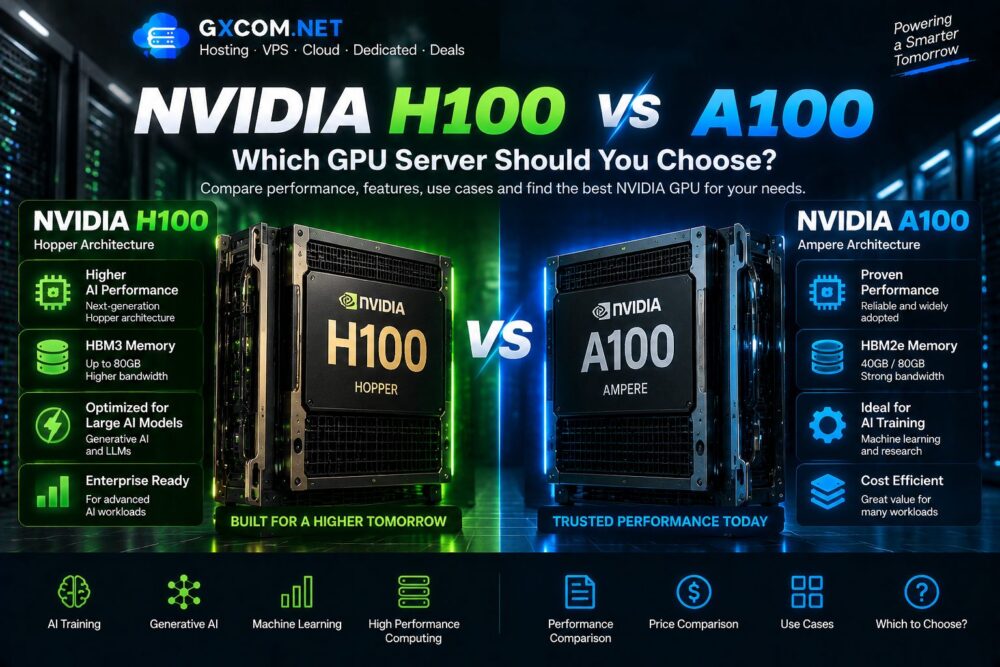
NVIDIA dominates much of this market with a broad range of data center and professional GPUs. From powerful H100-class accelerators for demanding AI training to A100 and L40S systems for machine learning and inference, businesses can choose from very different levels of performance and cost.
The Best NVIDIA GPU Servers are therefore not simply the servers with the fastest GPU. The right choice depends on the workload, GPU memory, deployment model, software ecosystem, scalability, and budget.
This guide compares NVIDIA AI server options and explains how to choose the right GPU infrastructure for your project.
Best NVIDIA GPU Servers at a Glance
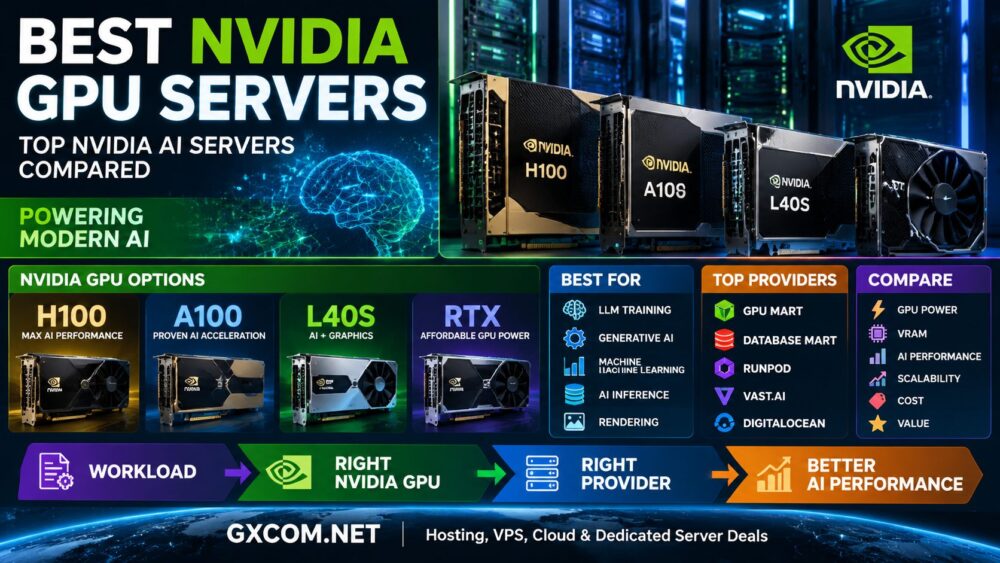
| NVIDIA GPU | Best For | Performance Tier | Typical Workload |
|---|---|---|---|
| H100 | Large-scale AI | Very High | LLM training, generative AI, enterprise AI |
| A100 | Machine Learning | High | Deep learning, research, AI training |
| L40S | AI Inference | High | Inference, graphics, generative AI |
| RTX-class GPU | Budget AI | Medium to High | Development, image generation, testing |
What Is an NVIDIA GPU Server?
An NVIDIA GPU server is a physical or virtual server equipped with one or more NVIDIA graphics processing units. Unlike traditional CPU-only servers, GPUs contain highly parallel processing architectures capable of handling thousands of calculations simultaneously.
This makes GPU servers particularly useful for:
- Artificial intelligence
- Machine learning
- Large language models
- Deep learning
- AI inference
- Computer vision
- Scientific computing
- 3D rendering
NVIDIA's CUDA ecosystem is another major reason its hardware is widely used for AI development. Many popular machine-learning frameworks and GPU-accelerated applications are optimized for NVIDIA hardware.
NVIDIA H100 GPU Servers
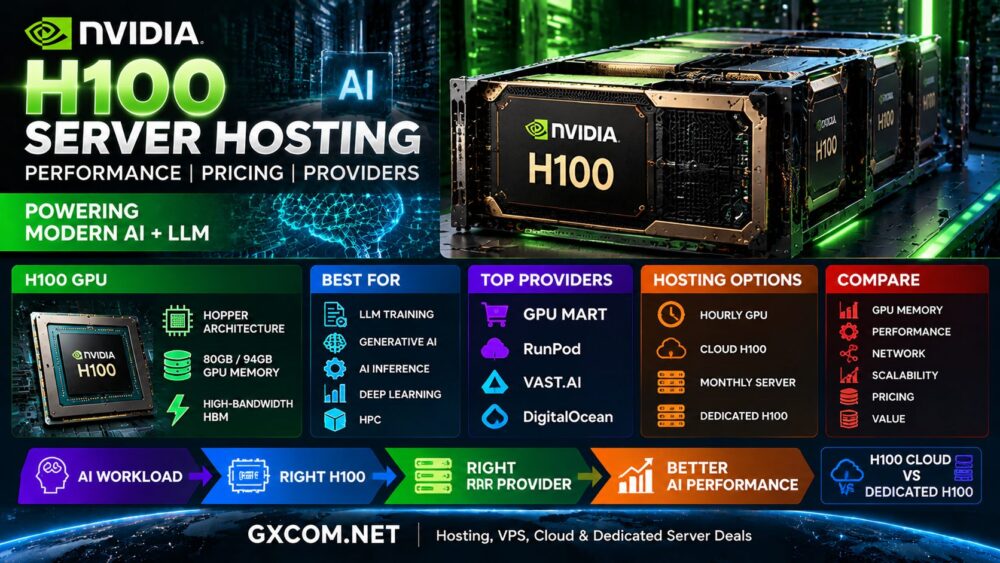
The NVIDIA H100 is designed for demanding data center AI workloads and is commonly associated with large-scale model training, generative AI, and high-performance computing.
H100 servers are particularly attractive for organizations working with:
- Large language models
- Generative AI training
- Transformer models
- Enterprise AI platforms
- High-performance computing
The main disadvantage is cost. H100 infrastructure sits at the premium end of the GPU server market, so smaller projects should determine whether they can achieve their objectives with less expensive hardware before selecting it.
NVIDIA A100 GPU Servers
The A100 remains an important AI accelerator for machine learning and deep-learning environments. Its mature software support and widespread deployment make it relevant for organizations that do not necessarily need newer premium hardware.
A100 servers can be suitable for:
- Machine-learning training
- Deep learning
- Data science
- AI research
- Inference
Depending on provider pricing and availability, A100 infrastructure can offer an interesting balance between AI capability and cost.
NVIDIA L40S GPU Servers
The L40S targets a broader combination of AI and graphics workloads. It can be especially attractive when inference, generative AI, visualization, and graphics acceleration are more important than maximum large-model training performance.
Typical applications include:
- AI inference
- Generative AI applications
- Image generation
- Virtual workstations
- Rendering
- Graphics-intensive applications
For a deeper comparison of these three GPU families, read our
H100 vs A100 vs L40S
guide.
RTX GPU Servers: A Lower-Cost Alternative
Not every AI workload requires a data center accelerator. NVIDIA RTX-class GPUs can provide substantial GPU performance for development, inference, image generation, rendering, and smaller machine-learning projects.
RTX GPU servers are particularly interesting for developers and startups trying to reduce infrastructure costs.
They can be used for:
- Stable Diffusion
- AI development
- Model experimentation
- Rendering
- Computer vision
- Smaller inference workloads
For cost-sensitive projects, compare additional options in our
Cheap GPU Servers
guide.
Best NVIDIA GPU Server Providers
The GPU itself is only one part of the buying decision. Provider reliability, networking, storage, billing, deployment flexibility, and support can significantly affect the overall experience.
GPU Mart
GPU Mart specializes in GPU hosting and is operated by Database Mart LLC. Its GPU-focused infrastructure makes it particularly relevant for users comparing GPU VPS, dedicated GPU servers, and AI computing environments.
GPU Mart can be considered for workloads such as AI development, machine learning, inference, rendering, and projects requiring dedicated GPU resources.
Database Mart
Database Mart is a U.S.-based infrastructure provider with a history extending back to 2005. Its broader server portfolio includes VPS, dedicated servers, and GPU infrastructure.
It is particularly worth considering for users who prefer a more traditional hosting environment alongside GPU computing rather than a purely serverless AI platform.
RunPod
RunPod is focused heavily on GPU computing for AI developers. Its flexible infrastructure makes it attractive for development, model experimentation, inference, and other workloads where users want access to GPU resources without purchasing hardware.
Vast.ai
Vast.ai takes a marketplace-oriented approach to GPU computing. Users can compare different available machines and GPU configurations, making the platform particularly interesting for price-sensitive AI workloads.
Because marketplace infrastructure can vary between hosts, users should compare individual machine specifications, reliability, storage, and networking rather than choosing on price alone.
DigitalOcean
DigitalOcean is attractive to developers who want GPU computing integrated with a broader cloud ecosystem. This can simplify projects that require GPU acceleration alongside application hosting, storage, databases, networking, and other cloud services.
NVIDIA GPU Server Provider Comparison
| Provider | Best For | Deployment Style |
|---|---|---|
| GPU Mart | GPU VPS and dedicated GPU hosting | Hosted GPU infrastructure |
| Database Mart | Traditional server + GPU workloads | VPS / Dedicated / GPU |
| RunPod | AI developers | Flexible GPU cloud |
| Vast.ai | Budget GPU computing | GPU marketplace |
| DigitalOcean | Cloud application developers | Cloud GPU infrastructure |
You can also see our broader
NVIDIA GPU Server Providers
comparison for additional provider-selection considerations.
NVIDIA GPU Server vs GPU Cloud
One of the most important decisions is whether to use dedicated GPU hardware or flexible cloud GPU infrastructure.
| Feature | Dedicated GPU Server | Cloud GPU |
|---|---|---|
| Hardware Access | Dedicated | Depends on service |
| Deployment | Usually slower | Fast |
| Scaling | Hardware dependent | Flexible |
| Billing | Often monthly | Often usage based |
| Best For | Continuous workloads | Variable workloads |
Cloud GPU infrastructure is generally attractive when demand changes frequently, while dedicated GPU servers can make more sense when workloads run continuously and predictable access to hardware is important.
NVIDIA GPU Servers for LLM Training
Large language model training is among the most demanding GPU workloads. Important considerations include GPU memory, memory bandwidth, inter-GPU communication, system RAM, storage throughput, and networking.
Large-scale training environments may require multiple GPUs working together rather than a single accelerator.
For these workloads, premium data center GPUs such as H100-class systems are more relevant than inexpensive consumer-oriented servers.
NVIDIA GPU Servers for AI Inference
Inference has different requirements from model training. Once a model has been trained, serving predictions can often run efficiently on less expensive hardware.
L40S and suitable RTX-class servers can therefore offer attractive performance for certain inference workloads without automatically requiring the most expensive accelerator available.
How Much Does an NVIDIA GPU Server Cost?
There is no single NVIDIA GPU server price. Total cost depends on:
- GPU model
- Number of GPUs
- GPU memory
- CPU configuration
- System RAM
- NVMe storage
- Network bandwidth
- Dedicated or shared infrastructure
- Hourly or monthly billing
Premium H100 infrastructure can cost substantially more than RTX or older-generation GPU configurations. The cheapest hourly rate is also not necessarily the lowest total project cost if a slower GPU requires significantly more computing time.
See our
AI Server Cost Guide
for a broader explanation of AI infrastructure costs.
How to Choose the Best NVIDIA GPU Server
Start with the workload rather than the GPU model.
| Workload | GPU Direction |
|---|---|
| Large LLM Training | H100-class infrastructure |
| Machine Learning | A100 / H100 depending on scale |
| AI Inference | L40S / suitable RTX / data center GPU |
| Image Generation | RTX / L40S |
| AI Development | RTX / affordable cloud GPU |
| Rendering | RTX / L40S |
Common NVIDIA GPU Server Buying Mistakes
Buying the Most Powerful GPU Automatically
More GPU performance does not always produce better value. Smaller workloads may leave expensive hardware underutilized.
Ignoring VRAM Requirements
A GPU can have strong computational performance but still be unsuitable if the workload exceeds available GPU memory.
Comparing Only Hourly Prices
Storage, bandwidth, CPU resources, startup time, data transfer, and GPU utilization can all affect the real cost of a project.
Ignoring Scalability
A development project may begin with one GPU but eventually require multiple GPUs or distributed infrastructure. Consider the upgrade path before committing to a platform.
Final Thoughts
The best NVIDIA GPU server depends on what you actually need to run.
H100-class infrastructure targets demanding AI training and large-scale generative AI. A100 remains relevant for established machine-learning environments, while L40S can provide a strong combination of AI inference and graphics capabilities. RTX-based GPU servers can offer a more affordable entry point for developers, startups, rendering, and smaller AI workloads.
Provider selection matters just as much as GPU selection. GPU Mart, Database Mart, RunPod, Vast.ai, and DigitalOcean represent different approaches ranging from dedicated GPU hosting and GPU marketplaces to flexible cloud infrastructure.
Instead of automatically choosing the largest GPU, match the workload to the required VRAM, performance, deployment model, and budget. The right NVIDIA GPU server is the one that delivers the required performance without paying for computing resources your project cannot use.