NVIDIA H100 and A100 are two of the most widely used AI accelerators for high-performance computing, machine learning and enterprise artificial intelligence workloads.
Both GPUs are designed for demanding AI applications, but they target different performance requirements, budgets and deployment scenarios.
Choosing between an NVIDIA H100 server and an A100 server depends on workload size, AI model complexity, performance expectations and infrastructure costs.
This guide compares NVIDIA H100 vs A100, including architecture, performance, memory, AI workloads, pricing considerations and which GPU server is the right choice.
NVIDIA H100 vs A100 Overview
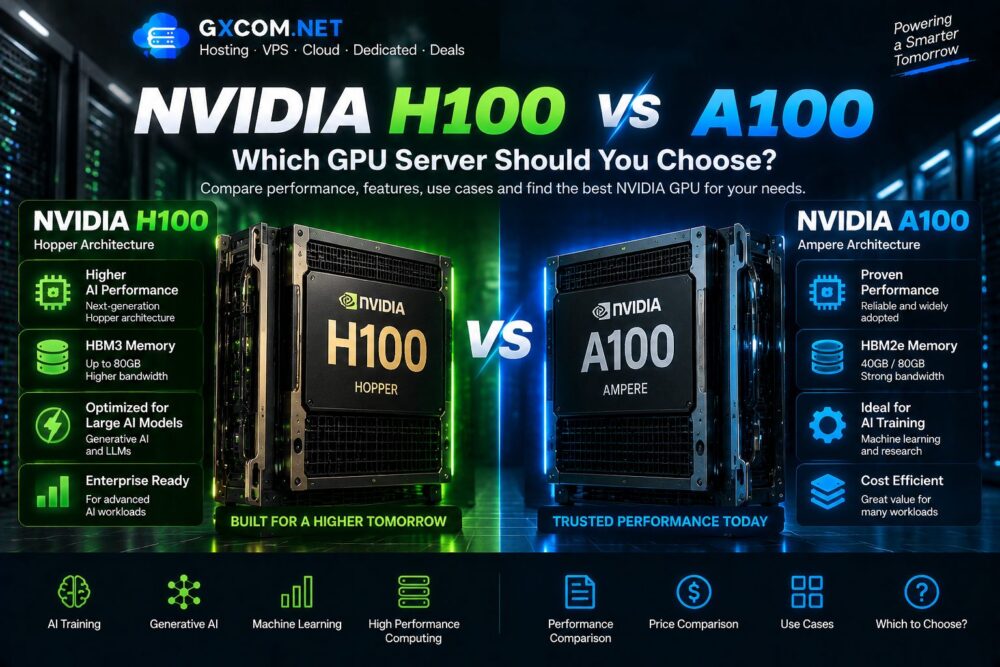
| Feature | NVIDIA H100 | NVIDIA A100 |
|---|---|---|
| GPU Generation | Hopper Architecture | Ampere Architecture |
| Main Target | Advanced AI workloads | AI training and computing |
| AI Performance | Higher | High |
| Memory Options | 80GB HBM3 | 40GB/80GB HBM2e |
| Best For | Large AI models | Machine learning workloads |
What Is NVIDIA H100?
The NVIDIA H100 is a next-generation AI accelerator based on NVIDIA Hopper architecture.
It was designed for advanced artificial intelligence workloads, especially large-scale model training and generative AI applications.
Common H100 applications include:
- Large language models
- Generative AI
- Enterprise AI platforms
- Deep learning training
- High-performance computing
What Is NVIDIA A100?
The NVIDIA A100 is an Ampere-based GPU accelerator widely adopted for AI research, cloud computing and machine learning workloads.
A100 remains popular because of its mature ecosystem and strong AI performance.
Common applications include:
- Machine learning training
- AI research
- Data analytics
- Cloud GPU computing
H100 vs A100 Architecture Differences
NVIDIA H100 Hopper Architecture
The H100 introduces newer architecture improvements designed specifically for artificial intelligence acceleration.
Key improvements include:
- Transformer Engine optimization
- Improved AI processing
- Higher memory bandwidth
- Advanced acceleration features
NVIDIA A100 Ampere Architecture
The A100 uses NVIDIA Ampere architecture and provides reliable performance for many AI workloads.
Advantages include:
- Mature ecosystem
- Wide availability
- Strong AI performance
- Proven enterprise adoption
NVIDIA H100 vs A100 Performance Comparison
| Category | H100 | A100 |
|---|---|---|
| AI Training | Excellent | Very Good |
| Large Models | Excellent | Good |
| Inference | Excellent | Very Good |
| Research Workloads | Excellent | Excellent |
| Cost Efficiency | Higher cost | More affordable |
H100 vs A100 Memory Comparison
| Specification | H100 | A100 |
|---|---|---|
| Memory Type | HBM3 | HBM2e |
| Memory Capacity | Up to 80GB | Up to 80GB |
| Memory Bandwidth | Higher | Lower |
GPU memory bandwidth is especially important for large AI models because data movement affects training and inference speed.
H100 vs A100 for AI Training
For large-scale AI training, NVIDIA H100 generally provides advantages because of newer architecture improvements and optimized AI acceleration features.
H100 is commonly used for:
- Large language model training
- Generative AI development
- Enterprise AI platforms
A100 remains suitable for:
- Machine learning research
- AI experiments
- Existing production workloads
H100 vs A100 for AI Inference
AI inference requirements vary depending on model size and user demand.
| Workload | Recommended GPU |
|---|---|
| Large AI models | H100 |
| Enterprise inference | H100 or A100 |
| Small and medium models | A100 |
| Development testing | A100 |
H100 GPU Server vs A100 GPU Server Pricing
| Factor | H100 Server | A100 Server |
|---|---|---|
| Hardware Cost | Higher | Lower |
| Availability | More limited | More available |
| Performance | Higher | Strong |
| Budget Friendly | Less suitable | More suitable |
Who Should Choose NVIDIA H100?
H100 servers are suitable for organizations requiring maximum AI performance.
- AI companies
- Large language model developers
- Enterprise AI platforms
- Advanced research teams
Who Should Choose NVIDIA A100?
A100 servers remain a strong choice for users needing reliable AI computing with lower infrastructure costs.
- Researchers
- Developers
- Machine learning teams
- Cloud AI projects
H100 vs A100: Which GPU Server Should You Choose?
| Requirement | Recommended Choice |
|---|---|
| Large AI models | NVIDIA H100 |
| Generative AI | NVIDIA H100 |
| Cost-conscious AI projects | NVIDIA A100 |
| Research workloads | Both options |
| AI development | A100 or H100 |
NVIDIA GPU Server Hosting Options
Both H100 and A100 are available through cloud GPU providers and dedicated server hosting companies.
Users can choose:
- Cloud GPU rental
- Dedicated GPU servers
- AI infrastructure platforms
- Private GPU clusters
Explore more NVIDIA hardware options in our
NVIDIA GPU Server Guide
.
Common Mistakes When Choosing H100 or A100
- Choosing based only on GPU specifications
- Ignoring workload requirements
- Underestimating memory needs
- Ignoring software compatibility
- Not considering total infrastructure costs
Frequently Asked Questions
Is H100 better than A100?
H100 provides newer architecture and higher performance, while A100 remains a widely used AI accelerator with strong capabilities.
Is A100 still good for AI?
Yes. A100 continues to support many AI training, research and cloud computing workloads.
Which GPU is better for large language models?
Large language model workloads often benefit from H100 because of its newer AI acceleration features.
Should I rent H100 or A100 servers?
The right choice depends on workload requirements, performance needs and budget.
Final Thoughts
NVIDIA H100 and A100 are both powerful AI accelerators, but they serve different computing requirements.
H100 is designed for advanced AI workloads requiring maximum performance, while A100 remains a reliable option for many machine learning and research applications.
Understanding workload requirements, GPU memory, performance goals and infrastructure costs will help you choose the right NVIDIA GPU server solution.