Do you really need to pay for an SSL certificate, or is a free SSL certificate good enough?
This is one of the most common questions website owners ask when enabling HTTPS.
Free SSL certificates are now widely available through hosting providers and automated certificate authorities, while commercial certificate providers continue to offer paid Domain Validation (DV), Organization Validation (OV), Extended Validation (EV), wildcard and multi-domain certificates.
That can make the decision confusing.
The most important thing to understand is that free SSL vs paid SSL is not simply a comparison between weak encryption and strong encryption.
A correctly configured, publicly trusted free TLS certificate can provide strong HTTPS encryption just like a paid certificate. The major differences usually involve validation level, certificate management, domain coverage, support, commercial features and organizational requirements.
This guide compares free and paid SSL certificates to help you decide which option is appropriate for your website.
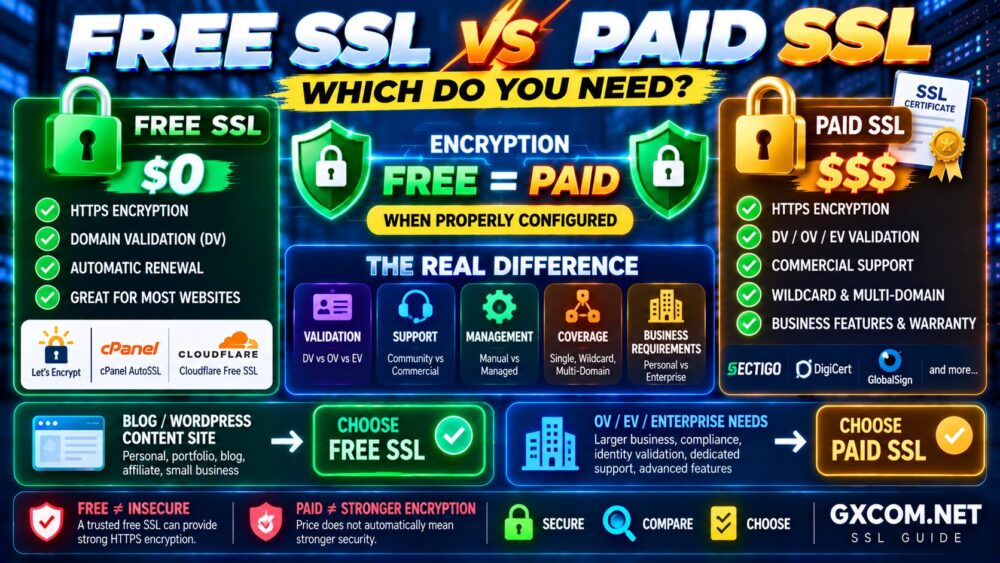
Free SSL vs Paid SSL: Quick Comparison
| Feature | Free SSL | Paid SSL |
|---|---|---|
| HTTPS Encryption | Yes | Yes |
| Domain Validation | Common | Available |
| Organization Validation | Usually No | Available |
| Extended Validation | No | Available |
| Automatic Renewal | Common | Depends on provider/platform |
| Wildcard Certificates | Available from some CAs | Widely Available |
| Multi-Domain Certificates | Available | Widely Available |
| Commercial Support | Usually Limited | Often Available |
| Certificate Warranty | Usually No | May Be Included |
| Typical Cost | Free | Varies |
For many blogs, WordPress sites, portfolios, content websites and small business websites, a properly configured free SSL certificate is usually sufficient.
Organizations with specific identity validation, support, procurement, compliance or certificate-management requirements may prefer or require paid certificates.
What Is a Free SSL Certificate?
A free SSL certificate is a publicly trusted TLS certificate issued without a certificate purchase fee.
Let's Encrypt is the best-known example, and many hosting companies integrate automated free SSL directly into their platforms.
Free certificates are commonly Domain Validation certificates.
Domain Validation confirms control over a domain name, but it does not perform the same organization identity verification associated with OV or EV certificates.
A typical free SSL deployment looks like:
Domain Validation → Certificate Issued → HTTPS Enabled → Automatic Renewal
For ordinary websites, this automated model can be extremely effective.
What Is a Paid SSL Certificate?
A paid SSL certificate is obtained through a commercial certificate provider, reseller or hosting company.
Depending on the product, paid certificates can offer:
- Domain Validation (DV)
- Organization Validation (OV)
- Extended Validation (EV)
- Wildcard coverage
- Multi-domain/SAN coverage
- Commercial technical support
- Certificate management services
- Warranty terms
- Additional enterprise features
The important distinction is that paying for a certificate does not automatically make the encryption itself stronger.
You are often paying for additional validation, support, certificate management, coverage, contractual features or business requirements.
Is Free SSL as Secure as Paid SSL?
For the core purpose of encrypting HTTPS traffic, a properly configured free certificate can provide strong modern TLS security.
HTTPS security depends on more than certificate price.
It also depends on:
- TLS configuration
- Private key security
- Web server configuration
- Certificate validity
- Certificate chain
- Supported protocols
- Software maintenance
- Application security
Therefore:
Paid Certificate ≠ Automatically Stronger Encryption.
And:
Free Certificate ≠ Weak HTTPS.
A badly configured server using an expensive certificate can still have security problems, while a correctly configured server using a free certificate can provide strong HTTPS protection.
Encryption: Free SSL vs Paid SSL
When browsers establish HTTPS connections, the strength of the resulting secure connection depends on the TLS configuration and cryptographic parameters supported by the client and server.
The certificate helps authenticate the server and establish trust, but its purchase price does not determine the security of every part of the TLS connection.
When comparing certificates, avoid marketing claims that imply:
$0 Certificate = Weak Encryption
and:
$200 Certificate = Automatically Stronger Encryption
That is not an accurate way to evaluate modern HTTPS security.
The Biggest Difference: Validation
One of the most meaningful differences between SSL certificate products is the level of identity validation.
The three terms you will commonly encounter are:
DV → Domain Validation
OV → Organization Validation
EV → Extended Validation
What Is a DV SSL Certificate?
A Domain Validation certificate verifies that the applicant controls the relevant domain.
Validation can be performed through mechanisms such as:
- DNS records
- HTTP validation
- Other CA-supported domain control methods
DV certificates can normally be issued quickly because they do not require the same organization identity checks as OV or EV certificates.
They are commonly suitable for:
- Blogs
- WordPress websites
- Portfolios
- Content websites
- Personal websites
- Small business websites
- Many application endpoints
What Is an OV SSL Certificate?
Organization Validation certificates add validation of organizational information beyond basic domain control.
The certificate authority verifies information about the organization according to its validation procedures.
OV certificates may be appropriate when verified organizational identity is important for internal policy, business requirements, certificate management or other organizational purposes.
What Is an EV SSL Certificate?
Extended Validation certificates require a more extensive identity verification process.
Historically, EV certificates were heavily marketed around prominent browser identity indicators.
Modern browsers no longer display EV identity in the highly prominent way many older SSL marketing materials illustrate.
Therefore, businesses should not purchase EV solely because they expect a dramatically different browser address-bar appearance.
EV can still have value where the organization's security policy, validation requirements or business processes specifically call for it.
Does Paid SSL Show a Better Padlock?
Generally, browsers do not give an ordinary paid DV certificate a special “premium” HTTPS indicator simply because money was paid for it.
If both websites establish valid trusted HTTPS connections, users generally see the browser's normal secure-connection experience.
The browser does not display:
FREE SSL
versus:
PREMIUM PAID SSL
as a simple consumer-facing quality score.
This is another reason not to choose a certificate based purely on old marketing screenshots.
Free SSL vs Paid SSL for WordPress
For most ordinary WordPress websites, free SSL is usually sufficient.
This includes:
- Blogs
- Affiliate websites
- News websites
- Portfolio websites
- Business websites
- SEO content websites
If your WordPress hosting includes automated SSL and renewal, there may be little practical reason to purchase a separate DV certificate.
The more important tasks are:
- Enable HTTPS correctly
- Redirect HTTP to HTTPS
- Fix mixed content
- Use HTTPS internal links
- Use HTTPS canonical URLs
- Monitor certificate renewal
If you have not enabled HTTPS yet, follow our SSL certificate installation guide.
Free SSL vs Paid SSL for Ecommerce
An ecommerce website does not automatically need a paid SSL certificate simply because it accepts payments.
A properly configured trusted TLS certificate can encrypt HTTPS traffic regardless of whether the certificate itself was free or paid.
However, ecommerce businesses may have additional requirements involving:
- Organizational identity validation
- Corporate security policies
- Payment infrastructure
- Vendor requirements
- Certificate lifecycle management
- Technical support
- Compliance processes
The decision should therefore be based on actual organizational requirements—not the assumption that free certificates cannot encrypt ecommerce traffic securely.
Free SSL vs Paid SSL for Business Websites
For a small business website that primarily contains company information, contact forms and marketing pages, a free DV certificate may be completely adequate.
A larger organization may prefer paid OV or EV certificates because it wants additional organizational validation, support or centralized certificate management.
Ask:
Do we need HTTPS encryption?
If yes, both free and paid certificates can potentially provide it.
Then ask:
Do we need verified organizational identity, specialized support or enterprise certificate management?
If yes, paid options become more relevant.
Free SSL vs Paid SSL for VPS and Dedicated Servers
If you manage your own VPS or dedicated server, free certificates can work very well—particularly when issuance and renewal are automated using ACME-compatible tools.
But self-managed servers introduce additional responsibility.
You need to manage:
- Certificate installation
- Private keys
- Web server configuration
- Automatic renewal
- Certificate deployment
- Web server reloads
- Monitoring
The question is not simply:
Free or Paid?
It is also:
Who Will Manage the Certificate Lifecycle?
Certificate Validity and Renewal
Free certificates are often designed around automated issuance and renewal.
This can be an advantage rather than a disadvantage when automation is configured correctly.
Shorter certificate lifetimes reduce the period during which a forgotten or compromised credential can remain valid, but they also make reliable automation essential.
Paid certificates also require lifecycle management, even when their issuance or management model differs.
The correct goal is:
Automatic Renewal + Monitoring + Successful Deployment.
Not simply:
Longer Validity = Better Certificate.
Free SSL and Automatic Renewal
One of the strongest practical advantages of free SSL ecosystems is automation.
Many hosting providers can:
- Validate the domain
- Issue the certificate
- Install it
- Renew it
- Deploy the renewed certificate
with little manual intervention.
This can make free SSL easier to maintain than manually purchased certificates.
However, automation must still be monitored.
If renewal fails because of DNS, firewall, validation or configuration changes, the certificate can eventually expire.
Paid SSL and Technical Support
Support is one area where commercial certificates may provide meaningful value.
Depending on the provider and product, paid certificates may include assistance with:
- Certificate issuance
- Validation
- Installation
- Reissuance
- Compatibility
- Certificate management
This can matter to organizations that prefer a commercial support relationship rather than relying on hosting support, documentation or internal administrators.
Always check exactly what support is included before paying a premium.
What Is an SSL Certificate Warranty?
Some commercial SSL certificates include a stated warranty.
This is frequently misunderstood.
An SSL warranty is not insurance that pays you whenever your website is hacked.
The terms are specific to the certificate provider and typically relate to defined certificate-authority failures or validation circumstances.
Before treating a large warranty figure as a major purchasing advantage, read:
- What events are covered
- Who is eligible
- Claim requirements
- Exclusions
- Maximum liability
Large Warranty Number ≠ General Website Hacking Insurance.
Wildcard SSL: Free vs Paid
A wildcard certificate can cover multiple subdomains at a defined level.
For example:
*.example.com
may be useful for:
blog.example.com
shop.example.com
app.example.com
Free wildcard certificates are available through some certificate authorities, while commercial providers also offer paid wildcard products.
Wildcard certificates can simplify some deployments, but they are not automatically the best solution for every infrastructure design.
Consider private-key exposure, automation and how many systems need access to the wildcard key.
Multi-Domain SSL: Free vs Paid
Multi-domain certificates use Subject Alternative Names to cover multiple hostnames in one certificate.
For example:
example.com
www.example.com
example.net
api.example.org
Both free and commercial certificate systems can support multi-domain certificates depending on the provider and validation method.
For large environments, certificate management architecture may matter more than whether an individual certificate is free.
Does Paid SSL Improve SEO?
Do not purchase an expensive SSL certificate because you expect it to rank better than a free SSL certificate.
For SEO, the important issue is that your website uses HTTPS correctly and consistently.
Check:
- HTTPS pages load successfully
- HTTP redirects to HTTPS
- Canonical tags use HTTPS
- Internal links use HTTPS
- XML sitemap uses HTTPS
- No mixed-content problems interfere with the site
Our Technical SEO Checklist covers HTTPS as part of a broader technical SEO audit.
Google Does Not Rank a Page Higher Simply Because Its SSL Certificate Costs More.
Does Free SSL Make a Website Look Cheap?
Visitors generally do not know how much you paid for the certificate simply by viewing a normal HTTPS website.
A correctly configured trusted certificate provides the expected HTTPS browser experience.
Your site's perceived trustworthiness is more likely to depend on factors such as:
- Brand reputation
- Website quality
- Accurate company information
- Professional design
- Clear contact information
- Privacy and security practices
- Reliable checkout processes
Paying for a certificate does not automatically make a poorly designed or untrustworthy website credible.
Is Let's Encrypt Safe?
Let's Encrypt is a publicly trusted certificate authority designed to make HTTPS widely accessible through automated certificate issuance and renewal.
Its certificates are used to establish normal trusted HTTPS connections.
The fact that certificates are issued without a purchase fee does not mean the encrypted connection is inherently weaker.
As with any certificate deployment, security still depends on correct server configuration, private-key protection and software maintenance.
Can Hackers Get Free SSL Certificates?
Yes, an attacker who controls a domain can potentially obtain a domain-validated certificate for that domain.
But the same basic lesson applies to paid DV certificates:
HTTPS Means the Connection Is Encrypted and the Certificate Validates the Covered Identity according to its validation level.
It does not mean:
This Website Is Automatically Honest or Safe.
Users should not treat the presence of HTTPS alone as proof that a website is trustworthy.
When Should You Use Free SSL?
Free SSL is usually an excellent choice when:
- You run a blog
- You operate a WordPress site
- You have a portfolio website
- You run a content or affiliate website
- You have a standard small business site
- Your hosting includes automatic SSL
- You can automate certificate renewal
- You only require domain validation
For these use cases, buying a separate DV certificate may provide little practical benefit.
When Should You Consider Paid SSL?
A paid certificate may make sense when:
- You require OV or EV validation
- Your organization has specific certificate policies
- You need commercial certificate support
- You require a particular certificate product
- You need enterprise certificate management
- A vendor or business process requires a particular certificate type
- Your organization prefers a commercial CA relationship
The decision should be based on requirements rather than fear that free certificates provide inherently weak encryption.
When Paid SSL Is Probably Unnecessary
You probably do not need to purchase a separate certificate simply because:
- You use WordPress
- You want HTTPS
- You want a browser-secure connection
- You want Google to crawl HTTPS pages
- You run an ordinary blog
- Your hosting already provides automated trusted SSL
Check what your hosting plan already includes before purchasing another certificate.
Free SSL vs Paid SSL Cost
The direct certificate cost of free SSL is zero, but certificate management still has an operational cost.
Someone or something must handle:
- Issuance
- Validation
- Installation
- Renewal
- Monitoring
- Troubleshooting
Paid certificates add a purchase cost but may bundle services that reduce some operational burden.
For businesses, the better comparison is therefore:
Total Certificate Lifecycle Cost
rather than:
$0 vs $X Certificate Price.
Free SSL vs Paid SSL: Which Is Better?
There is no universal winner.
| Use Case | Recommended Starting Point |
|---|---|
| Personal Blog | Free SSL |
| WordPress Content Site | Free SSL |
| Affiliate Website | Free SSL |
| Portfolio | Free SSL |
| Small Business Website | Free SSL / Paid if business requirements justify it |
| Standard Ecommerce Site | Trusted SSL based on platform and organizational requirements |
| Organization Requiring OV | Paid OV |
| Organization Requiring EV | Paid EV |
| Enterprise Certificate Program | Commercial/managed solution may be appropriate |
What Should You Check Before Buying Paid SSL?
Before paying for a certificate, ask:
- Does my hosting already include free SSL?
- Do I need more than Domain Validation?
- Do I need OV or EV?
- Do I need wildcard or multi-domain coverage?
- Can renewal be automated?
- Do I need commercial support?
- What does the warranty actually cover?
- Does my organization have a certificate policy?
- Can my existing platform manage certificates automatically?
If your only requirement is:
“I need HTTPS for my WordPress website.”
a free trusted certificate is often all you need.
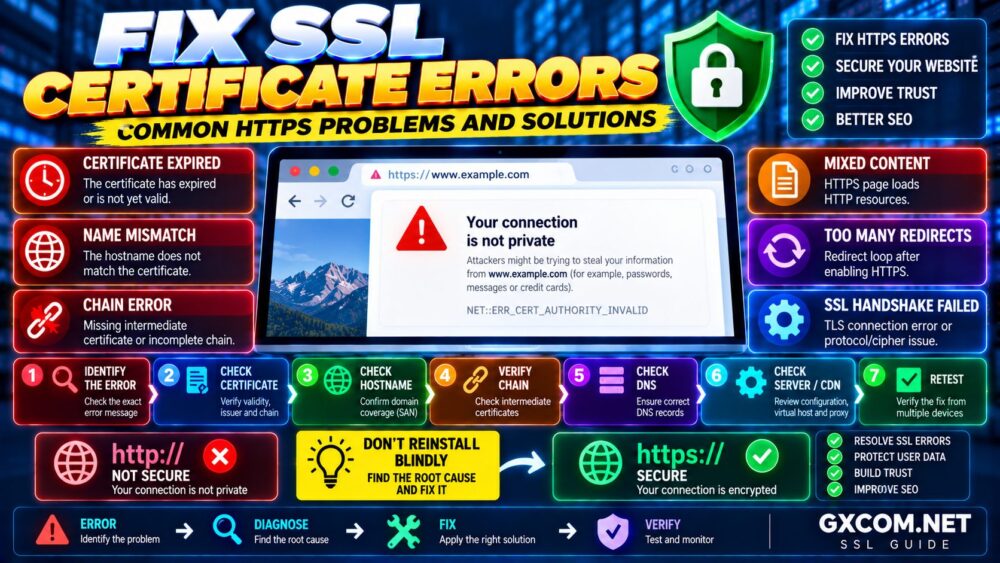
What If Your Free SSL Certificate Is Showing Errors?
Do not assume the problem exists because the certificate was free.
The actual cause may be:
- Expired certificate
- Failed automatic renewal
- Hostname mismatch
- Incomplete certificate chain
- Incorrect DNS
- CDN configuration
- Redirect loop
- Mixed content
Use our SSL certificate troubleshooting guide to diagnose the specific error.
Free SSL vs Paid SSL FAQ
Is free SSL really secure?
Yes, a properly configured and publicly trusted free TLS certificate can provide strong HTTPS encryption. Overall security also depends on your server, TLS configuration, private-key security and application security.
Is paid SSL more secure than free SSL?
Not automatically. Paid certificates can provide additional identity validation, support and commercial features, but price alone does not determine the strength of the HTTPS encryption.
Is Let's Encrypt SSL good enough?
For many websites requiring standard domain-validated HTTPS, yes. It is particularly useful when issuance and renewal are automated correctly.
Should I use free SSL for WordPress?
For most WordPress websites, a trusted free SSL certificate with reliable automatic renewal is sufficient.
Do ecommerce websites need paid SSL?
Not simply because they are ecommerce websites. The certificate choice should depend on the platform, validation requirements, organizational policies, support needs and other business requirements.
Does paid SSL improve Google rankings?
No special ranking advantage comes from paying more for the certificate itself. Focus on implementing HTTPS correctly and consistently.
What is the difference between DV, OV and EV?
DV verifies domain control. OV additionally validates organizational information. EV requires a more extensive organization identity validation process.
Can I use free SSL on a VPS?
Yes. Free certificates are widely used on VPS and dedicated servers, especially with automated ACME clients.
Are free wildcard SSL certificates available?
Yes, some certificate authorities provide free wildcard certificates, although validation and automation requirements may differ from ordinary single-domain certificates.
Why do companies still buy SSL certificates?
Organizations may require OV or EV validation, commercial support, specific certificate products, centralized management, contractual features or compliance with internal policies.
Final Verdict: Free SSL or Paid SSL?
For most ordinary websites, the decision is simpler than SSL marketing sometimes makes it appear.
Choose Free SSL If:
- You need standard HTTPS
- Domain Validation is sufficient
- Your hosting includes automated SSL
- You run WordPress, a blog, portfolio or content site
- You can reliably automate renewal
Consider Paid SSL If:
- You specifically require OV or EV
- You need commercial certificate support
- Your organization has certificate procurement requirements
- You need particular management or contractual features
The key takeaway is:
FREE SSL ≠ WEAK SECURITY
and:
PAID SSL ≠ AUTOMATICALLY STRONGER ENCRYPTION
For many websites, a free, trusted and automatically renewed SSL certificate is the most practical choice.
For organizations with additional identity, support or certificate-management requirements, a paid certificate can provide meaningful value.
Choose based on your actual requirements—not the certificate price.