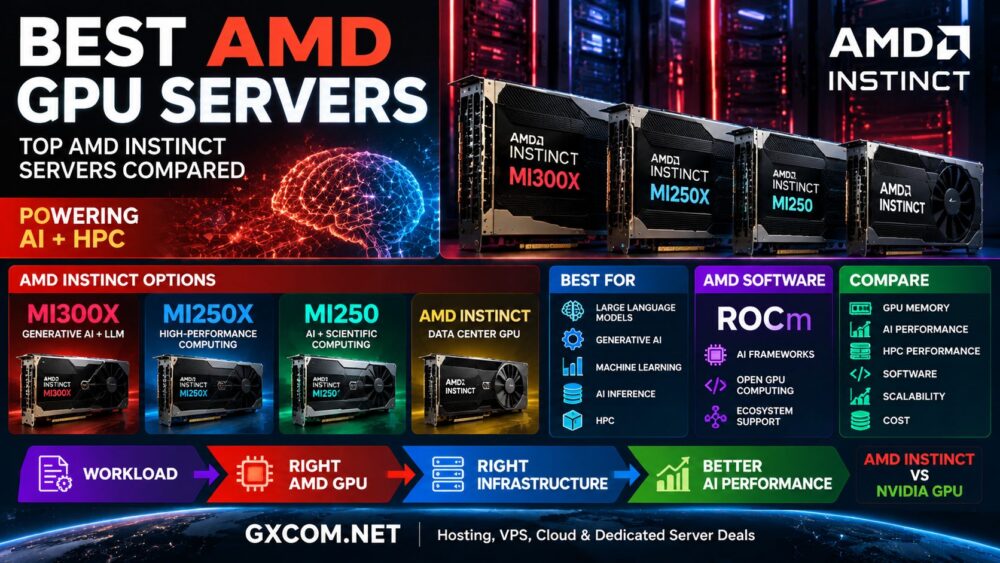
The rapid growth of generative AI and large language models has created enormous demand for high-memory GPU infrastructure. While NVIDIA has traditionally dominated AI acceleration, AMD has emerged as an increasingly important alternative with its Instinct data center GPU family.
At the center of that strategy is the AMD Instinct MI300X Server, a high-performance AI platform designed for large language models, generative AI, inference, machine learning, and memory-intensive computing.
With 192GB of HBM3 memory per MI300X accelerator and AMD's ROCm software ecosystem, MI300X infrastructure is particularly interesting for organizations that need large GPU memory capacity and want an alternative to NVIDIA-based AI servers.
This guide explains MI300X performance, specifications, AI capabilities, server costs, software requirements, and how it compares with NVIDIA H100 infrastructure.
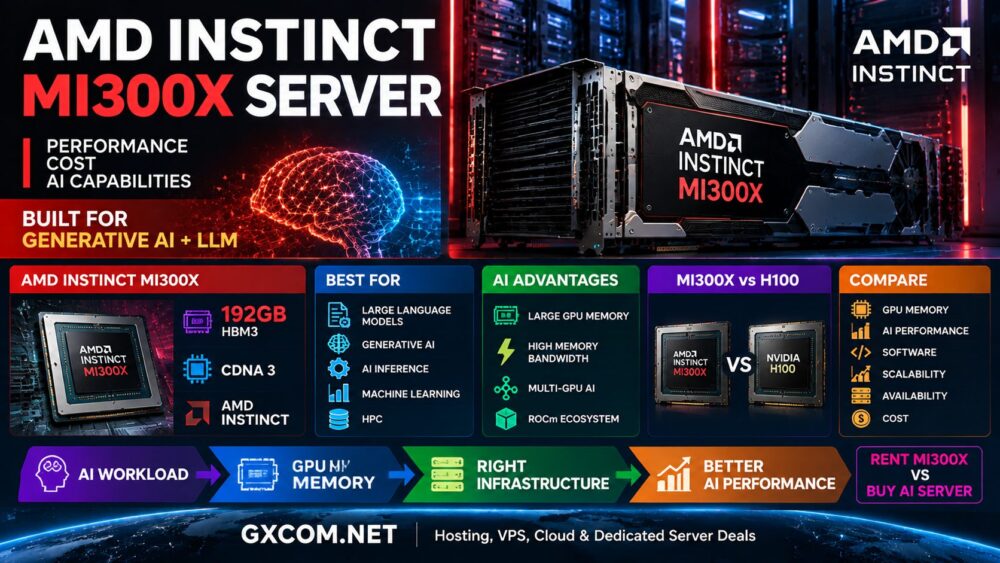
AMD Instinct MI300X at a Glance
| Feature | AMD Instinct MI300X |
|---|---|
| Architecture | AMD CDNA 3 |
| GPU Memory | 192GB HBM3 |
| Primary Market | AI and HPC |
| Best For | LLMs, Generative AI, Inference |
| Software Platform | AMD ROCm |
| Deployment | Single / Multi-GPU AI Infrastructure |
What Is the AMD Instinct MI300X?
AMD Instinct MI300X is a data center accelerator based on AMD's CDNA 3 architecture. It was designed specifically for demanding AI and high-performance computing workloads rather than conventional desktop graphics.
The accelerator targets workloads such as:
- Large language models
- Generative AI
- AI inference
- Machine learning
- Deep learning
- Natural language processing
- High-performance computing
Unlike consumer GPUs, MI300X is designed to operate as part of enterprise-class server infrastructure where memory capacity, bandwidth, multi-GPU communication, reliability, and software optimization are critical.
Why 192GB HBM3 Matters
One of the most important characteristics of MI300X is its 192GB of HBM3 memory.
GPU memory has become a major infrastructure constraint for modern AI because large models can require enormous amounts of memory for model weights, context, KV cache, intermediate calculations, and batch processing.
More accelerator memory can provide several potential advantages:
- Running larger models on fewer GPUs
- Supporting larger context sizes
- Increasing inference batch sizes
- Reducing model partitioning
- Simplifying some multi-GPU deployments
This does not automatically make MI300X faster for every workload, but it makes the accelerator particularly interesting for memory-intensive AI applications.
AMD MI300X for Large Language Models
Large language models are one of the primary use cases for MI300X servers.
LLM infrastructure must balance several resources:
- GPU compute performance
- GPU memory
- Memory bandwidth
- System RAM
- NVMe storage
- Inter-GPU communication
- Network bandwidth
For large-model inference, memory capacity can be especially important because fitting more of the model into accelerator memory can reduce dependence on slower system memory or complex model partitioning.
AMD MI300X for Generative AI
Generative AI extends far beyond chatbots. Modern workloads include text generation, multimodal models, AI assistants, content generation, code generation, and enterprise knowledge systems.
MI300X servers can be considered for:
- Generative AI platforms
- Enterprise LLM applications
- AI assistants
- Model serving
- AI API infrastructure
- Research and development
Organizations considering AMD infrastructure should verify that their models and software stacks are properly supported and optimized for ROCm before migrating production workloads.
AMD MI300X for AI Inference
Inference is an important use case because it often determines the ongoing cost of operating an AI application after the model has been trained.
Inference performance depends on more than raw GPU compute.
Important factors include:
- Model size
- Precision
- Batch size
- Context length
- GPU memory
- Memory bandwidth
- Inference framework
- Software optimization
The large memory capacity of MI300X can make it attractive for serving large models where memory requirements would otherwise require additional accelerators.
AMD MI300X Server Architecture
A production MI300X server includes much more than the accelerator itself.
A complete AI server typically combines:
- One or more MI300X accelerators
- High-core-count server CPUs
- Large system memory
- High-performance NVMe storage
- High-speed networking
- Enterprise power and cooling
- ROCm-compatible operating environment
For multi-GPU AI deployments, communication between accelerators becomes increasingly important as workloads scale across multiple devices.
AMD MI300X and ROCm
ROCm is AMD's software platform for GPU computing and represents one of the most important considerations when deploying MI300X infrastructure.
ROCm provides the software foundation for accelerated AI and HPC workloads, including libraries, development tools, compilers, and integration with popular machine-learning frameworks.
Before choosing MI300X, verify:
- ROCm version compatibility
- Operating system support
- Machine-learning framework support
- Model compatibility
- Container environment
- Required libraries
This is particularly important for organizations migrating applications originally built around NVIDIA CUDA.
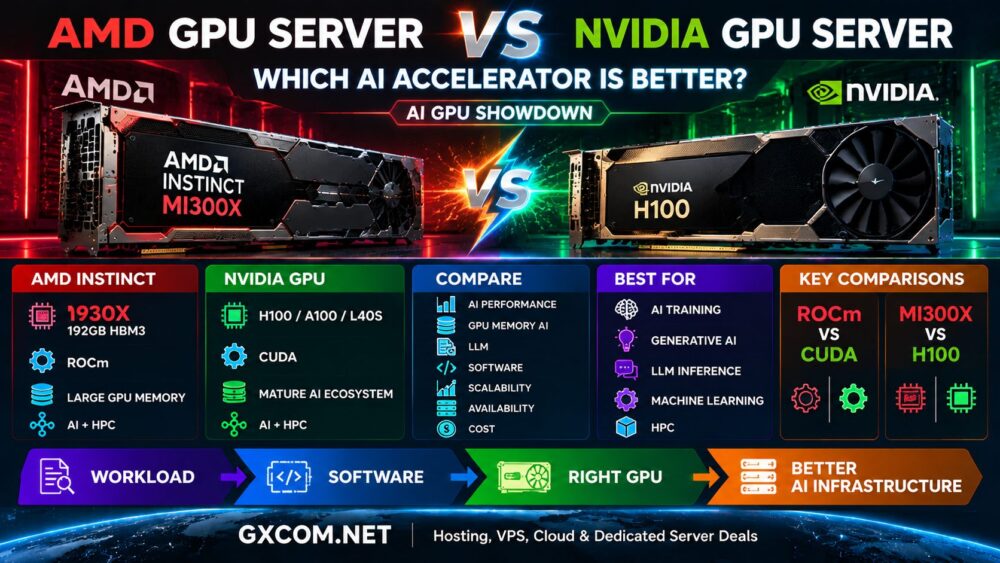
AMD MI300X vs NVIDIA H100
The MI300X is frequently compared with NVIDIA H100 because both target high-end AI infrastructure.
| Factor | AMD MI300X | NVIDIA H100 |
|---|---|---|
| Primary Market | AI / HPC | AI / HPC |
| Software Ecosystem | ROCm | CUDA |
| Memory Strength | Very large HBM capacity | High-performance HBM configurations |
| LLM Workloads | Strong fit | Strong fit |
| Provider Availability | More limited | Broader |
| Ecosystem Maturity | Growing | Highly established |
There is no universal winner because real-world performance depends on the model, framework, precision, optimization, server architecture, and workload.
If you are comparing NVIDIA alternatives as well, read our
Best NVIDIA GPU Servers
guide.
MI300X vs A100 and L40S
MI300X occupies a different position from many older or more specialized NVIDIA accelerators.
A100 remains widely used for machine learning and established AI workloads, while L40S combines AI acceleration with graphics-oriented capabilities.
MI300X is more directly targeted at high-end AI and memory-intensive large-model workloads.
For additional NVIDIA context, see:
H100 vs A100 vs L40S.
AMD MI300X Server Performance
GPU performance cannot be summarized by a single specification or benchmark.
Real-world MI300X performance depends on:
- AI model
- Training or inference workload
- Precision
- Batch size
- ROCm optimization
- Number of GPUs
- Memory utilization
- CPU performance
- Storage throughput
- Networking
For this reason, organizations evaluating MI300X should prioritize benchmarks using their actual models or representative workloads rather than relying only on theoretical performance figures.
How Much Does an AMD MI300X Server Cost?
There is no single MI300X server price because providers package GPU infrastructure differently.
Total cost depends on:
- Number of MI300X GPUs
- CPU configuration
- System RAM
- NVMe storage
- Network connectivity
- Server location
- Hourly or monthly billing
- Dedicated or cloud deployment
- Support and management
High-end AI servers also have significant power and cooling requirements, which are reflected in infrastructure pricing.
For a complete breakdown of AI infrastructure expenses, see our
AI Server Cost Guide.
Renting MI300X vs Buying an MI300X Server
| Factor | Rent MI300X | Buy MI300X Server |
|---|---|---|
| Upfront Cost | Lower | High |
| Deployment | Faster | Requires infrastructure |
| Scaling | More flexible | Hardware dependent |
| Ownership | No | Yes |
| Maintenance | Provider managed | Owner responsibility |
| Best For | Variable workloads | Stable long-term workloads |
Renting can be particularly useful for organizations that want to benchmark ROCm and MI300X performance before making a large capital investment.
See our
GPU Server Rental
guide for more information about hourly, monthly, cloud, and dedicated GPU rental models.
Where Can You Find MI300X Servers?
MI300X infrastructure is available through selected cloud platforms, AI infrastructure specialists, server vendors, and data center providers.
Availability is generally less widespread than many NVIDIA GPU configurations, so buyers should verify the exact hardware before choosing a provider.
Important questions include:
- Is the GPU actually MI300X?
- How many GPUs are included?
- Is the hardware dedicated?
- Which ROCm version is installed?
- What CPU and RAM are included?
- What storage performance is available?
- What network speed is included?
- Is pricing hourly or monthly?
MI300X for Startups
AI startups should be careful about purchasing high-end hardware too early.
During development, workload requirements can change rapidly. Renting MI300X infrastructure can allow teams to test model performance and memory requirements before committing to dedicated hardware.
For smaller projects, less expensive GPU infrastructure may still provide better value.
MI300X for Enterprise AI
Enterprise organizations may have different priorities, including:
- Predictable performance
- Data security
- Large model support
- Multi-GPU scaling
- Private infrastructure
- Technical support
- Long-term capacity planning
For these deployments, the complete server architecture matters as much as the MI300X accelerator itself.
MI300X Server Advantages
- 192GB HBM3 memory per accelerator
- Designed for modern AI workloads
- Strong fit for large language models
- ROCm-based open GPU computing ecosystem
- Suitable for inference and generative AI
- Alternative to NVIDIA-centric infrastructure
MI300X Server Limitations
- Provider availability can be more limited
- ROCm compatibility must be verified
- Some applications remain CUDA-dependent
- High-end infrastructure remains expensive
- Migration may require software optimization
Who Should Choose an MI300X Server?
MI300X is particularly relevant for:
- AI companies running large models
- Generative AI platforms
- Enterprise AI teams
- Machine-learning researchers
- Organizations evaluating alternatives to NVIDIA
- Memory-intensive AI inference
For a broader comparison across AMD's data center accelerator family, read:
Best AMD GPU Servers.
Final Thoughts
AMD Instinct MI300X has become an important option in the rapidly expanding AI infrastructure market.
Its 192GB HBM3 memory capacity makes it particularly interesting for large language models, generative AI, inference, and other memory-intensive workloads. At the same time, ROCm provides AMD with a growing software platform for AI and accelerated computing.
MI300X should not automatically be selected simply because it offers large GPU memory. Buyers should evaluate model compatibility, ROCm support, actual workload performance, provider availability, multi-GPU requirements, and total infrastructure cost.
For organizations whose software stack is compatible, MI300X servers can provide a serious alternative to NVIDIA-based AI infrastructure and expand the choices available for building high-performance AI systems.