Choosing the best managed cloud hosting provider can make a major difference to how efficiently you operate a website or online business. A well-managed hosting service can reduce routine server administration, simplify maintenance, and provide technical assistance when infrastructure problems occur.
But managed cloud hosting is not one standardized product.
Some providers offer fully managed virtual servers, while others provide managed cloud platforms with application-focused support. The differences can include operating system maintenance, security updates, backups, monitoring, software configuration, and the level of assistance available when something goes wrong.
That makes choosing the right provider more complicated than comparing CPU cores, RAM, and storage.
MORE RESOURCES ≠ BETTER MANAGED HOSTING.
In this guide, we compare three managed hosting options worth considering: ScalaHosting, Hostwinds, and UltaHost. We also explain how managed cloud hosting works, what management should include, how to evaluate performance, and when paying for managed infrastructure is actually worth it.
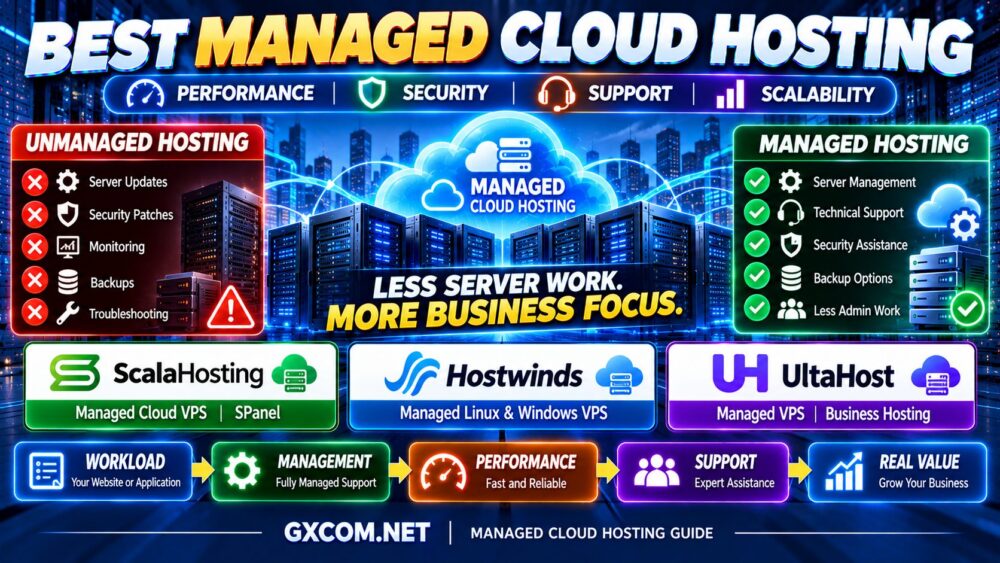
Best Managed Cloud Hosting Providers at a Glance
| Provider | Best For | Main Strength | What to Verify |
|---|---|---|---|
| ScalaHosting | WordPress, business websites, and agencies | Managed Cloud VPS with SPanel | Plan resources, management scope, and renewals |
| Hostwinds | Businesses wanting managed server options | Managed Linux and Windows VPS services | Selected service type and support responsibilities |
| UltaHost | Growing websites and small businesses | Managed VPS options and hosting assistance | Included features, backups, and renewal terms |
Quick recommendations:
- Best for managed WordPress and agency hosting: ScalaHosting
- Best for Linux and Windows managed VPS flexibility: Hostwinds
- Best for businesses seeking managed VPS convenience: UltaHost
These recommendations are based on service positioning and publicly described features, not independent benchmark testing. Actual performance, support quality, and included services can vary by plan.
What Is Managed Cloud Hosting?
Managed cloud hosting combines hosted computing resources with a defined level of administration and technical assistance from the provider.
Depending on the service, management may include:
- Operating system maintenance
- Security updates
- Server monitoring
- Web server configuration
- Control panel administration
- Backup management
- Performance troubleshooting
- Technical support
The important phrase is depending on the service.
Not every managed cloud hosting plan includes application development, WordPress plugin troubleshooting, malware cleanup, database optimization, or guaranteed recovery from every incident.
Always read the provider's management policy before purchasing.
Managed Cloud Hosting vs Traditional Web Hosting
Traditional shared web hosting typically places many customer websites on a common hosting environment with limited control over server configuration.
Managed cloud hosting or managed cloud VPS services may provide greater resource allocation, operating system flexibility, and administration support.
However, not every managed cloud product provides dedicated resources, automatic scaling, or high availability.
For a broader comparison of cloud-based hosting models, read our Best Cloud Hosting Solutions guide.
1. ScalaHosting — Best for Managed WordPress and Business Cloud Hosting
ScalaHosting is a strong candidate for businesses and website owners looking for managed virtual server hosting without handling every aspect of server administration themselves.
Its managed Cloud VPS offerings are particularly relevant to WordPress websites, online stores, agencies, and growing business applications.
Key Strengths
- Managed Cloud VPS hosting options
- SPanel hosting control panel
- WordPress-friendly hosting environment
- Server management assistance
- Resource configurations for different workloads
- Security and backup features that vary by plan
One distinguishing feature is SPanel, ScalaHosting's hosting control panel, which can help users manage websites, databases, email accounts, and other hosting functions.
For agencies and businesses accustomed to a control panel workflow, this can make server administration more approachable.
Who Should Choose ScalaHosting?
ScalaHosting is particularly worth considering for:
- WordPress business websites
- WooCommerce stores
- Website agencies
- Multiple-site hosting
- Businesses migrating from shared hosting
Its managed approach can be valuable when a business wants more control and resources than shared hosting provides but does not want to operate a server entirely on its own.
Potential Limitations
Managed hosting does not eliminate the need to maintain applications, plugins, and business data.
Review the precise support scope, backup policy, resource limits, and renewal terms for the selected plan.
Best fit: Managed WordPress, business websites, and agencies seeking a control-panel-oriented hosting environment.
2. Hostwinds — Best for Managed Linux and Windows VPS Flexibility
Hostwinds is worth considering for businesses that need managed virtual server hosting and want options across Linux and Windows environments.
Its managed VPS products are relevant to users who require more control than shared hosting while still valuing assistance with server administration.
Key Strengths
- Managed Linux VPS options
- Managed Windows VPS options
- Different CPU, RAM, and storage configurations
- Virtual server administration features
- Options for users with different technical requirements
- Hosting support and management services
Hostwinds can be particularly relevant when a business application depends on a specific operating system.
For example, Linux hosting is common for PHP applications, WordPress, and many open-source workloads, while Windows hosting may be required for particular Microsoft-oriented software.
Who Should Choose Hostwinds?
Consider Hostwinds if you need:
- Managed Linux hosting
- Managed Windows hosting
- Business application hosting
- Flexible virtual server resources
- Assistance with server-level administration
Its managed VPS offerings may be especially useful for organizations that want a virtual server without taking full responsibility for routine operating system maintenance.
Potential Limitations
Hostwinds offers different hosting products, and the management scope of one product should not be assumed to apply to another.
Verify the selected plan's operating system, storage technology, backup features, and support responsibilities.
Best fit: Businesses needing managed Linux or Windows virtual server hosting.
3. UltaHost — Best for Growing Websites Seeking Managed Hosting Convenience
UltaHost offers managed VPS hosting options that may appeal to businesses looking for more resources and control than traditional shared hosting.
Its product range is relevant to growing websites, eCommerce projects, and customers who prefer hosting services with administration assistance.
Key Strengths
- Managed VPS hosting options
- Linux and other hosting configurations depending on product
- NVMe-based storage offerings
- Website and application hosting
- Hosting support services
- Upgrade options for growing workloads
For a growing business website, the attraction is not simply obtaining more CPU or RAM. It is the combination of hosting resources and operational convenience.
Who Should Choose UltaHost?
UltaHost is worth evaluating for:
- Growing business websites
- WordPress installations
- Small online stores
- Users moving away from shared hosting
- Businesses without dedicated server administrators
Potential Limitations
Different UltaHost products may include different levels of management and different technical features.
Confirm which backup, security, migration, and support services are included in the plan you intend to purchase.

Also evaluate renewal pricing and any additional control panel or service costs.
Best fit: Small businesses and growing websites that want managed VPS convenience.
ScalaHosting vs Hostwinds vs UltaHost: Which Is Better?
The best choice depends on what you expect the provider to manage.
| Priority | Provider to Evaluate First | Reason |
|---|---|---|
| Managed WordPress and agencies | ScalaHosting | SPanel and managed Cloud VPS positioning |
| Managed Windows VPS | Hostwinds | Windows VPS product availability |
| Managed Linux business hosting | Hostwinds or ScalaHosting | Managed server options |
| Growing websites seeking managed VPS | UltaHost | Managed VPS product range |
Do not interpret this table as a performance ranking.
There is no reliable way to declare one provider universally faster without testing comparable configurations under the same workload.
What Should Fully Managed Cloud Hosting Include?
The phrase “fully managed” can sound reassuring, but it does not have an identical meaning across providers.
Before purchasing, ask the following questions.
Operating System Management
Does the provider install security updates, maintain system packages, and troubleshoot operating system problems?
Web Server Management
Will the provider help configure NGINX, Apache, LiteSpeed, PHP, or other supported software?
Security Management
Does management include firewall configuration, intrusion monitoring, malware investigation, or only basic server hardening?
Backup Management
Are backups included? How often are they created? How long are they retained? Can the provider restore them?
Application Support
Will support troubleshoot WordPress plugins, WooCommerce issues, application errors, or custom code?
Some managed hosting services focus primarily on server infrastructure rather than application-level problems.
Performance Optimization
Will support investigate slow PHP processes, database queries, caching configuration, and storage I/O?
These details can matter more than a general claim of 24/7 support.
Managed Cloud Hosting vs Unmanaged Cloud Hosting
Managed and unmanaged hosting can use similar underlying server resources. The major difference is who performs the administration.
| Feature | Managed Hosting | Unmanaged Hosting |
|---|---|---|
| Operating system maintenance | Provider assists within service scope | Customer responsibility |
| Security configuration | May be partially managed | Primarily customer responsibility |
| Application installation | Varies by provider | Customer responsibility |
| Technical flexibility | May have restrictions | Usually greater control |
| Administration effort | Generally lower | Generally higher |
| Service cost | Often higher | Often lower |
If you are comfortable administering Linux, configuring firewalls, and maintaining databases, unmanaged hosting may provide better direct infrastructure value.
If server administration would distract from running your business, managed hosting may justify its additional cost.
For a detailed explanation, see our Managed Hosting vs Unmanaged Hosting guide.
How Much CPU Does Managed Cloud Hosting Need?
CPU requirements depend on application behavior rather than the number of websites alone.
A cached WordPress blog can generate relatively little CPU activity, while a WooCommerce store or membership website may create many uncached requests.
| Workload | CPU Starting Point | Important Factor |
|---|---|---|
| Small Business Website | 2 vCPU | Caching and optimization |
| Growing WordPress Website | 2–4 vCPU | PHP and database load |
| Busy WooCommerce Store | 4–8 vCPU | Dynamic requests |
| Heavy Business Application | 4–8 vCPU+ | Concurrency and processing |
These figures are illustrative starting points, not performance guarantees.
4 vCPU ≠ 4 vCPU.
Processor generation, shared CPU contention, and application characteristics can significantly influence performance.
How Much RAM Do You Need?
RAM is used by the operating system, web server, PHP workers, database, caching services, and background processes.
For many small business websites, 4GB can be a reasonable starting point. Growing websites may benefit from 8GB, while heavier applications and databases can require 16GB or more.
However:
MORE RAM ≠ FASTER WEBSITE.
Additional RAM is useful when the application experiences genuine memory pressure.
If CPU is saturated while memory usage remains low, buying more RAM may produce little improvement.
Does NVMe Storage Matter for Managed Cloud Hosting?
NVMe can improve storage-related operations, especially for database-heavy applications.
Potential benefits include faster reads and writes, lower storage latency, and improved performance for I/O-sensitive workloads.
But NVMe does not automatically solve:
- Slow PHP execution
- Inefficient database queries
- Poorly optimized plugins
- Insufficient CPU resources
- Missing page caching
NVMe ≠ FAST WEBSITE BY ITSELF.
Always evaluate the complete application stack.
Best Managed Cloud Hosting for WordPress
WordPress is one of the most common reasons businesses upgrade from shared hosting to managed VPS or cloud hosting.
A managed environment may simplify server maintenance while providing more flexibility for:
- PHP configuration
- Database management
- Object caching
- SSL certificates
- Security updates
- Backup administration
However, WordPress speed also depends heavily on theme quality, plugin behavior, caching, and database efficiency.
For broader WordPress-specific infrastructure guidance, see our Best VPS for WordPress comparison.
Best Managed Cloud Hosting for WooCommerce
WooCommerce often creates more dynamic processing than a simple blog or content website.
Cart, checkout, account, and personalized session requests may bypass full-page caching.
For a busy store, prioritize:
- Consistent CPU performance
- Sufficient PHP workers
- Database efficiency
- Object caching
- Reliable backups
- Support that understands the hosting stack
A provider's management scope matters because not every support team will troubleshoot WooCommerce plugins or custom checkout problems.
Best Managed Cloud Hosting for Agencies
Agencies managing multiple client websites often value administrative convenience as much as raw server performance.
Important features include:
- Multiple website management
- Client account separation
- Backup and restore tools
- Control panel usability
- Security maintenance
- Migration assistance
- Support availability
ScalaHosting's SPanel approach can be relevant here, although agencies should verify specific account-management and isolation capabilities before purchasing.
As the number of hosted websites increases, consider whether separate VPS instances or stronger isolation would reduce operational risk.
Managed Cloud Hosting for High-Traffic Websites
High traffic does not always mean a website needs a very large server.
The more useful questions are:
- How many visitors arrive simultaneously?
- How many requests are dynamic?
- How much CPU does each request consume?
- Is the database becoming a bottleneck?
- How effective is caching?
A well-cached content website can handle substantial traffic with modest resources.
A smaller but highly dynamic application may need much stronger CPU and database performance.
TRAFFIC ≠ SERVER LOAD.
Cloud Infrastructure Does Not Automatically Mean High Availability
One of the most common misunderstandings about cloud hosting is the assumption that every cloud server automatically survives hardware failures without interruption.
That is not necessarily true.
A single managed VPS can still experience downtime caused by infrastructure failure, software problems, or maintenance.
True high availability may require:
- Redundant application instances
- Load balancing
- Database replication
- Independent failure domains
- Monitoring and failover procedures
Before relying on availability claims, review the provider's service architecture and SLA.
Managed Cloud Hosting Security: What Is Your Responsibility?
Managed hosting can reduce the customer's administration workload, but it does not remove every security responsibility.
Website owners should still maintain:
- Strong passwords and multifactor authentication
- Application and plugin updates where required
- Appropriate user permissions
- Secure application code
- Data protection policies
- Independent backup verification
Security is a shared responsibility, and the boundary depends on the provider's service agreement.
Managed Cloud Hosting Backups and Disaster Recovery
Backups should be treated as a purchasing requirement, not an optional afterthought.
Check:
- Backup frequency
- Retention period
- Off-server storage
- Restoration procedure
- Backup encryption
- Recovery time expectations
A snapshot is not necessarily a complete disaster recovery strategy.
For important websites, maintain a backup copy outside the primary hosting failure domain whenever practical.
How Much Does Managed Cloud Hosting Cost?
Managed hosting often costs more than unmanaged infrastructure because administration and support services are part of the offering.
But the lowest advertised price does not necessarily represent the lowest operating cost.
Consider:
- Base hosting subscription
- Management services
- Control panel licensing
- Backups
- Additional storage
- Bandwidth or traffic allowances
- Renewal pricing
- Migration costs
- Internal administration time
REAL HOSTING COST = HOSTING FEES + EXTRAS + ADMINISTRATION TIME + OPERATIONAL RISK
A more expensive managed plan may be economical when it replaces substantial administration work.
Conversely, an experienced system administrator may obtain better value from unmanaged hosting.
Managed Cloud Hosting vs Managed VPS: Is There a Difference?
The terms overlap, but they are not always interchangeable.
Managed VPS generally describes a virtual private server with an agreed level of administration support.
Managed cloud hosting may describe a broader platform that includes virtual compute, storage, networking, and managed hosting features.
However, providers use these terms differently.
The product name is less important than the actual infrastructure and service agreement.
For a more detailed comparison of cloud hosting and VPS infrastructure, read Cloud Hosting vs VPS.
When Is Managed Cloud Hosting Worth Paying For?
Managed cloud hosting can be worth the additional expense when:
- You do not have an experienced server administrator
- Your website generates meaningful business revenue
- You need help with operating system maintenance
- You manage multiple websites
- Server administration consumes too much time
- You want clearly defined infrastructure support
Unmanaged hosting may be more appropriate when:
- You already have Linux or Windows administration expertise
- You need unrestricted system customization
- You operate custom infrastructure automation
- You prefer to control every aspect of server maintenance
MANAGED HOSTING IS NOT ALWAYS FASTER. IT IS OFTEN EASIER TO OPERATE.
Common Managed Cloud Hosting Buying Mistakes
Assuming Fully Managed Means Everything Is Included
Application support, malware cleanup, backups, and custom software troubleshooting may have exclusions.
Choosing Based Only on RAM
More memory does not compensate for weak CPU performance or inefficient application code.
Ignoring Renewal Pricing
Introductory offers and standard renewal rates may differ. Evaluate long-term costs.
Assuming Cloud Means Automatic Failover
High availability requires specific technical architecture, not simply cloud branding.
Failing to Test Backups
A backup is only useful if it can be restored successfully.
Ignoring Support Scope
24/7 support availability does not mean every technical issue is covered.
Managed Cloud Hosting Buying Checklist
- ✓ Confirm what the provider manages
- ✓ Compare CPU quality and allocation
- ✓ Choose sufficient RAM
- ✓ Review SSD or NVMe storage
- ✓ Check backup and restoration policies
- ✓ Confirm server location
- ✓ Evaluate support responsibilities
- ✓ Review security features
- ✓ Check migration assistance
- ✓ Understand renewal pricing
- ✓ Verify scalability
- ✓ Review the SLA
- ✓ Calculate total operating cost
Best Managed Cloud Hosting FAQ
What is the best managed cloud hosting provider?
The best provider depends on the workload and support requirements. ScalaHosting is worth evaluating for managed WordPress and agency hosting, Hostwinds for managed Linux and Windows VPS options, and UltaHost for growing websites seeking managed VPS convenience.
Is managed cloud hosting worth it?
Managed hosting can be worth paying for when server administration consumes significant time or requires expertise your organization does not have. The value depends on the actual management scope and service quality.
What is the difference between managed and unmanaged cloud hosting?
Managed hosting includes provider administration services within a defined scope. Unmanaged hosting leaves most operating system and application maintenance responsibilities with the customer.
Is managed cloud hosting good for WordPress?
Yes. Managed hosting can simplify infrastructure maintenance for WordPress websites, although application performance still depends on caching, plugins, themes, and database optimization.
Does managed cloud hosting include backups?
Not always. Backup frequency, retention, restoration, and pricing vary by provider and plan. Verify the exact terms before purchasing.
Does managed cloud hosting guarantee uptime?
No hosting service can guarantee that failures will never occur. Review the provider's SLA, architecture, and recovery procedures rather than assuming managed cloud hosting includes automatic failover.
How much RAM does managed cloud hosting need?
Small websites may operate comfortably with a few gigabytes of RAM, while busy stores and applications may require 8GB, 16GB, or more. Actual memory usage should guide sizing.
Is managed cloud hosting faster than shared hosting?
It can be, particularly when the service provides stronger or more consistent resources. However, speed also depends on application optimization, caching, database performance, and network latency.
Can I upgrade managed cloud hosting later?
Many providers offer resource upgrades, but the available options and possible downtime vary. Confirm upgrade procedures before purchasing.
Final Verdict: Which Managed Cloud Hosting Provider Should You Choose?
The best managed cloud hosting provider is the one that combines suitable infrastructure with the level of administration your business actually needs.
ScalaHosting is a strong candidate for managed WordPress, agency, and business hosting where SPanel and server management are attractive.
Hostwinds is worth considering for businesses that want managed Linux or Windows virtual server options.
UltaHost can be a practical option for growing websites seeking managed VPS hosting and operational convenience.
Before choosing, follow this framework:
WORKLOAD → MANAGEMENT SCOPE → CPU → RAM → STORAGE → SECURITY → SUPPORT → TOTAL COST
Remember:
MORE RAM ≠ FASTER WEBSITE.
MANAGED ≠ ZERO RESPONSIBILITY.
CLOUD ≠ AUTOMATIC HIGH AVAILABILITY.
LOWEST PRICE ≠ LOWEST REAL COST.
Choose a managed cloud hosting service based on the resources, administration responsibilities, support capabilities, and long-term operating value that fit your website or business—not simply the largest advertised specifications.