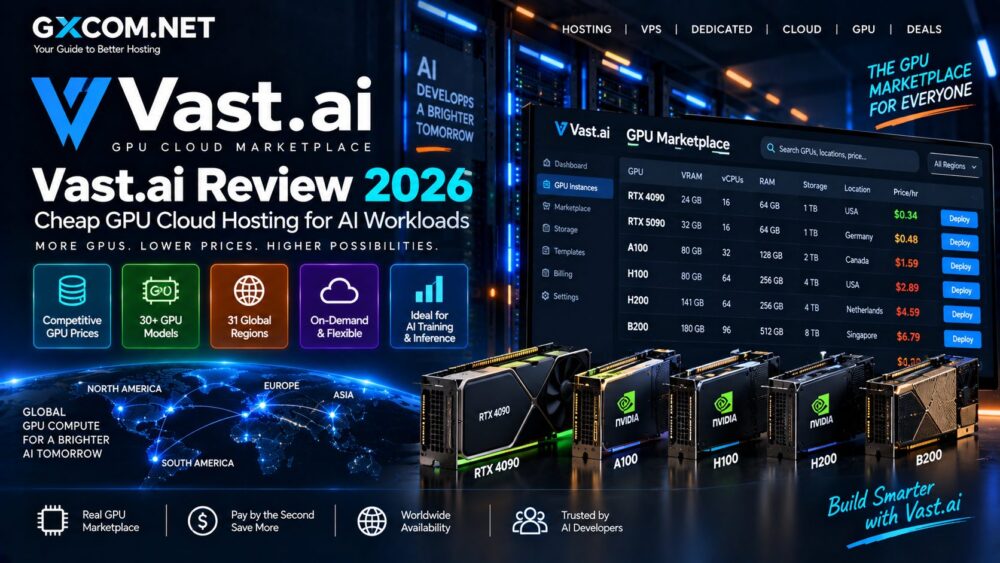
Renting powerful GPUs for artificial intelligence can become expensive quickly, particularly when a project requires dozens or hundreds of compute hours. Vast.ai takes a different approach from conventional GPU cloud providers by operating a marketplace where independent hosts and data centers compete to rent their GPU capacity. In this Vast.ai Review 2026, we examine GPU pricing, performance, RTX 4090 and H100 availability, reliability and whether the marketplace model really delivers cheaper AI compute.
The concept is attractive: instead of buying GPU capacity from one centralized cloud provider at standardized prices, users search a marketplace containing machines with different GPUs, CPUs, storage, network connections, reliability scores and prices.
This competition can produce unusually inexpensive GPU instances. It also means customers need to evaluate individual offers more carefully than they would on a standardized cloud platform.
Last updated: September 2026. Vast.ai is a live marketplace. GPU prices, availability and individual host specifications can change continuously, so examples in this review should be treated as market snapshots rather than guaranteed future prices.
Vast.ai Review 2026: Quick Overview
| Feature | Vast.ai |
|---|---|
| Platform Type | GPU compute marketplace |
| Primary Focus | AI, machine learning and GPU workloads |
| GPU Selection | Large range of consumer and data-center GPUs |
| Pricing | Marketplace-based and dynamic |
| Rental Options | On-demand and other marketplace contract types |
| Deployment | Container-based GPU instances |
| Best For | Cost-conscious AI developers and researchers |
| Main Advantage | Potentially very low GPU rental prices |
| Main Drawback | Hardware quality and reliability vary between listings |
What Is Vast.ai?
Vast.ai is a marketplace connecting people and organizations that need GPU compute with hosts that have available GPU hardware.
This is fundamentally different from renting an instance from a conventional centralized cloud provider.
A Vast.ai search can return machines from different locations with dramatically different:
- GPU configurations
- CPU performance
- System RAM
- SSD speed
- PCIe bandwidth
- Internet speed
- Reliability scores
- Maximum rental duration
- Hourly prices
This flexibility is one reason Vast.ai can offer compelling prices, but it also makes selecting an instance more technical.
If you are still researching the wider market, our GPU cloud providers section covers other AI infrastructure options.
How the Vast.ai GPU Marketplace Works
Hosts list available GPU machines on the marketplace. Customers search and filter those machines according to their workload requirements.
The platform exposes considerably more hardware information than a simple list of GPU models.
Depending on the offer, users can examine metrics such as:
- GPU count and VRAM
- CUDA version
- CPU cores
- System memory
- PCIe bandwidth
- Storage capacity and speed
- Download and upload bandwidth
- Host reliability
- Maximum instance duration
- Deep-learning performance
For experienced users, this creates an opportunity to find machines optimized for a specific workload rather than paying for unnecessary resources.
Vast.ai GPU Performance
There is no single Vast.ai performance result because Vast.ai does not represent one standardized server architecture.
Two machines containing the same RTX 4090 can have different CPUs, storage speeds, PCIe configurations and network performance.
That distinction matters.
A GPU-heavy inference workload may care primarily about GPU compute and VRAM, while a data-intensive training job can also depend heavily on storage throughput and CPU performance.
When comparing offers, check the complete machine rather than filtering only by GPU model.
GPU Selection on Vast.ai
One of the strongest characteristics of Vast.ai is hardware variety.
The marketplace can contain both consumer and professional NVIDIA GPUs, including popular hardware such as:
- RTX 3090
- RTX 4090
- RTX 5090
- RTX A6000
- A40
- A100
- H100
- H200
- Newer accelerator configurations as hosts add hardware
The exact inventory changes because hosts independently add and remove capacity.
Vast.ai RTX 4090 Pricing
RTX 4090 is particularly interesting for developers seeking strong AI performance without paying data-center GPU prices.
When checked in September 2026, verified RTX 4090 offers on the Vast.ai marketplace demonstrated how widely prices can vary.
Single-GPU listings included examples around:
- $0.36 per hour
- $0.43 per hour
- $0.61 per hour
- $0.68 per hour
- $0.75 per hour
Other offers were considerably more expensive.
The difference reflects more than the GPU itself. Location, CPU resources, storage, network performance, reliability and host pricing all influence the offer.
This is why quoting one permanent “Vast.ai RTX 4090 price” can be misleading.
Why Vast.ai Prices Change
Pricing is central to any Vast.ai Review 2026, but the marketplace model makes it different from a conventional GPU provider.
Vast.ai itself explains that cloud GPU rental prices depend on factors including:
- GPU model
- Current supply
- Current demand
- Rental type
- Available hosts
This means an instance that looks exceptionally cheap today may disappear tomorrow.
Conversely, additional hosts entering the market can create new lower-cost offers.
Cheap GPU Cloud: What Should You Actually Compare?
Sorting exclusively by hourly price is one of the easiest mistakes to make on a GPU marketplace.
Imagine two RTX 4090 machines:
| Specification | Server A | Server B |
|---|---|---|
| GPU | RTX 4090 | RTX 4090 |
| Hourly Price | Lower | Higher |
| Storage | Slower | Fast NVMe |
| Network | Limited | High bandwidth |
| Reliability | Lower | Higher |
If Server B completes the workload faster or avoids interruptions, the higher hourly price can still produce a better overall result.
Vast.ai Reliability
Reliability deserves more attention on Vast.ai than on a highly standardized centralized cloud.
The marketplace displays host reliability information that can help customers evaluate machines before renting them.
Current verified listings can show reliability scores above 99%, but that does not mean every machine has identical infrastructure quality.
For experiments, development and disposable workloads, accepting more infrastructure variation may be reasonable in exchange for a lower price.
Production applications should apply stricter filters.
Verified Machines
Vast.ai allows users to filter for verified machines.
This can be useful when customers want to narrow the marketplace rather than evaluating every available host.
Verification should still be considered alongside:
- Reliability
- Maximum rental duration
- Storage performance
- Network speed
- GPU configuration
No single marketplace metric should replace evaluating the full offer.
Vast.ai for AI Training
Low GPU prices can make Vast.ai attractive for model training, particularly when workloads can tolerate flexible infrastructure.
Potential applications include:
- LLM fine-tuning
- Computer vision training
- Diffusion models
- Research experiments
- Embedding workloads
- Machine-learning development
For larger distributed training jobs, buyers should pay close attention to multi-GPU topology, PCIe or NVLink performance and the consistency of the underlying system.
Vast.ai for AI Inference
Inference can be another strong use case, especially when a model fits comfortably on consumer GPUs.
For example, a 24 GB RTX 4090 can handle many quantized models and image-generation workloads without requiring H100-class infrastructure.
For larger models, users can search for GPUs with more VRAM.
Matching model requirements to GPU memory is often more cost-effective than automatically selecting the most powerful accelerator.
Vast.ai for Stable Diffusion and Image Generation
Image-generation workloads are particularly well suited to marketplace GPU infrastructure.
RTX 3090, RTX 4090 and RTX 5090 systems can offer substantial compute performance while avoiding the hourly rates associated with high-end data-center accelerators.
For temporary generation jobs, this can make renting far more practical than purchasing a high-end GPU workstation.
Vast.ai Templates and Containers
Vast.ai workloads generally run in containerized environments.
Users can deploy templates containing common AI software rather than manually configuring every component from scratch.
Container-based deployment is useful for reproducibility, but new users should still understand basic concepts such as Docker images, storage volumes, ports and SSH access.
Storage and Bandwidth Costs
The displayed GPU rental rate is not necessarily the entire cost of running an instance.
Vast.ai listings can include storage and bandwidth charges, and these vary between hosts.
This is particularly important when working with:
- Large model weights
- Training datasets
- Checkpoints
- Generated images or video
- Frequent data transfers
Always inspect the complete offer before starting a long-running workload.
Vast.ai vs RunPod
Vast.ai and RunPod both appeal to cost-conscious GPU users, but they approach infrastructure differently.
Vast.ai emphasizes an open marketplace where individual offers can vary substantially in price and hardware characteristics.
RunPod provides a more structured GPU cloud experience through products such as Pods, Serverless and Clusters.
Vast.ai can reward users willing to search and evaluate marketplace listings carefully. RunPod may appeal to developers who prefer a more standardized product structure.
Read our RunPod Review 2026 for the full analysis.
Vast.ai vs Lambda GPU Cloud
Lambda takes another approach, focusing heavily on AI infrastructure built around NVIDIA GPU systems and larger-scale training environments.
Vast.ai's marketplace can expose a much wider variety of individual machines and price points.
The trade-off is consistency. Lambda's infrastructure is more provider-controlled, while Vast.ai customers select from independently operated marketplace hosts.
Our Lambda GPU Cloud Review examines that alternative in detail.
Vast.ai vs Dedicated GPU Server
Marketplace GPU rental avoids purchasing expensive hardware upfront and is particularly attractive when compute demand is temporary.
Continuous workloads require a different calculation.
If a GPU needs to operate nearly 24 hours a day for months, dedicated hardware can sometimes produce a lower long-term cost.
See our GPU Server vs Cloud GPU comparison before committing a permanently busy workload to hourly cloud pricing.
Vast.ai Pros & Cons
| Pros | Cons |
|---|---|
| Potentially very low GPU prices | Prices change continuously |
| Large variety of hardware | Machine quality varies between hosts |
| Consumer and data-center GPUs | More technical selection process |
| Detailed hardware filters | Storage and bandwidth can add costs |
| Useful reliability information | Availability is not standardized |
| Good fit for experiments and research | Production workloads require careful host selection |
Who Should Consider Vast.ai?
Vast.ai is particularly attractive to users who prioritize GPU price and are comfortable evaluating technical specifications.
Good candidates include:
- AI developers
- Machine-learning researchers
- Students
- AI startups
- Stable Diffusion users
- LLM experimenters
- Developers running temporary GPU workloads
Who May Prefer an Alternative?
Teams that want identical hardware, standardized infrastructure and highly predictable deployments may prefer a more centralized GPU cloud.
Enterprise workloads with strict infrastructure requirements should also evaluate the exact host, location and reliability characteristics carefully.
For permanently utilized infrastructure, compare marketplace rentals with dedicated GPU servers before making a long-term decision.
Vast.ai Review 2026: Final Verdict
Our Vast.ai Review 2026 shows why the platform attracts cost-conscious AI developers. Its marketplace model creates competition between GPU hosts and can expose RTX 4090, RTX 5090, A100, H100 and other accelerators at highly competitive hourly rates.
The same marketplace structure is also its biggest trade-off. Two listings with the same GPU can differ substantially in CPU resources, storage, network performance, reliability and maximum rental duration.
Vast.ai therefore works best for users who are willing to evaluate infrastructure rather than selecting an instance based only on the GPU name.
For experiments, fine-tuning, image generation, AI research and temporary inference workloads, the ability to shop dynamically for inexpensive compute can be extremely useful.
For production workloads, prioritize reliability and total infrastructure quality over the absolute lowest hourly rate.
Used carefully, Vast.ai can be one of the more interesting marketplaces to include when comparing GPU server deals and AI compute options.