Cloud disaster recovery costs depend on how quickly an application must recover, how much data it can lose, and which resources remain available during an outage. A cheap backup plan may be sufficient for a low-priority website, while a business-critical database may justify a continuously running secondary environment.
This guide compares backup and restore, pilot light, warm standby, and active-active architectures. It also explains replication traffic, backup retention, recovery testing, and how to calculate a realistic disaster recovery budget.
Start With RTO and RPO, Not Server Prices
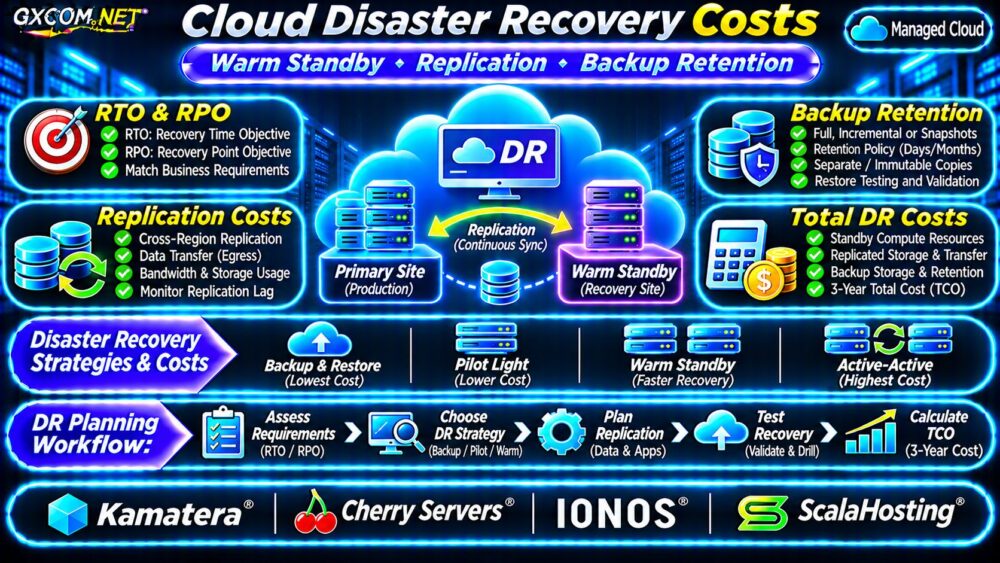
Recovery time objective (RTO) is the targeted maximum duration of service interruption. Recovery point objective (RPO) defines the acceptable age of recovered data. A four-hour RTO and one-hour RPO require different investments from a system targeting minutes.
Define these objectives separately for applications, databases, and external integrations. Recovery targets are planning requirements, not guarantees supplied automatically by cloud hosting.
Compare Four Cloud Disaster Recovery Strategies
| Strategy | Recovery Environment | Typical Cost Position |
|---|---|---|
| Backup and restore | Rebuild after an incident | Lowest ongoing infrastructure |
| Pilot light | Core data and services maintained | Moderate ongoing resources |
| Warm standby | Smaller functioning application stack | Higher recurring capacity |
| Active-active | Multiple sites serve production traffic | Highest complexity and capacity |
Backup and Restore
Maintain recoverable copies in a separate failure domain and provision infrastructure after an incident. This reduces idle compute spending but increases recovery time because servers, applications, and databases must be rebuilt and validated.
Pilot Light
Keep critical data or core services available at the recovery location while deploying remaining application capacity when needed. Replication and essential storage still incur charges even when application servers are absent.
Warm Standby
Operate a scaled-down, functional copy of production. During an outage, promote or scale the recovery environment and redirect traffic. Unlike pilot light, warm standby can already process requests at reduced capacity, although scaling and cutover still take time.
Active-Active
Run production traffic across multiple sites. This can reduce dependence on a single location but adds capacity, routing, database consistency, and operational complexity. It does not eliminate the need for independent backups.
Our cloud VPS high availability guide explains the distinction between redundancy and recovery planning.

What Does Warm Standby Actually Cost?
A standby server is not necessarily free because it receives little traffic. Budget for its running compute, replicated database, persistent storage, load balancing or DNS services, monitoring, security updates, and periodic scaling tests.
Capacity must be sufficient to operate essential functions immediately after failover. If the standby environment cannot serve the expected emergency load, the recovery plan must include tested scaling procedures and realistic provisioning delays.
Use separate estimates for normal standby operation and temporary full-capacity operation during incidents or drills. Provider billing may change when additional instances or storage volumes are created.
Replication Traffic and Database Consistency
Cross-region replication can incur outbound transfer charges, receiving-side storage costs, and database service fees. Replication volume depends on changed data, not simply the original database size.
For illustration, 30 GB of changes replicated daily represents approximately 900 GB transferred over thirty days. This is a traffic estimate, not a price quote. Compression, retries, snapshots, and replication architecture can change the actual volume.
Asynchronous replication can lag behind production. Monitor replication delay and test whether the achieved recovery point meets the business RPO. Synchronous replication has different latency and availability tradeoffs.
Replication can also propagate accidental deletion or corruption. Maintain separate, protected recovery points rather than treating a replica as a complete backup strategy.
Backup Retention: Storage Costs Accumulate
Retention policies determine how many recovery points remain available. Daily backups retained for seven days generally consume less storage than daily, weekly, and monthly copies kept for a year, but actual consumption depends on changed blocks, deduplication, and compression.
Estimate storage using retained full backups plus incremental changes, then include cross-location copies, retrieval charges, and minimum storage durations where applicable.
Protect important copies with separate credentials, restricted deletion permissions, and immutability where supported. Verify application-consistent database recovery and avoid deleting older backups before testing newer ones.
Our VPS snapshot and backup recovery guide compares recovery limitations and independent storage.
Illustrative Monthly and Three-Year DR Budget
Consider a hypothetical warm standby environment with $45 in standby compute, $25 in replicated storage, $12 in backup retention, $8 in network services, and $30 in monitoring and administration each month.
| Illustrative Component | Monthly Cost |
|---|---|
| Standby compute | $45 |
| Replicated storage | $25 |
| Backup retention | $12 |
| Network services | $8 |
| Monitoring and administration | $30 |
| Total | $120 |
The recurring total is $1,440 annually or $4,320 over thirty-six months, assuming unchanged usage and rates. Add one-time setup, recovery drills, temporary full-scale compute, software licenses, taxes, and incident response before estimating complete ownership costs.
These numbers are hypothetical and are not quotations from any provider. Our cloud server cost optimization guide offers broader budgeting techniques.
Four Approved Providers to Evaluate
Kamatera: Configurable Recovery Compute
Kamatera offers configurable cloud servers and an optional daily backup service. Evaluate whether the selected locations, networking, retention, and support scope meet your recovery requirements. Do not assume its standard backup option provides a complete warm standby architecture.
Cherry Servers: Independent Backup Storage
Cherry Servers documents backup storage separate from its server infrastructure for eligible products and regions. Check geographic availability, capacity, access method, and restoration procedures before designing an offsite recovery plan.
IONOS: Cloud Infrastructure Components
IONOS is a candidate for comparing compute, storage, and network resources. Verify region availability, backup products, transfer policies, and whether the selected architecture requires customer-managed failover.

ScalaHosting: Managed Server Support
ScalaHosting may suit teams seeking assistance with server operations. Confirm backup retention, restoration assistance, geographic independence, and responsibility for recovery testing in the actual service agreement.
Recovery Testing and Hidden Operational Costs
A disaster recovery design is incomplete until teams test restoration, application dependencies, DNS changes, user authentication, and database consistency. Exercises can temporarily increase compute, storage, and transfer bills.
Schedule realistic drills, record achieved RTO and RPO, and update procedures after infrastructure changes. Budget for staff time and the possibility that test environments need production-like capacity.
For backup product comparisons, see our managed cloud backup costs guide.
Frequently Asked Questions
Is Warm Standby Cheaper Than Active-Active?
Often, because standby capacity is smaller during normal operation. Actual costs depend on workload size, replication, licensing, and recovery objectives.
Can Replication Replace Backups?
No. Replication can copy unwanted changes or corrupted data. Keep independent recovery points with tested retention and restoration procedures.
Final Verdict
Cloud disaster recovery costs should follow business-defined RTO and RPO targets. Backup and restore minimizes ongoing infrastructure, pilot light retains critical components, and warm standby trades higher recurring spending for faster recovery readiness.
Compare Kamatera, Cherry Servers, IONOS, and ScalaHosting against documented product capabilities. Choose a recovery design that your team can actually test, operate, and afford.