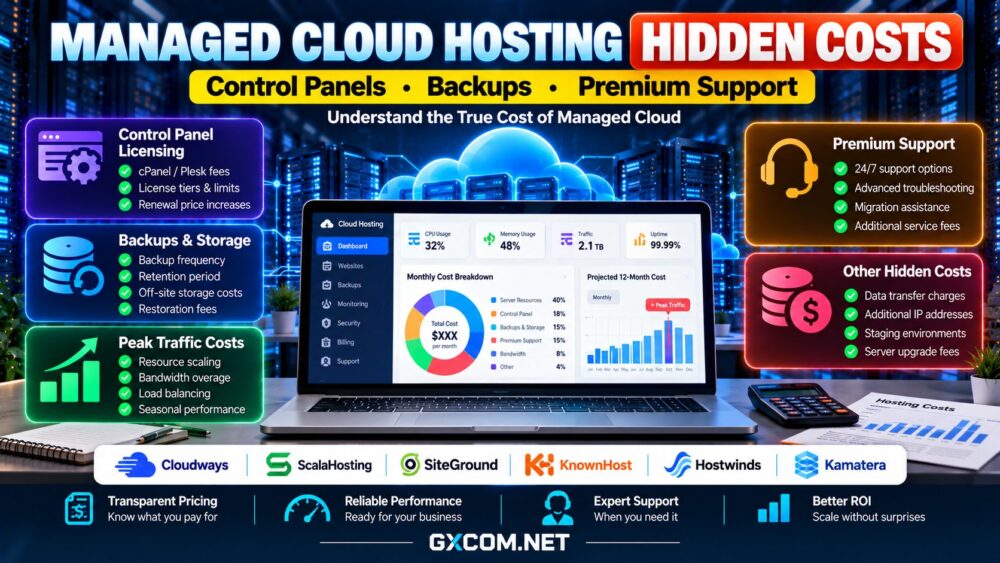
The advertised monthly price is only the starting point when comparing managed cloud hosting hidden costs. Control panel licenses, backup retention, additional storage, premium support, and network usage can change what a business actually spends. Two plans with similar computing resources may produce very different bills because their management services are packaged differently.
This guide explains where extra charges originate, how to question providers before checkout, and how to calculate a realistic annual budget. It also examines Cloudways, ScalaHosting, KnownHost, Hostwinds, and Kamatera through the lens of billing transparency rather than headline discounts.
Why the Base Hosting Price Can Be Misleading
A hosting advertisement may describe server resources while excluding software licenses, off-site backups, specialist support, or taxes. Introductory promotions and longer billing commitments can further complicate comparisons. The cheapest entry price does not necessarily mean the lowest operating cost.
Start by identifying whether a product is a managed application platform, a managed VPS, or an infrastructure service requiring separate administration. Management boundaries affect both invoices and the amount of work your team must perform. Our managed cloud hosting comparison provides a broader framework for evaluating those differences.
Control Panel Licensing and Administration Fees
Some hosting packages include a proprietary dashboard, while others use separately licensed software such as cPanel or Plesk. License costs may depend on the server, account count, license tier, or billing arrangement. A control panel included in one package should not be assumed free on another.
Ask whether the quoted amount includes the required panel, additional accounts, security extensions, and future license adjustments. Agencies managing many websites should pay particular attention to account-based limits and the cost of adding customers.
There is also a labor trade-off. A familiar panel can reduce routine administration time, but paying for tools nobody uses wastes money. Compare the cost of the license with the operational value of its automation, access controls, and backup integration.
Backups, Snapshots, and Restoration Charges
Backup pricing deserves a separate line in every comparison. Providers may bundle a limited retention period, offer paid backup schedules, charge for additional storage, or treat snapshots differently from recoverable application backups.
Check backup frequency, retention, storage location, encryption, and the ability to restore individual files or databases. Ask whether a restore operation involves a service fee and whether emergency assistance falls within standard support. A backup that has never been tested is an uncertain recovery strategy.

Snapshot charges may increase as disk usage grows. Keeping multiple full copies of large databases can create a recurring expense, especially when retention periods expand. Before buying more backup capacity, define a recovery point objective and decide which information truly requires frequent protection.
Premium Support and the Meaning of Managed
Managed hosting does not have one universal definition. A provider might maintain the operating system and network while leaving WordPress plugins, custom code, malware investigation, or database optimization to the customer.
Some services offer additional support tiers, paid migrations, priority escalation, or separately scoped professional work. Confirm whether around-the-clock assistance applies to infrastructure incidents, application failures, or both. An advertised response target is not the same as a guaranteed resolution time.
Request a responsibility matrix before purchase. Identify who installs security patches, investigates slow queries, restores backups, manages DNS, and communicates during outages. For more detail, see our managed cloud hosting support guide.
Bandwidth, Storage, and Scaling Expenses
Traffic allowances can hide important distinctions between inbound transfer, outbound transfer, private networking, and overage billing. A website delivering large media files may consume far more bandwidth than a small business blog with similar visitor counts.
Storage costs also depend on the type of disk, capacity, snapshots, and backup replication. Moving to a larger server may increase more than CPU and memory charges if the new configuration changes storage or licensing requirements.
Ask whether resizing is billed immediately, whether unused resources remain chargeable, and how additional IP addresses or load balancers are priced. Compare alternative purchasing models in our cloud hosting deals and offers guide.
Five Providers to Compare for Total Hosting Cost
Cloudways: Platform Convenience Versus Add-On Spending
Cloudways suits buyers evaluating an application-focused managed cloud platform. Review the current pricing page for included management, backup settings, monitoring, optional services, and support levels. Its convenience may reduce internal administration time, but calculate the complete configuration rather than comparing only server size.
ScalaHosting: Managed VPS and Control Panel Value
ScalaHosting is relevant when comparing managed VPS-style hosting and bundled management tools. Check which control panel is included with the selected plan, how backups are provided, and whether any requested software or migration work costs extra. Verify renewal pricing and the resources available after upgrades.
KnownHost: Included Management and Support Boundaries
KnownHost deserves consideration for businesses prioritizing managed server assistance. Examine the exact product’s control panel, backup arrangements, support scope, and renewal terms. Request clarification about tasks that fall outside standard management, particularly application-level troubleshooting and restoration.
Hostwinds: Configuration and Optional Services
Hostwinds provides hosting configurations worth evaluating for buyers comparing management and infrastructure choices. Confirm which services are included with the chosen product and which require separate purchases, including backups, licenses, and additional technical assistance. Avoid comparing unlike plans solely by their advertised monthly prices.
Kamatera: Flexible Infrastructure and Management Choices
Kamatera is useful as a comparison point for configurable cloud infrastructure. Buyers should distinguish server resource charges from any selected managed services, operating-system licenses, storage, and backup options. Flexible configuration can help align resources with demand, but it also requires careful cost monitoring.
Build a Twelve-Month Total Cost Estimate
Use a simple formula: annual hosting cost equals infrastructure, licenses, backups, support, network overages, and internal administration, adjusted for promotions and renewal changes. Include expected scaling during busy periods and one-time migration or setup expenses.

For example, suppose a hypothetical plan costs $45 monthly, a panel costs $12, backups cost $10, and premium support costs $18. The recurring total is $85 per month, or $1,020 annually before taxes and labor. If migration costs another $150, first-year spending becomes $1,170. These numbers illustrate the calculation; they are not provider quotations.
Compare the result against an unmanaged alternative only after assigning a reasonable value to administrator time. Our managed versus unmanaged hosting guide explains that operational trade-off.
Questions to Ask Before Checkout
Request an itemized quote showing initial and renewal rates, billing terms, included panel licenses, backup limits, support exclusions, bandwidth allowances, and cancellation rules. Ask whether promotional credits expire and how invoices change after a resource upgrade.
Save the quote and service description alongside the contract. If the provider cannot explain a potential charge clearly, treat that uncertainty as part of the purchasing risk rather than assuming the service is included.
Final Verdict: Compare the Complete Bill
The most important managed cloud hosting hidden costs are often attached to services businesses consider essential: administration tools, recoverable backups, and responsive support. Cloudways, ScalaHosting, KnownHost, Hostwinds, and Kamatera offer different operating models, so the right choice depends on the exact configuration and responsibilities purchased.
Build a twelve-month estimate, verify exclusions in writing, and prioritize predictable recovery and support over the lowest advertised starting price. A transparent hosting plan is easier to budget for and safer to scale.