Choosing between managed cloud and self managed cloud is an important decision for businesses that want to use cloud infrastructure without unnecessary complexity.
Both solutions provide access to powerful cloud resources, but they differ significantly in server management, technical requirements, security responsibilities, pricing and support.
This guide compares managed cloud vs self managed cloud to help you understand which solution is better for your website, application or business.
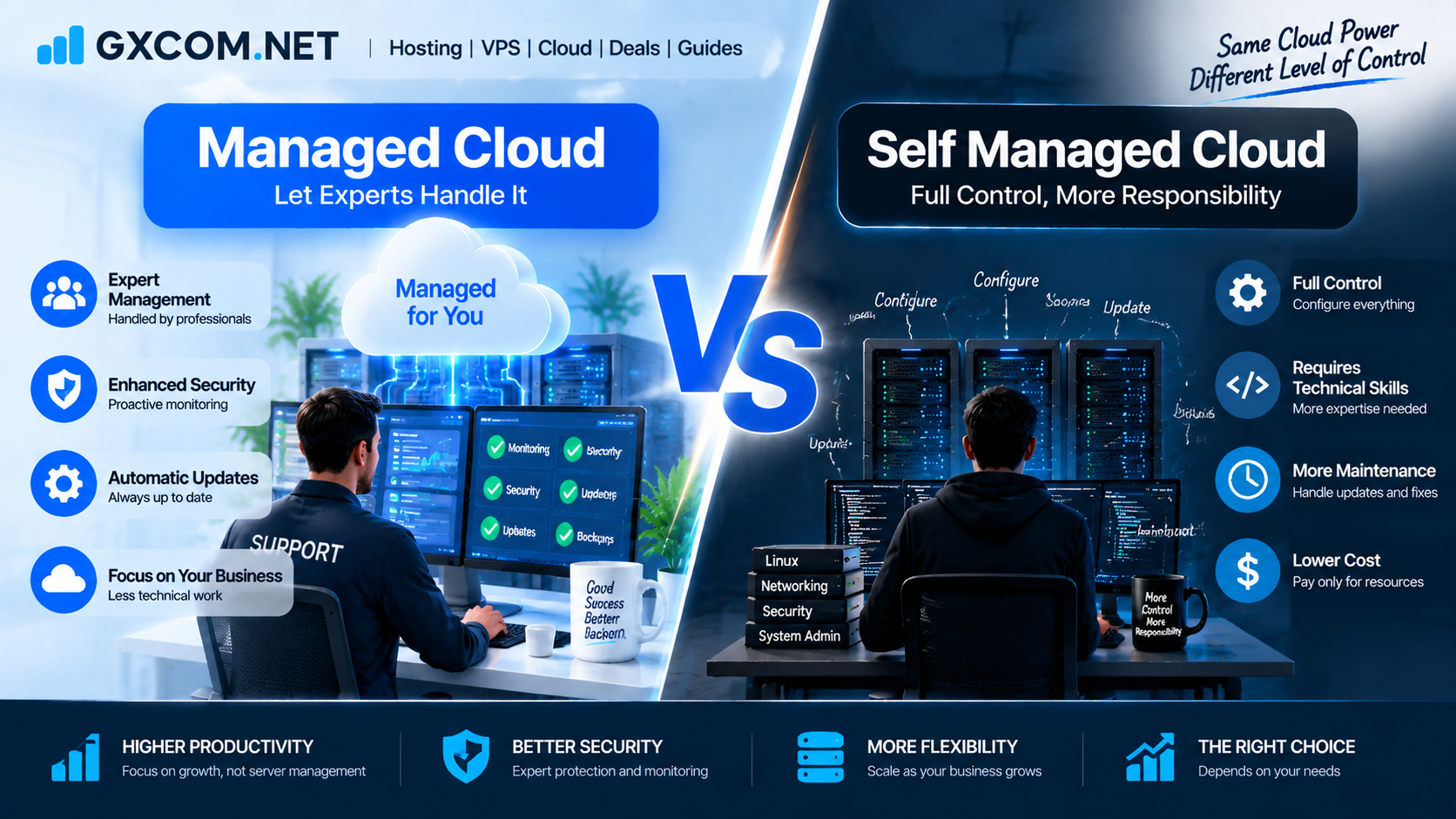
Quick Comparison: Managed Cloud vs Self Managed Cloud
| Feature | Managed Cloud | Self Managed Cloud |
|---|---|---|
| Server Management | Provider handles maintenance | User manages everything |
| Technical Skills | Lower requirements | Advanced skills needed |
| Control | Limited but easier | Full control |
| Cost | Higher | Lower |
| Support | Professional assistance | Limited provider support |
What Is Managed Cloud Hosting?
Managed cloud hosting is a service where a cloud provider takes responsibility for server operations, maintenance and technical management.
The provider typically handles:
- Server monitoring
- Security updates
- Performance optimization
- Backup management
- Technical troubleshooting
Users who want easier cloud management can explore our best managed cloud hosting providers guide.
What Is Self Managed Cloud Hosting?
Self managed cloud hosting gives users complete responsibility for configuring and maintaining their cloud servers.
The user manages:
- Operating system configuration
- Security settings
- Software installation
- Server optimization
- Troubleshooting
This option provides maximum flexibility but requires stronger technical knowledge.
Main Differences Between Managed Cloud and Self Managed Cloud
1. Server Management Responsibility
The biggest difference is who manages the cloud environment.
With managed cloud hosting, the provider handles most technical tasks.
With self managed cloud, the customer is responsible for administration and maintenance.
2. Technical Requirements
Managed cloud solutions are designed for users who want cloud performance without becoming server administrators.
Self managed cloud is better suited for developers and technical teams with Linux, networking and security experience.
3. Control and Customization
Self managed cloud provides greater control because users can configure almost every aspect of the server environment.
Managed cloud provides easier operation but may limit some advanced customization options.
4. Security Responsibility
Security responsibilities are different between the two solutions.
| Security Task | Managed Cloud | Self Managed Cloud |
|---|---|---|
| Updates | Provider managed | User managed |
| Monitoring | Included | User setup required |
| Backups | Usually available | User configuration required |
| Protection | Professional support | User responsibility |
Performance Comparison
| Feature | Managed Cloud | Self Managed Cloud |
|---|---|---|
| Performance | Optimized by experts | User controlled |
| Scalability | Easy | Requires technical management |
| Configuration | Simplified | Highly customizable |
Advantages of Managed Cloud
- Less technical workload
- Professional support
- Better security management
- Faster deployment
- Suitable for businesses
Disadvantages of Managed Cloud
- Higher monthly cost
- Less server-level control
- Some customization limitations
Advantages of Self Managed Cloud
- Complete server control
- Lower cost
- Maximum customization
- Suitable for developers
Disadvantages of Self Managed Cloud
- Requires technical expertise
- More maintenance work
- Security management responsibility
Who Should Choose Managed Cloud?
Managed cloud hosting is suitable for:
- Small businesses
- Ecommerce websites
- Agencies
- Companies without server teams
- Website owners who value convenience
Who Should Choose Self Managed Cloud?
Self managed cloud is suitable for:
- Developers
- System administrators
- Technology companies
- Custom applications
- Users needing full control
Managed Cloud vs Self Managed Cloud: Cost Comparison
| Cost Factor | Managed Cloud | Self Managed Cloud |
|---|---|---|
| Hosting Cost | Higher | Lower |
| Administration Cost | Lower | Higher |
| Technical Support | Included | Additional cost |
| Maintenance Time | Minimal | High |
Managed Cloud vs Self Managed Cloud: Which One Is Better?
The right choice depends on your technical ability, budget and business requirements.
Choose managed cloud if:
- You want professionals to handle maintenance.
- You need reliable technical support.
- You want to focus on your business.
Choose self managed cloud if:
- You have technical expertise.
- You need full server control.
- You want lower hosting costs.
Final Verdict
Managed cloud and self managed cloud both provide powerful cloud infrastructure, but they target different users.
Managed cloud is ideal for businesses that need reliable performance without managing complex server tasks.
Self managed cloud is better for developers and technical teams that require maximum flexibility and control.
Understanding your technical skills and business goals is the key to choosing the right cloud solution.
Frequently Asked Questions
Is managed cloud better than self managed cloud?
Managed cloud is better for users who need support and convenience, while self managed cloud is better for users who need complete control.
Is self managed cloud cheaper?
Yes. Self managed cloud usually costs less because users handle server administration themselves.
Do businesses need managed cloud hosting?
Businesses without dedicated technical teams often benefit from managed cloud services.
Can developers use managed cloud?
Yes. Developers can use managed cloud when they want to reduce server maintenance work.