Cloud PostgreSQL hosting creates a practical choice for growing applications: pay for a managed database service or install PostgreSQL on a self-hosted VPS. The cheapest subscription is not necessarily the lowest operating cost. Backups, upgrades, monitoring, database administration, and recovery can outweigh the server bill.
This guide compares both approaches using PostgreSQL-specific requirements and an illustrative three-year ownership model.
Managed PostgreSQL vs Self-Hosted VPS: What Changes?
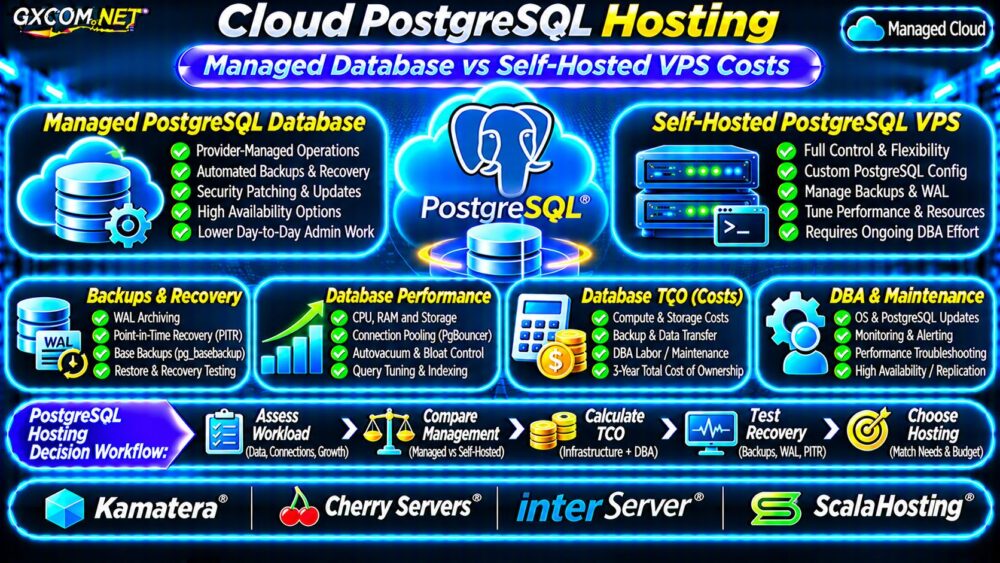
A managed PostgreSQL service generally handles underlying infrastructure, routine maintenance workflows, and selected backup or availability features. The customer still owns application queries, schema design, access policies, and important configuration decisions. Exact responsibilities depend on the service tier.
On a self-hosted VPS, the customer typically installs PostgreSQL, configures storage and security, schedules upgrades, maintains backups, and responds to database incidents. The infrastructure provider maintains the contracted underlying hosting platform, not necessarily the database.
| Decision Factor | Managed Database | Self-Hosted VPS |
|---|---|---|
| Operating system maintenance | Usually provider-operated | Customer-operated |
| PostgreSQL configuration | Restricted or configurable | Extensive control |
| Backups and restoration | Product-dependent tools | Customer designs and tests |
| Billing | Multiple service components | Server plus operational expenses |
| Incident response | Shared responsibility | Primarily customer responsibility |
PostgreSQL Performance: CPU, RAM and Storage
Compare performance using actual query latency, concurrent sessions, memory pressure, and storage behavior rather than advertised virtual CPU counts alone. PostgreSQL relies on shared buffers and the operating system page cache; adding RAM does not fix every inefficient query.
Slow transactions can reflect missing indexes, lock contention, excessive connections, or storage latency. Use EXPLAIN with appropriate safeguards to investigate expensive statements before upgrading instances.
Autovacuum also needs sufficient resources to remove dead tuples and prevent table bloat. On a self-hosted server, administrators must monitor its progress and tune settings when workloads justify changes.
Connection Pooling and Capacity
Many application connections consume memory and scheduling overhead. PgBouncer or another compatible pooling approach may reduce connection pressure, but transaction pooling can change session behavior. Test prepared statements and application compatibility before deployment.

For more information about infrastructure administration responsibilities, see our managed vs unmanaged VPS comparison.
Backups, WAL and Point-in-Time Recovery
PostgreSQL write-ahead logging (WAL) supports crash recovery and, when combined with a suitable base backup and archived WAL, point-in-time recovery (PITR). A simple logical pg_dump is useful for selected restores but is not a substitute for a physical backup plus WAL archive when PITR is required.
Self-hosted operators must configure archiving, protect credentials, monitor failed backup jobs, manage retention, and test complete restores. The pg_basebackup utility can create physical base backups, subject to the documented permissions and configuration requirements.
Managed services may automate selected backup tasks, but retention windows, restoration charges, geographic independence, and recovery options vary. Verify whether backups survive account compromise or regional disruption.
Read our VPS snapshot and backup recovery comparison before relying on infrastructure snapshots alone.
High Availability and Upgrade Responsibilities
A single VPS remains a single failure domain even with daily backups. Building PostgreSQL replication and automated failover adds standby compute, storage, monitoring, and operational complexity. Replication does not replace independent backups because accidental changes can propagate.
Managed database products may offer standby or multi-zone options for additional charges. Confirm failover behavior, maintenance windows, supported PostgreSQL extensions, and whether major-version upgrades require application testing or downtime.
Neither managed hosting nor self-hosting guarantees a particular recovery time. Define recovery time objective (RTO) and recovery point objective (RPO), then validate them through controlled restoration exercises.
Monthly PostgreSQL Hosting Cost Comparison
Consider a hypothetical small production workload. A self-hosted VPS costs $28 monthly, storage and backups add $12, and monitoring costs $5. Four hours of administration at $30 per hour add $120. The resulting estimated ownership cost is $165 monthly.
A hypothetical managed database costs $125 for database capacity, $20 for storage and backup-related services, and $10 for monitoring and transfer. One hour of internal administration adds $30, bringing the total to $185 monthly.
| Illustrative Monthly Expense | Self-Hosted | Managed |
|---|---|---|
| Infrastructure and services | $45 | $155 |
| Internal labor | $120 | $30 |
| Total | $165 | $185 |
These figures are invented planning inputs, not vendor quotations. They exclude extraordinary incidents, migration, additional replicas, taxes, and downtime losses. Over thirty-six months, the modeled totals are $5,940 self-hosted and $6,660 managed, a $720 difference before excluded expenses.
Find the Administration Break-Even Point
In this example, managed services cost $110 more before labor. At $30 per administrative hour, the managed option breaks even when self-hosting requires approximately 3.7 more staff hours monthly than managed hosting. Actual staffing requirements vary dramatically.
Our cloud server cost optimization guide explains broader infrastructure budget controls.
Four Approved Hosting Providers to Evaluate
These GXCOM.NET-approved affiliate providers are candidates for VPS or server-based PostgreSQL deployments, not verified equivalents to a native managed PostgreSQL database service.
Kamatera: Configurable Cloud VPS
Kamatera suits teams evaluating adjustable compute resources for self-managed PostgreSQL. Ask about storage characteristics, network charges, and optional management responsibilities.
Cherry Servers: Infrastructure Flexibility
Cherry Servers is relevant when compute, storage, and networking requirements need careful matching. Confirm available server products and recovery options for the intended location.
InterServer: Predictable VPS Budget
InterServer offers a comparison point for teams prioritizing a simpler virtual-server budget. Evaluate storage limits, support boundaries, and database administration workload.
ScalaHosting: Managed Server Support
ScalaHosting deserves consideration when businesses want assistance with server operations. Verify explicitly whether the chosen plan includes PostgreSQL-specific tuning, backups, and incident response.
Our fully managed vs semi-managed hosting cost comparison explains why support boundaries matter.
Which PostgreSQL Hosting Model Should You Choose?
- Choose managed PostgreSQL when staff time, routine maintenance, and standardized recovery workflows justify the premium.
- Choose a self-hosted VPS when you have database expertise, require extensive control, and can operate reliable backups.
- Request written confirmation of supported versions, extensions, backup retention, incident ownership, and exit procedures.
- Benchmark production-like queries and test restores before committing critical workloads.
Frequently Asked Questions
Is Managed PostgreSQL Always More Expensive?
No. Subscription costs may be higher, but reduced administration and incident work can change total ownership costs.
Can a VPS Provide PostgreSQL PITR?
Yes, with correctly configured physical backups, WAL archiving, sufficient retention, and verified restoration procedures.
Final Verdict
Compare cloud PostgreSQL hosting using total operating costs, not instance prices alone. Managed databases reduce selected maintenance burdens; self-hosted VPS deployments offer greater control but require operational discipline. Choose the model that meets performance, recovery, and staffing requirements at a sustainable long-term cost.