Cloud VPS high availability requires more than choosing a virtual server advertised with strong uptime. A cloud VPS may recover from certain hardware failures, but application outages can still occur when databases, networks, storage, or software components fail.
For SaaS platforms, online stores, and business applications, reliable availability depends on redundancy, health checks, replication, and tested failover procedures. This guide explains the architecture, operational risks, and real costs of building a highly available VPS environment.
What Does Cloud VPS High Availability Mean?
High availability (HA) is the ability of a service to remain accessible, or recover quickly, when infrastructure components fail.
A single cloud VPS may benefit from provider-level virtualization and hardware recovery features. However, these do not necessarily protect against application crashes, corrupted databases, configuration errors, or regional outages.
Application-level HA typically requires multiple service instances and mechanisms that redirect traffic away from unhealthy components.
For fundamental infrastructure differences, see our Cloud Hosting vs VPS Comparison.
Single VPS vs High Availability Architecture
A traditional deployment places the application and database on one VPS. This design is inexpensive and simple, but creates several single points of failure.
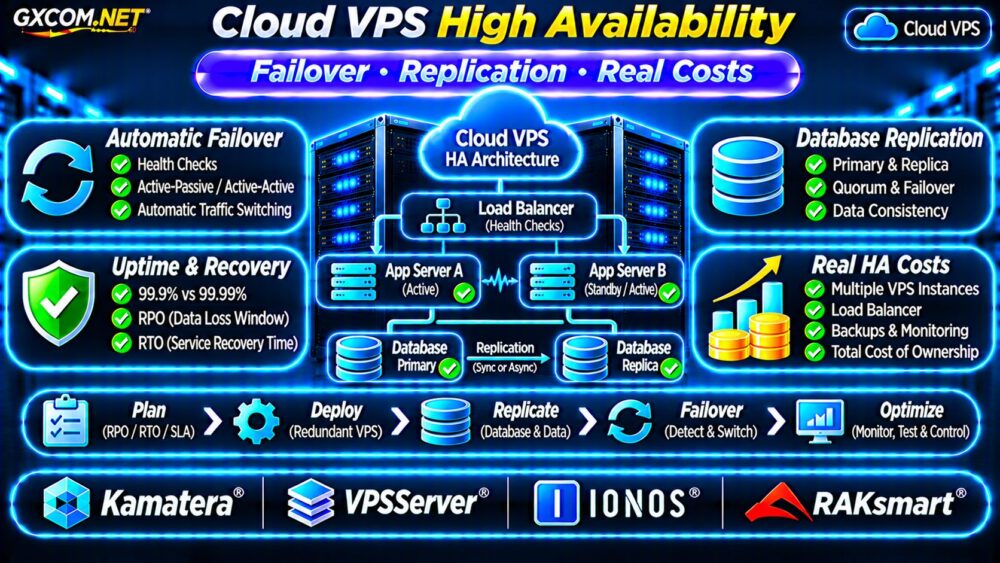
A redundant design may use two application servers, a load balancer, and replicated database infrastructure. Additional components improve resilience only when their own failure modes are addressed.
| Component | Single VPS | HA Design |
|---|---|---|
| Application | One instance | Multiple healthy instances |
| Traffic routing | Direct connection | Health-aware load balancing |
| Database | Single primary | Replication and controlled failover |
| Failure recovery | Manual or provider-dependent | Automated or orchestrated procedures |
| Operating cost | Lower | Higher infrastructure and administration costs |
Even two application servers cannot guarantee availability if they depend on one unprotected database or load balancer.
Cloud VPS Failover: How It Works
Failover transfers service responsibility from a failed component to a healthy alternative. The process can be manual, automated, or partially automated.
Health Checks and Traffic Routing
Load balancers use health checks to determine whether application instances should receive traffic.
Effective checks should test meaningful application readiness rather than simply confirming that a TCP port is open.
During failover, connection interruption, session handling, and application startup time can affect users. Shared session storage or stateless application design may be necessary.
Active-Passive vs Active-Active
Active-passive systems maintain a standby instance that takes over after failure. Active-active systems distribute requests across multiple operating instances.

Neither model is automatically superior. Database architecture, application compatibility, operational complexity, and budget determine the appropriate design.
Database Replication and Data Consistency
Database replication maintains copies of data across separate systems. Asynchronous replication can reduce primary transaction latency but may lose recent writes during unexpected failure.
Synchronous replication can strengthen consistency guarantees, although network latency and quorum requirements may affect write availability.
Replication also copies certain unwanted changes, including accidental deletions. Therefore, replicated databases still require independent backups.
Avoid Split-Brain Failures
Split brain occurs when multiple nodes incorrectly believe they are the active primary, potentially producing conflicting data.
Use appropriate quorum, fencing, leader election, and database-specific failover mechanisms. Avoid implementing database promotion with an untested shell script.
RPO, RTO and Uptime Targets
Recovery point objective (RPO) defines the maximum acceptable data-loss window. Recovery time objective (RTO) defines the targeted time to restore service.
For example, an RPO of five minutes and an RTO of fifteen minutes require different infrastructure from a system that tolerates several hours of downtime.
Uptime percentages provide another planning reference:
| Availability Target | Approximate Downtime per 30 Days |
|---|---|
| 99.9% | 43.2 minutes |
| 99.95% | 21.6 minutes |
| 99.99% | 4.32 minutes |
These are mathematical allowances, not guaranteed provider results. SLA exclusions, measurement methods, and service credits may differ.
For recovery planning, consult our VPS Snapshot Backup and Recovery Guide.
Fault Domains and Network Redundancy
Deploying two VPS instances on the same physical host may provide limited protection against hardware failure.
Ask whether instances can be separated across hosts, racks, availability zones, or regions. These are different levels of fault isolation.
Cross-region deployments can improve geographic resilience but introduce latency, data transfer charges, and more complex replication.
Also consider redundant DNS, load balancing, storage, and network paths. Every shared dependency deserves a failure analysis.
Four Cloud VPS Providers to Compare
The following GXCOM.NET-approved affiliate providers are infrastructure candidates. Their actual HA features, deployment locations, and service guarantees must be verified for the selected product.
Kamatera: Configurable Cloud Infrastructure
Kamatera is worth evaluating for adjustable cloud resources and network requirements. Confirm available load balancing options, instance placement, backup services, and regional redundancy.
VPSServer: VPS Deployment Flexibility
VPSServer can be compared for cloud VPS configurations and deployment locations. Verify snapshot functionality, network options, recovery procedures, and any supported failover mechanisms.
IONOS: Infrastructure and Cost Planning
IONOS is another candidate for evaluating cloud server resources and recurring costs. Check the exact product’s redundancy options, networking features, and applicable SLA terms.
RAKsmart: Regional Infrastructure Options
RAKsmart may be considered when regional deployment and network requirements influence purchasing decisions. Confirm available locations, private networking, backup arrangements, and failover support.
Do not assume that purchasing two VPS instances from one provider automatically creates a supported high availability service.
Real Cloud VPS High Availability Costs
HA infrastructure introduces costs beyond the primary server. Additional instances, load balancing, replicated storage, backups, monitoring, and data transfer can substantially increase the budget.
Consider a hypothetical monthly deployment:
| Infrastructure Component | Monthly Cost |
|---|---|
| Two application VPS instances | $60 |
| Database primary and replica | $80 |
| Load balancing | $20 |
| Backups and monitoring | $25 |
| Illustrative total | $185 |
That equals $2,220 annually before taxes, engineering labor, bandwidth overages, and other services. These figures are hypothetical, not provider quotations.
Compare data transfer expenses using our Cloud VPS Bandwidth Costs Guide.
Testing Failover Before Production
A high availability design is only as reliable as its tested recovery procedures.

Simulate application crashes, database primary failure, network interruption, and unavailable nodes in a controlled environment.
Measure actual recovery time, data consistency, and customer-visible errors. Document manual recovery procedures when automation fails.
Monitor replication lag, load balancer health, backup completion, and resource capacity. A standby server must have enough capacity to handle the workload after failover.
When Is High Availability Worth the Cost?
HA is particularly valuable when downtime interrupts revenue, customer operations, or contractual commitments.
Smaller applications may achieve better initial value through dependable backups, monitoring, and documented restoration procedures rather than complex multi-node infrastructure.
Evaluate the financial impact of downtime against additional hosting and operational expenses.
Cloud VPS HA Buying Checklist
- Identify application, database, network, and storage failure points.
- Confirm instance separation across appropriate fault domains.
- Define RPO, RTO, and service availability objectives.
- Verify replication, load balancing, and failover capabilities.
- Maintain independent backups and test restoration.
- Calculate full infrastructure and administration costs.
Frequently Asked Questions
Does Cloud VPS Automatically Include High Availability?
No. Provider-level recovery features do not necessarily include application redundancy, database failover, or uninterrupted service.
Is Database Replication a Replacement for Backups?
No. Replication may propagate corruption or accidental deletions. Independent backups remain essential.
Can Two VPS Servers Guarantee 99.99% Uptime?
No. Actual availability depends on architecture, shared dependencies, failure detection, operational procedures, and provider reliability.
Final Verdict
Cloud VPS high availability requires coordinated application redundancy, database replication, secure networking, and tested recovery workflows.
Compare Kamatera, VPSServer, IONOS, and RAKsmart using verified infrastructure capabilities and complete costs. Choose an architecture that meets realistic recovery objectives rather than paying for redundancy that has never been tested.