Private AI infrastructure is becoming an important consideration for businesses that want greater control over model deployment, sensitive datasets, and long-running inference workloads. While shared GPU cloud platforms offer flexibility, dedicated GPU servers provide a different balance of hardware access, isolation, and operating costs.
Cherry Servers GPU Bare Metal combines dedicated physical hardware with configurable NVIDIA GPU acceleration, system memory, and NVMe storage. This makes it worth evaluating for organizations running internal language models, retrieval-augmented generation (RAG), model fine-tuning, and production AI services.
But dedicated hardware is not automatically the cheapest or most secure option. This review examines GPU isolation, storage architecture, networking, infrastructure expenses, and alternatives to help determine whether Cherry Servers fits a private AI deployment.
Editorial note: This analysis is based on published provider documentation and general infrastructure planning principles. GXCOM.NET has not independently benchmarked Cherry Servers GPU performance, security controls, or service reliability.
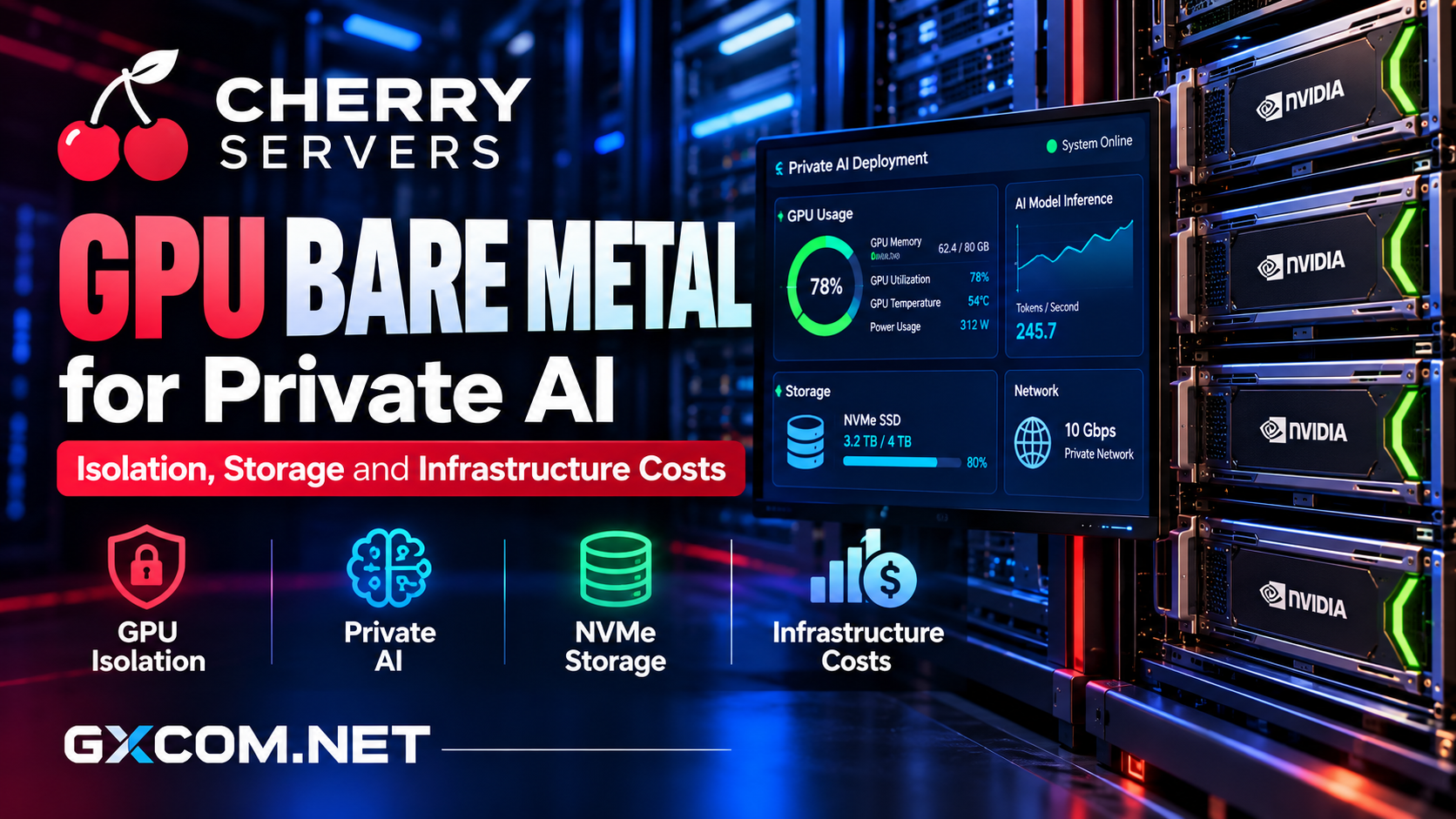
What Does Cherry Servers Offer for Private AI?
Cherry Servers provides single-tenant bare metal infrastructure with configurable processors, RAM, storage, and optional GPU accelerators on supported configurations. Its dedicated GPU offerings target AI, machine learning, high-performance computing, and other accelerated workloads.
Unlike a shared virtual GPU instance, a dedicated bare metal server gives the customer control over the allocated physical machine. Teams can install supported operating systems, manage GPU drivers, deploy containers, and configure their own AI software stack.
This approach is particularly attractive when an application runs continuously or requires specialized system configuration.
However, buyers should verify the selected GPU model, installation options, provisioning time, and region before ordering. Available hardware is not identical across every location.
GPU Isolation: What Does Bare Metal Actually Protect?
Physical resource isolation is one of the main reasons organizations consider dedicated GPU hosting.
Single-Tenant Hardware
With bare metal, the allocated CPU, memory, and GPU resources are not simultaneously assigned to unrelated customers through a shared host virtualization layer.
This reduces certain forms of resource contention and gives administrators more direct control over drivers, operating systems, and workload scheduling.
For sustained inference services, dedicated capacity can also simplify performance planning because another tenant is not competing for the same assigned physical GPU.
Isolation Is Not Complete Security
Single-tenant hardware does not automatically provide encryption, regulatory compliance, or protection against every attack.
Administrators remain responsible for operating-system patching, access permissions, secrets management, container security, network filtering, and application vulnerabilities.
Businesses processing confidential information should also examine provider access procedures, data center location, contractual safeguards, and applicable compliance requirements.
Private AI is therefore an architecture and governance decision, not simply a server product label.
Choosing the Right GPU and VRAM Capacity
The best GPU depends on the model, context length, numerical precision, batch size, and whether the workload involves training or inference.
Cherry Servers lists different NVIDIA accelerators for dedicated AI infrastructure, including configurations featuring A40 and A100 GPUs. Inventory and specifications should be confirmed before purchase.
Inference Versus Fine-Tuning
Inference workloads primarily need sufficient memory for model weights, key-value caches, and concurrent requests. Fine-tuning introduces additional memory demands for activations, gradients, and optimizer states.

For smaller quantized models, a modest GPU may be sufficient. Larger models, longer contexts, and higher concurrency can require substantially more VRAM.
Techniques such as LoRA and QLoRA can reduce training memory requirements, but they do not eliminate hardware limits.
GPU Memory Is Not the Only Bottleneck
CPU preprocessing, system RAM, storage throughput, and network latency can all reduce effective GPU utilization.
Before choosing an expensive accelerator, benchmark representative requests and measure tokens per second, latency, memory consumption, and concurrent throughput.
For a broader hardware comparison, explore our NVIDIA GPU server providers guide.
NVMe Storage for Private AI Workloads
AI applications require more storage than their model weights alone might suggest. A production environment can include training datasets, vector databases, downloaded models, temporary caches, logs, and multiple checkpoints.
Cherry Servers offers configurable SSD and NVMe storage on eligible dedicated configurations, including custom builds for larger storage requirements.
Model Files and Dataset Capacity
Start by estimating the total footprint of model files, datasets, embeddings, and temporary processing space.
Keep additional headroom for model revisions, container images, and checkpoint growth. A storage configuration that barely fits the initial deployment may become restrictive during updates.
NVMe Performance and RAID
Local NVMe drives can reduce loading times and support demanding data pipelines. However, performance depends on the drive model, RAID layout, filesystem, and competing I/O activity.
RAID can improve resilience against selected drive failures, but it is not a replacement for independent backups.
Important models, datasets, and configuration files should be backed up to a separate destination with tested recovery procedures.
Storage Security
Private AI deployments should consider encryption at rest, encryption in transit, restricted administrative access, and secure data deletion.
Ask how failed or retired drives are handled and whether the selected infrastructure can meet the organization’s data retention requirements.
Networking and Private AI Deployment
Network architecture matters when a GPU server communicates with application servers, databases, internal APIs, or remote users.
Cherry Servers advertises private networking features and configurable connectivity on supported bare metal products.
For internal AI services, administrators may prefer private network paths rather than exposing model administration interfaces directly to the public internet.
Review firewall policies, bandwidth allowances, additional IP requirements, and traffic charges before deploying a production endpoint.
Large dataset transfers can also affect costs and deployment time, even when GPU processing itself is efficient.
Cherry Servers GPU Infrastructure Costs
The total cost of dedicated GPU hosting extends beyond the accelerator.
Important variables include the server rental period, GPU model, CPU and RAM allocation, NVMe capacity, bandwidth, backups, software, and operational support.
Cherry Servers offers hourly and fixed-period billing options for eligible infrastructure, allowing buyers to compare short-term testing with longer deployments.
Illustrative Utilization Calculation
Suppose a hypothetical dedicated GPU server costs $600 monthly and operates for 720 hours. If productive GPU utilization reaches 600 hours, the effective infrastructure cost is $1 per productive hour.
If the same machine is actively used for only 150 hours, that figure becomes $4 per productive hour.
These are illustrative calculations, not Cherry Servers quotations. They exclude storage upgrades, bandwidth, administration, and other applicable expenses.
When Bare Metal Becomes Economical
Dedicated GPU servers become more attractive when workloads are predictable, sustained, and capable of using the allocated hardware efficiently.
For occasional experiments, on-demand GPU cloud services may avoid paying for long idle periods.
Compare both approaches in our affordable GPU servers guide.
Cherry Servers Versus Other GPU Hosting Providers
RunPod: Flexible GPU Cloud Computing
RunPod is worth comparing for development teams that need GPU access for experiments, fine-tuning, or variable workloads without committing to a dedicated physical server.
Its Pod-based environment may suit intermittent projects, although storage persistence, GPU availability, and idle resource costs require attention.
GPU Mart: Dedicated GPU Hosting Options
GPU Mart offers another route for teams comparing GPU-focused server infrastructure. Buyers should assess the actual accelerator, VRAM, operating system, storage configuration, and contract terms.
It can be useful to compare GPU Mart with Cherry Servers when a dedicated configuration is preferred over a flexible cloud instance.
Vultr: Cloud GPU Infrastructure
Vultr provides cloud infrastructure options relevant to AI workloads. Its suitability depends on available GPU products, deployment region, storage integration, and pricing structure.
Cloud GPU services can simplify certain deployment workflows, but dedicated hardware may offer greater control for sustained applications.
For additional options, see our AI GPU VPS providers comparison.
Who Should Choose Cherry Servers GPU Bare Metal?
Cherry Servers is worth considering for businesses running persistent private AI services, internal LLM applications, data-intensive pipelines, or inference systems that need dedicated hardware resources.
It is particularly relevant when teams require operating-system control, predictable capacity, and configurable local storage.
However, organizations without infrastructure management expertise may prefer a more managed environment. Dedicated servers still require patching, monitoring, security controls, and disaster recovery planning.
Our GPU versus CPU server comparison provides additional guidance on workload suitability.
Final Verdict: Is Cherry Servers Worth It for Private AI?
Cherry Servers GPU Bare Metal is a credible option for organizations that prioritize single-tenant infrastructure, configurable storage, and direct control over their AI deployment environment.
Its strongest appeal is not simply access to GPU acceleration, but the ability to design a dedicated server around sustained workloads and operational requirements.
Still, physical isolation does not replace security engineering, and a fixed server commitment only delivers value when utilization justifies the expense.
Choose Cherry Servers when dedicated control and continuous workloads matter most. Compare RunPod for flexible experimentation, GPU Mart for alternative dedicated configurations, and Vultr for cloud-oriented deployment requirements.
Frequently Asked Questions
Is Cherry Servers GPU hosting suitable for private LLMs?
Yes, suitable dedicated GPU configurations can host private LLM workloads. Model size, VRAM requirements, software compatibility, and security controls determine the appropriate setup.
Does bare metal guarantee complete data privacy?
No. Bare metal provides physical resource isolation, but data protection still requires encryption, access controls, secure administration, and appropriate provider agreements.
Does Cherry Servers offer NVMe storage?
Yes. NVMe storage is available on supported dedicated server configurations, with capacity and drive options varying by product.
Is dedicated GPU hosting cheaper than GPU cloud rental?
It can be for consistently utilized workloads. Short or unpredictable jobs may cost less on flexible cloud GPU platforms.