GPU computing is no longer limited to large enterprises and research labs. Developers, startups, AI creators, and machine learning teams can now rent GPU-powered virtual infrastructure without purchasing expensive physical servers.
The Best GPU VPS Providers combine powerful NVIDIA GPUs, flexible deployment, fast storage, reliable networking, and pricing models that make accelerated computing accessible for projects of different sizes.
Whether you are running AI inference, Stable Diffusion, machine learning experiments, model development, or GPU-accelerated applications, this guide explains what to look for in a GPU VPS and compares several popular platforms for AI workloads.

Best GPU VPS Providers Compared
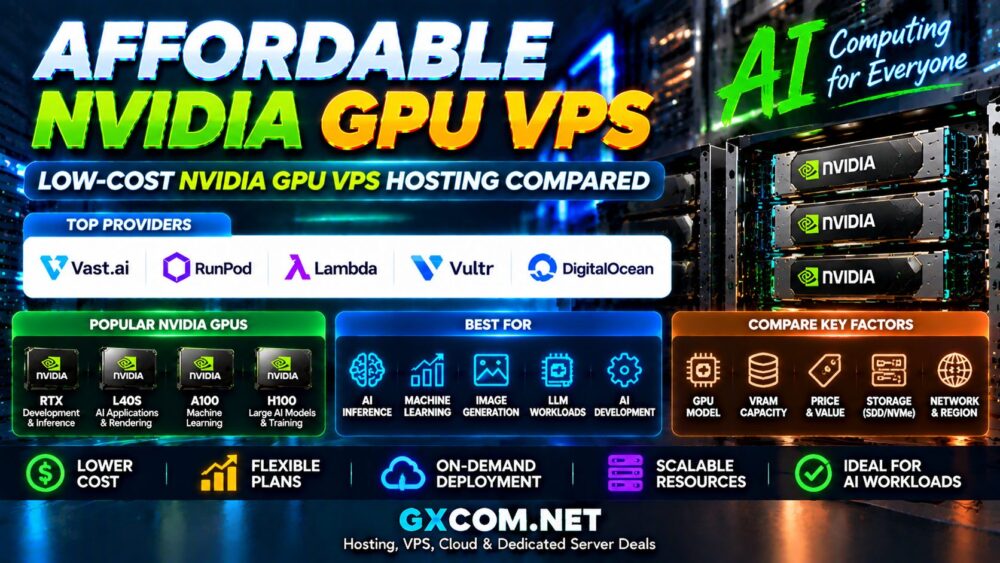
| Provider | Best For | Infrastructure Style |
|---|---|---|
| RunPod | AI developers and flexible GPU workloads | On-demand GPU cloud |
| Vast.ai | Budget-conscious GPU users | GPU marketplace |
| Lambda | Machine learning and AI development | AI-focused GPU cloud |
| Vultr | Cloud infrastructure users | Cloud GPU instances |
| DigitalOcean | Developers building AI applications | GPU cloud infrastructure |
GPU availability, supported models, regions, and pricing can change frequently. Always verify the current configuration before deploying a production workload.
What Is a GPU VPS?
A GPU VPS is virtualized or cloud-based compute infrastructure that gives a user access to GPU acceleration alongside CPU, RAM, storage, and networking resources.
Depending on the platform, GPU access may be provided through a dedicated accelerator, virtualized infrastructure, containers, or another cloud deployment model.
Typical GPU VPS workloads include:
- AI inference
- Machine learning development
- Stable Diffusion
- Generative AI applications
- Small and medium AI models
- Rendering
- Video processing
- Data science
GPU VPS vs Regular VPS
A normal VPS is usually based primarily on CPU computing. That works well for websites, databases, APIs, development environments, and many business applications.
A GPU VPS adds hardware acceleration for workloads capable of using parallel GPU processing.
| Feature | Regular VPS | GPU VPS |
|---|---|---|
| Primary Compute | CPU | CPU + GPU |
| Website Hosting | Excellent | Usually unnecessary |
| AI Inference | Limited | Excellent |
| Machine Learning | Limited | Much better |
| Image Generation | Slow or impractical | Recommended |
| Cost | Lower | Higher |
Top GPU VPS Providers
1. RunPod
RunPod is focused on GPU computing for artificial intelligence and developer workloads. Its platform is popular with users who want flexible access to different GPU classes without purchasing dedicated hardware.
Potential advantages include:
- Multiple GPU options
- AI-focused deployment
- Flexible compute environments
- Developer-oriented workflows
- Suitable options for temporary workloads
RunPod can be particularly attractive for experimentation, inference, generative AI, and workloads that do not need a permanently running physical GPU server.
2. Vast.ai
Vast.ai uses a marketplace approach to GPU computing. Users can compare available GPU resources from different hosts, making the platform interesting for buyers who prioritize price and hardware choice.
Advantages may include:
- Wide range of GPU hardware
- Competitive marketplace pricing
- Flexible configurations
- Useful options for experimental workloads
Because marketplace hosts and configurations can vary, users should carefully compare reliability, networking, storage, and availability rather than choosing purely by price.
3. Lambda
Lambda specializes in infrastructure for artificial intelligence and machine learning. Its GPU cloud services are designed around AI development rather than conventional website hosting.
Typical use cases include:
- Machine learning development
- AI model training
- Deep learning
- Research workloads
- AI inference
For users comparing larger NVIDIA GPU infrastructure as well, see our NVIDIA GPU Server Providers guide.
4. Vultr GPU Cloud
Vultr combines GPU computing with a broader cloud infrastructure ecosystem. This can be useful for projects that need GPU acceleration alongside conventional cloud services.
Important considerations include:
- Available GPU models
- Regional availability
- Storage options
- Networking
- Deployment flexibility
5. DigitalOcean GPU Infrastructure
DigitalOcean has expanded beyond traditional developer cloud servers into GPU-powered infrastructure for AI applications.
It can appeal to developers who prefer cloud infrastructure with familiar deployment tools while building AI applications, inference services, and accelerated workloads.
GPU configurations and regional availability should be checked before choosing a deployment location.
Which NVIDIA GPU Should You Choose?
The right GPU depends heavily on model size, VRAM requirements, performance targets, and budget.
| GPU Class | Typical Use |
|---|---|
| RTX-class GPUs | Development, image generation and smaller AI workloads |
| L40S-class GPUs | Inference, graphics and AI applications |
| A100-class GPUs | Professional machine learning and AI workloads |
| H100-class GPUs | Large AI models and demanding training workloads |
Not every project needs the most expensive GPU. Matching hardware to the workload is usually more cost-effective than simply selecting the highest-end accelerator.
GPU VPS for AI Inference
Inference is one of the strongest use cases for GPU VPS infrastructure because applications can access accelerated computing without maintaining an expensive physical server.
Examples include:
- AI chat applications
- Image generation
- Computer vision
- Recommendation systems
- AI APIs
GPU VPS for Stable Diffusion and Image Generation
Generative image workloads can benefit substantially from GPU acceleration. For smaller image-generation projects, an affordable GPU can be more economical than enterprise AI hardware.
Our Affordable GPU Servers guide explains additional lower-cost GPU computing options.
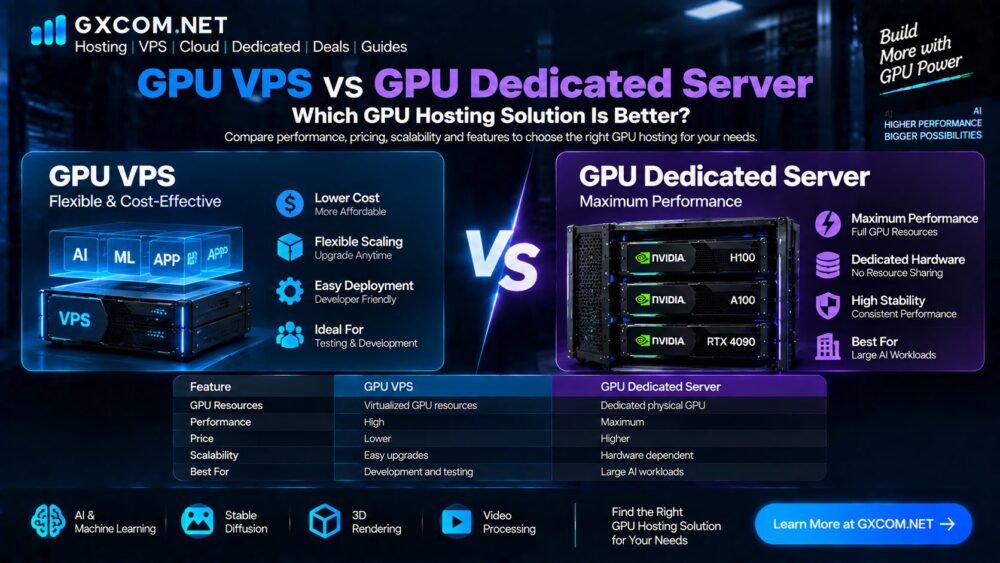
GPU VPS vs Dedicated GPU Server
GPU VPS and dedicated GPU servers solve different infrastructure problems.
| Feature | GPU VPS / Cloud GPU | Dedicated GPU Server |
|---|---|---|
| Entry Cost | Lower | Higher |
| Deployment | Fast | May require provisioning |
| Flexibility | High | Lower |
| Hardware Control | Depends on platform | High |
| Best For | Flexible and variable workloads | Continuous heavy workloads |
For long-running workloads with consistently high GPU utilization, dedicated hardware can sometimes make more economic sense. For temporary projects and variable demand, GPU cloud infrastructure provides greater flexibility.
How Much Does a GPU VPS Cost?
GPU VPS pricing varies much more than conventional VPS pricing because GPU hardware can differ dramatically in performance and memory capacity.
Important cost factors include:
- GPU model
- GPU VRAM
- Number of GPUs
- CPU allocation
- System RAM
- Storage
- Bandwidth
- Billing model
- Region
Hourly billing can be useful for temporary AI experiments, while sustained workloads require closer comparison of total monthly infrastructure cost.
GPU VPS vs CPU Server for AI
CPU servers remain important for application logic, preprocessing, databases, and many general-purpose tasks. However, AI workloads involving highly parallel mathematical operations can benefit substantially from GPU acceleration.
See our detailed GPU Server vs CPU Server comparison for the differences in architecture, workloads, performance, and cost.
How to Choose the Best GPU VPS Provider
Before choosing a provider, compare:
- GPU model and generation
- Available VRAM
- CPU and system RAM
- NVMe or SSD storage
- Network performance
- Data center regions
- Billing granularity
- GPU availability
- Deployment tools
- Support
Common GPU VPS Buying Mistakes
Choosing Only by GPU Name
A GPU is only one component of the system. CPU, RAM, storage, networking, and software configuration can also affect real-world performance.
Ignoring VRAM
GPU memory can determine whether a model fits on the accelerator at all. A faster GPU with insufficient VRAM may be unsuitable for your workload.
Paying for More GPU Than You Need
Using premium AI accelerators for small inference or development workloads can increase costs without delivering proportional value.
Ignoring Idle Time
Hourly GPU instances can become expensive when left running without useful workloads. Shut down unused resources where the provider's billing model allows it.
Who Should Use a GPU VPS?
A GPU VPS is particularly useful for:
- AI developers
- Machine learning engineers
- Startups
- Researchers
- Generative AI projects
- Image-generation applications
- AI API developers
- Temporary GPU workloads
Final Thoughts
The best GPU VPS provider depends on your workload, budget, GPU requirements, and preferred deployment model.
RunPod and Vast.ai can be attractive for flexible and cost-sensitive GPU computing, Lambda focuses strongly on AI infrastructure, while Vultr and DigitalOcean integrate GPU computing into broader cloud platforms.
Instead of choosing solely by price or GPU model, compare VRAM, CPU resources, storage, networking, availability, and total workload cost. The right GPU VPS should provide enough acceleration for your application without forcing you to pay for GPU capacity you do not need.