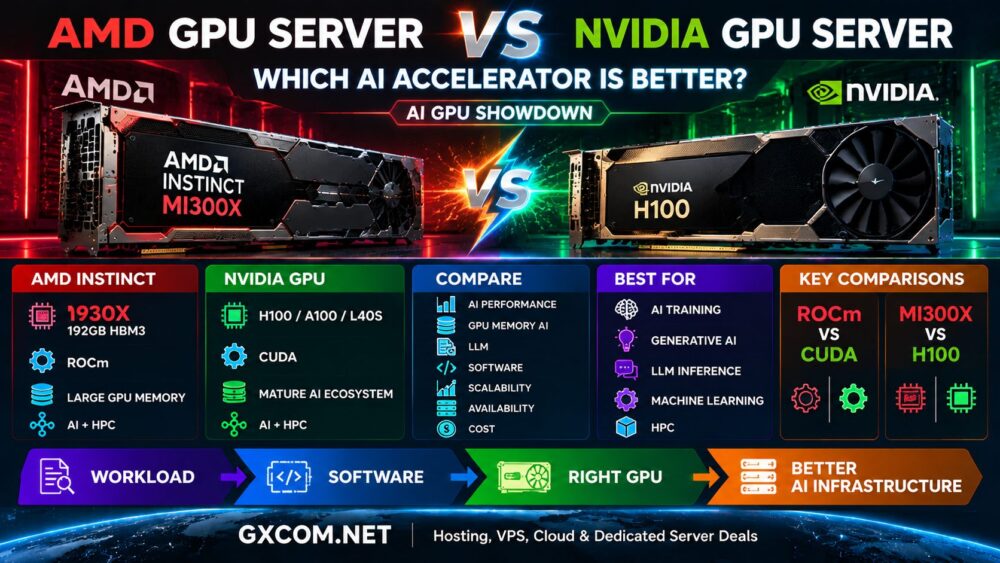
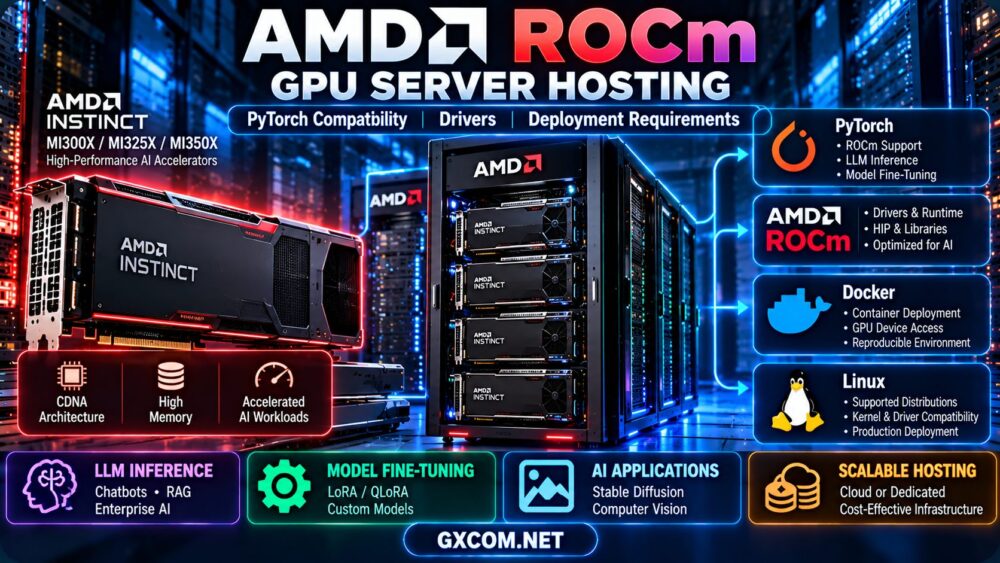
Choosing between the AMD Instinct MI300X, MI325X, and MI350X can significantly affect the cost, performance, and scalability of an AI server deployment. These data center accelerators are designed for demanding workloads such as large language model inference, AI training, high-performance computing, and enterprise AI infrastructure.
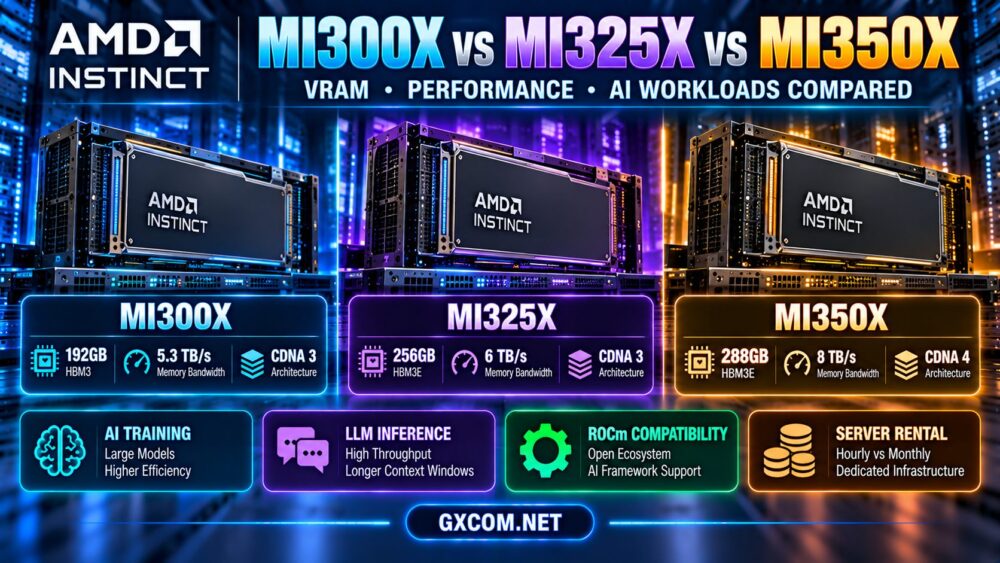
However, the newest accelerator is not automatically the most cost-effective option. The MI300X offers 192GB of high-bandwidth memory, the MI325X increases capacity to 256GB, and the MI350X introduces AMD's CDNA 4 architecture with 288GB of HBM3E memory and additional low-precision computing capabilities.
In this AMD Instinct MI300X vs MI325X vs MI350X comparison, we examine GPU specifications, AI workload suitability, ROCm software requirements, multi-GPU server architecture, and rental value to help buyers choose the right infrastructure.
AMD Instinct MI300X vs MI325X vs MI350X: Specifications Compared
All three accelerators target high-performance AI and data center workloads, but they differ in memory capacity, bandwidth, architecture, and supported numerical formats.
| Specification | MI300X | MI325X | MI350X |
|---|---|---|---|
| GPU architecture | AMD CDNA 3 | AMD CDNA 3 | AMD CDNA 4 |
| GPU memory | 192GB HBM3 | 256GB HBM3E | 288GB HBM3E |
| Peak memory bandwidth | 5.3TB/s | 6TB/s | 8TB/s |
| Form factor | OAM module | OAM module | OAM module |
| Software ecosystem | AMD ROCm | AMD ROCm | AMD ROCm |
| Key advantage | Established high-memory AI accelerator | More VRAM on CDNA 3 | CDNA 4 and advanced low-precision AI computing |
| Potential workload fit | LLM inference and AI training | Memory-intensive inference and training | Advanced AI inference, training and HPC |
Specifications are based on AMD's published accelerator documentation. Memory and bandwidth figures describe individual GPUs, not complete multi-GPU servers. Peak specifications are not application benchmarks.
The right GPU depends on more than memory capacity. Model architecture, numerical precision, software support, batch size, and server topology can all influence real-world results.
AMD Instinct MI300X: High-Memory AI Computing on CDNA 3
The AMD Instinct MI300X is built on the CDNA 3 architecture and provides 192GB of HBM3 memory with up to 5.3TB/s of theoretical memory bandwidth.
Its substantial memory capacity makes it relevant for large language models and memory-intensive AI workloads that might otherwise require more aggressive quantization or multiple smaller accelerators.
Where MI300X Makes Sense
- LLM inference where model weights and runtime memory fit within 192GB.
- AI training workloads supported by the selected ROCm software stack.
- Enterprise applications requiring large GPU memory capacity.
- High-performance computing tasks compatible with AMD's accelerator architecture.
- Deployments where a competitively priced MI300X server meets the performance target.
MI300X can remain economically attractive even when newer GPUs are available. If an application already runs efficiently and does not need additional memory or newer low-precision capabilities, upgrading may provide limited financial benefit.
AMD Instinct MI325X: 256GB HBM3E for Larger AI Models
The AMD Instinct MI325X remains within the CDNA 3 generation but increases GPU memory to 256GB of HBM3E and raises peak memory bandwidth to 6TB/s.
Compared with MI300X, the MI325X offers approximately 33% more memory capacity and 13% more theoretical memory bandwidth.
Why More GPU Memory Matters
Large language model inference requires memory for model weights, temporary buffers, runtime operations, and the key-value cache used during generation.
Higher concurrency and longer context windows can increase memory pressure even when the underlying model weights remain unchanged.
The MI325X may help accommodate larger models, additional inference requests, or less aggressive quantization.
MI325X vs MI300X: Is the Upgrade Worth It?
MI325X is worth evaluating when:
- A model or application exceeds the practical memory budget of MI300X.
- Longer contexts increase KV-cache requirements.
- Higher batch sizes are limited by available GPU memory.
- Memory bandwidth constrains the workload.
- The rental premium is justified by improved useful throughput.
However, greater VRAM does not automatically mean proportionally faster AI computation. For compute-bound workloads, the improvement may be smaller than the memory specifications suggest.
AMD Instinct MI350X: CDNA 4 and 288GB HBM3E
The AMD Instinct MI350X introduces the CDNA 4 architecture, delivering 288GB of HBM3E memory and up to 8TB/s of theoretical memory bandwidth per GPU.
Compared with MI325X, the MI350X provides approximately 12.5% more GPU memory and 33% more peak memory bandwidth.
The MI350X also introduces expanded support for low-precision formats, including MXFP4 and MXFP6, which can benefit compatible AI workloads.
What Makes CDNA 4 Different?
CDNA 4 introduces architectural improvements aimed at advanced AI computation, high-bandwidth memory access, and efficient data movement.
Supported low-precision operations may help accelerate AI inference and training when the software framework, model, and numerical requirements can use them effectively.
However, theoretical matrix throughput is not equivalent to end-to-end model performance. Software optimization and workload characteristics remain critical.
When Should You Consider MI350X?
- Large-scale AI inference requiring substantial memory capacity.
- Workloads that benefit from higher memory bandwidth.
- Supported low-precision AI models and optimized software kernels.
- Enterprise AI systems with demanding throughput requirements.
- Multi-GPU platforms designed around CDNA 4 capabilities.
The strongest reason to select MI350X is a measurable improvement in cost per completed workload, not simply the availability of newer hardware.
MI300X vs MI325X vs MI350X for LLM Inference
LLM inference is one of the most relevant applications for high-memory AMD Instinct accelerators.
Inference performance depends on model size, quantization, context length, request concurrency, batch scheduling, memory bandwidth, and the inference engine.
MI300X for Established LLM Deployments
MI300X can be a practical starting point when the model and runtime fit comfortably within its 192GB memory capacity.
Its value improves when the selected software stack is mature and the server's rental cost is competitive.
MI325X for Memory-Intensive Inference
MI325X provides additional memory headroom for model weights, KV cache, and concurrent requests.
This may help reduce memory-related compromises in some deployments.
MI350X for High-Throughput AI Serving
MI350X combines greater memory bandwidth with newer architectural capabilities that may improve performance for compatible inference workloads.
For production deployments, compare measured tokens per second, time to first token, latency under concurrency, and total infrastructure cost.

For a broader discussion of production serving requirements, see our AI inference server hosting guide.
How Much LLM Memory Do These AMD GPUs Provide?
GPU memory capacity is especially important when deciding whether a model can fit on one accelerator.
For an approximate weight-only estimate, multiply the number of model parameters by the bytes required for each parameter.
| Model Size | Approximate 16-bit Weight Memory | Approximate 8-bit Weight Memory |
|---|---|---|
| 70B parameters | 140GB | 70GB |
| 100B parameters | 200GB | 100GB |
| 120B parameters | 240GB | 120GB |
| 140B parameters | 280GB | 140GB |
These simplified decimal estimates assume dense models and exclude KV cache, framework overhead, temporary buffers, quantization metadata, and other runtime memory requirements. They do not establish whether a model will run successfully on a particular GPU.
For example, a 100B-parameter model at 16-bit precision requires approximately 200GB for weights alone. That exceeds the MI300X's 192GB capacity but is below the MI325X's 256GB capacity.
Whether the model actually fits on MI325X depends on the remaining memory required by the inference engine and workload.
Likewise, a 140B-parameter model at 16-bit precision consumes approximately 280GB for weights alone, leaving very little theoretical headroom on a 288GB MI350X.
Therefore, GPU selection should be based on complete runtime memory requirements rather than parameter count alone.
AMD Instinct GPUs for AI Training and Fine-Tuning
Training and fine-tuning can require substantially more GPU memory than inference because additional memory is needed for gradients, optimizer states, activations, and temporary operations.
The exact requirement depends on the training method, numerical precision, optimizer, sequence length, and distributed training strategy.
Full-Parameter Training
Full-parameter training updates all model weights and may require large multi-GPU systems with sophisticated memory management.
MI300X, MI325X, and MI350X can be evaluated for supported training frameworks, but GPU memory alone does not determine training feasibility.
LoRA and QLoRA Fine-Tuning
Parameter-efficient fine-tuning techniques can reduce memory requirements by updating a smaller number of trainable parameters.
For suitable workloads, these techniques may reduce the need for expensive multi-GPU infrastructure.
Read our LLM fine-tuning GPU requirements guide for a detailed explanation of LoRA, QLoRA, and memory planning.
ROCm Compatibility: A Critical AMD GPU Server Requirement
AMD Instinct accelerators rely on the ROCm software ecosystem for supported GPU computing workloads.
ROCm provides components used by AI frameworks, mathematical libraries, compilers, and runtime environments.
However, compatibility must be evaluated for the exact accelerator model and software version.
Check the ROCm Version
MI300X, MI325X, and MI350X do not necessarily share identical support across older ROCm releases.
Newer GPU architectures may require newer drivers, runtime libraries, or optimized kernels.
Before renting a server, confirm:
- The GPU model is supported by the intended ROCm release.
- The operating system and kernel are supported.
- The installed GPU driver is compatible with the runtime.
- The required PyTorch or other framework build supports the GPU.
- Inference libraries and custom kernels support the target architecture.
- The provider permits the necessary driver and software configuration.
PyTorch and AI Framework Support
Many AI projects depend on PyTorch, Hugging Face libraries, inference engines, and custom GPU kernels.
A framework supporting ROCm in general does not guarantee that every feature, extension, or third-party CUDA-oriented library works identically on all AMD accelerators.
Testing the complete application stack is essential before committing to a long-term GPU server rental.
ROCm Support for MI350X
MI350X belongs to the CDNA 4 generation, so older environments designed around CDNA 3 should not be assumed to work without changes.
Check AMD's current ROCm compatibility matrix and the hosting provider's supported system images before deployment.
Multi-GPU AMD Instinct Server Architecture
AMD Instinct accelerators are frequently deployed in integrated multi-GPU server platforms.
An eight-GPU system can provide substantial aggregate memory, but the application does not automatically treat all GPU memory as one unrestricted pool.
| Eight-GPU Configuration | Aggregate Installed HBM | Key Consideration |
|---|---|---|
| 8 × MI300X | 1,536GB | CDNA 3 platform and software topology |
| 8 × MI325X | 2,048GB | Higher aggregate memory capacity |
| 8 × MI350X | 2,304GB | CDNA 4 and newer platform capabilities |
These are aggregate installed memory capacities, not guarantees that a single application can access all memory without partitioning or communication overhead.
When comparing servers, verify Infinity Fabric connectivity, CPU resources, system RAM, storage throughput, and networking for distributed training.
Our multi-GPU server hosting guide explains the broader impact of GPU topology and scaling costs.
AMD GPU Server Rental: Hourly vs Monthly vs Dedicated
Rental economics are a major consideration when choosing high-end AI accelerators.
The best billing model depends on utilization, workload duration, required availability, and infrastructure flexibility.
Hourly AMD GPU Rental
Hourly billing can suit temporary experimentation, benchmarking, short-term inference testing, and occasional training jobs.
However, the selected GPU model must actually be available from the provider, and storage or reserved resources may continue generating charges.
Monthly GPU Server Rental
Monthly rental can be attractive for predictable AI workloads that use the server regularly.
Compare the monthly commitment with expected billable hours and the performance of alternative GPU configurations.
Dedicated AMD Instinct Servers
Dedicated infrastructure can offer a defined hardware configuration and greater control over the software environment.
However, specialized Instinct servers may involve substantial provisioning, cooling, networking, and minimum-commitment requirements.
For a practical billing comparison, see our hourly vs monthly GPU server rental guide.
How to Compare MI300X, MI325X and MI350X Rental Value
The cheapest advertised GPU rate is not necessarily the lowest cost for a completed workload.
Use the following formula:
Total workload cost = GPU compute charges + storage + data transfer + licensing + setup and other applicable costs
Then divide by the useful output produced, such as completed inference requests, generated tokens, processed datasets, or finished training runs.
Illustrative Rental Cost Example
Assume three hypothetical GPU server configurations complete the same AI processing task:
| Configuration | Illustrative Hourly Rate | Job Duration | Compute Cost |
|---|---|---|---|
| MI300X server | $2.00 | 10 hours | $20.00 |
| MI325X server | $2.75 | 7 hours | $19.25 |
| MI350X server | $4.00 | 4 hours | $16.00 |
All rates and completion times are hypothetical examples, not verified supplier prices or actual AMD GPU benchmarks. The example excludes additional costs and does not predict relative performance.
The calculation illustrates why a newer, more expensive accelerator may sometimes have a lower cost per completed job.
However, a workload that does not benefit from additional memory bandwidth or architectural features may produce a different result.
Where to Evaluate AMD GPU Server Infrastructure
High-end AMD Instinct infrastructure is a specialized category. Not every GPU hosting provider offers MI300X, MI325X, or MI350X servers.
Before ordering, distinguish between a verified Instinct GPU listing and a general-purpose GPU hosting company.
Cherry Servers: Dedicated Infrastructure Evaluation
Cherry Servers is relevant when evaluating dedicated server procurement, infrastructure configuration, and long-running GPU workloads.
For AMD Instinct requirements, confirm whether the exact accelerator model and suitable server platform can be supplied. A general GPU server product should not be treated as proof of MI350X availability.
RunPod: Cloud GPU Rental Comparison
RunPod can serve as a reference when comparing flexible GPU cloud rental models, deployment options, and operational costs.
However, its general GPU cloud offerings should not be assumed to include the specific AMD Instinct accelerators discussed here. Verify the current GPU catalog before selecting it for an AMD deployment.
Vast.ai: GPU Marketplace Economics
Vast.ai provides a marketplace model for GPU compute, making it relevant when researching usage-based infrastructure economics.
Listings vary, and buyers must verify the actual GPU hardware, software compatibility, storage conditions, and host reliability. Do not assume that MI300X, MI325X, or MI350X capacity is available.
ServerMania: Custom Dedicated Server Procurement
ServerMania can be considered for dedicated server and custom infrastructure discussions.
Organizations seeking AMD Instinct systems should request confirmation of the exact accelerator, platform design, ROCm compatibility, cooling, networking, and commercial terms before treating a proposal as suitable.
Buying tip: If a provider cannot verify the required Instinct GPU model, use that provider only as a general infrastructure comparison—not as a confirmed supplier of the accelerator.
Which AMD Instinct GPU Should You Choose?
| Requirement | Recommended Starting Point | Why |
|---|---|---|
| Established AI workload within 192GB | MI300X | May avoid paying for unnecessary memory |
| Workload needs more than 192GB | MI325X | 256GB HBM3E provides additional headroom |
| Memory bandwidth is a major bottleneck | Benchmark MI350X | Up to 8TB/s theoretical bandwidth |
| Advanced supported low-precision AI | Evaluate MI350X | CDNA 4 and MXFP4/MXFP6 capabilities |
| Continuous multi-GPU training | Compare complete server platforms | Topology and software support matter |
| Limited or irregular AI jobs | Compare available hourly options | Utilization determines rental economics |
These recommendations are starting points rather than universal performance rankings. A representative benchmark and a verified quote are necessary for a final procurement decision.

AMD Instinct GPU Server Buying Checklist
- Verify the exact accelerator: MI300X, MI325X, or MI350X.
- Check usable GPU memory: Confirm dedicated allocation and any virtualization limits.
- Confirm ROCm support: Match GPU, driver, operating system, and runtime versions.
- Test the software stack: Validate PyTorch, inference engines, and required kernels.
- Review GPU topology: Confirm Infinity Fabric connections and multi-GPU architecture.
- Check CPU and system RAM: Avoid data loading and preprocessing bottlenecks.
- Evaluate NVMe storage: Include model files, datasets, and checkpoints.
- Inspect networking: Confirm bandwidth and latency for multi-node workloads.
- Compare total cost: Include compute, storage, traffic, support, and contract terms.
- Benchmark representative jobs: Measure cost per completed task rather than relying on peak specifications.
Frequently Asked Questions
What is the difference between MI300X and MI325X?
Both use AMD's CDNA 3 architecture, but MI325X increases GPU memory from 192GB HBM3 to 256GB HBM3E and peak memory bandwidth from 5.3TB/s to 6TB/s.
How much VRAM does AMD MI350X have?
AMD Instinct MI350X provides 288GB of HBM3E memory per GPU, according to AMD's published product specifications.
Is MI350X faster than MI325X?
MI350X has a newer CDNA 4 architecture, higher peak memory bandwidth, and additional low-precision computing capabilities. Actual performance gains depend on the application, precision, software optimization, and server configuration.
Can MI300X run a 70B language model?
A dense 70B model stored at 16-bit precision requires approximately 140GB for weights alone, so some inference configurations may fit within MI300X's 192GB memory. Actual feasibility depends on runtime overhead, KV cache, context length, and concurrency.
Does AMD Instinct support PyTorch?
Supported AMD Instinct GPUs can run compatible PyTorch builds through ROCm. The exact framework, ROCm release, operating system, and GPU model must be checked together.
Is MI350X compatible with older ROCm versions?
Not necessarily. MI350X is a CDNA 4 accelerator and requires a ROCm software environment that explicitly supports it. Consult AMD's current compatibility matrix before deployment.
Can I combine eight AMD Instinct GPUs in one server?
AMD provides integrated multi-GPU platform designs, including eight-accelerator configurations. Actual usable memory and scaling behavior depend on software, interconnects, and server topology.
Which AMD Instinct GPU offers the best rental value?
The best value depends on the workload and current supplier pricing. Compare measured performance, software compatibility, billable hours, and total infrastructure cost rather than relying on memory capacity alone.
Final Verdict: MI300X vs MI325X vs MI350X
The AMD Instinct MI300X vs MI325X vs MI350X decision should begin with application memory requirements, supported software, and actual workload performance.
MI300X remains relevant for established AI applications that can use its 192GB memory efficiently.
MI325X offers additional HBM3E capacity and bandwidth for memory-intensive inference and training workloads.
MI350X introduces CDNA 4, 288GB of HBM3E, higher memory bandwidth, and advanced low-precision AI capabilities for demanding applications.
For procurement, Cherry Servers, RunPod, Vast.ai, and ServerMania represent different infrastructure models to investigate, but buyers must independently confirm availability of the exact AMD Instinct accelerator.
GPU MEMORY → ROCm COMPATIBILITY → AI WORKLOAD → SERVER TOPOLOGY → BENCHMARK RESULTS → TOTAL RENTAL COST
The best AMD GPU server is the configuration that reliably meets your software and performance requirements at the lowest sustainable cost per completed workload.