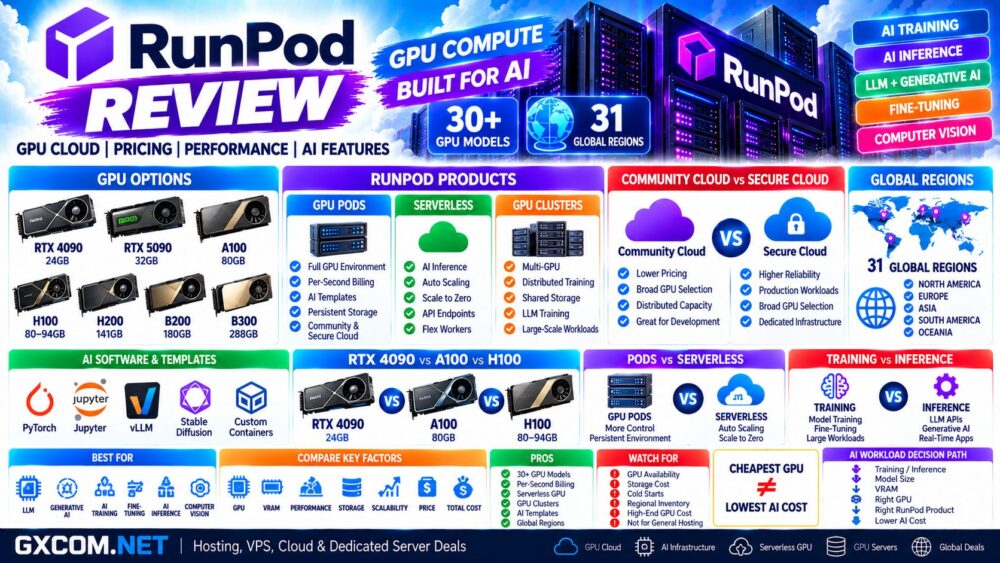
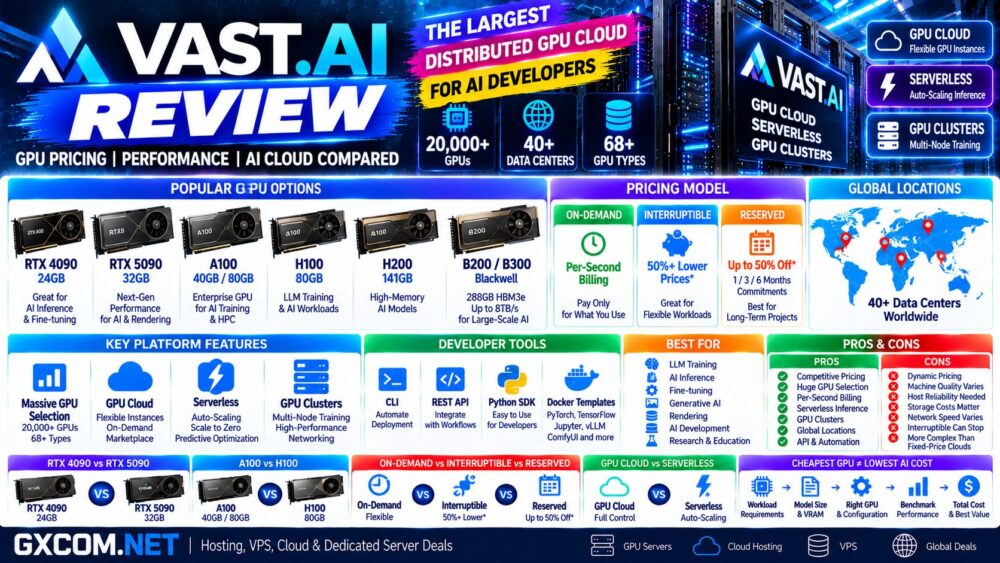
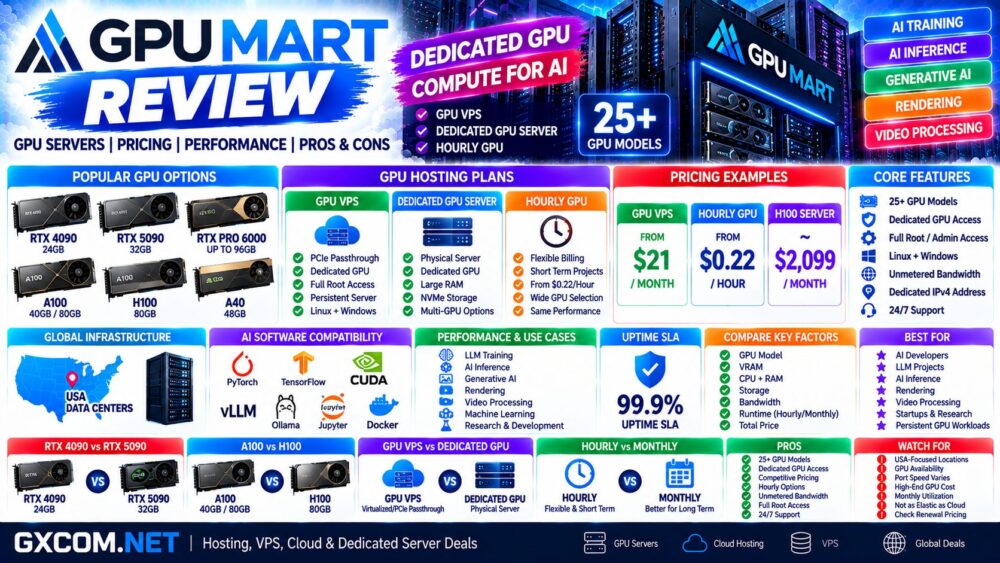
GPU Mart is a specialized GPU hosting provider designed for artificial intelligence, machine learning, LLM inference, deep learning, rendering, video processing, and other GPU-intensive workloads.
Unlike GPU marketplaces built primarily around short-lived shared or on-demand instances, GPU Mart focuses heavily on persistent GPU hosting. Its platform includes GPU VPS, dedicated GPU servers, multi-GPU systems, and selected hourly GPU rentals.
The GPU lineup ranges from inexpensive entry-level NVIDIA cards to RTX 4090, RTX 5090, RTX Pro 6000, A100, and H100 infrastructure. GPU Mart also provides full root or administrator access, persistent storage, dedicated IPv4 addresses, and unmetered bandwidth on many plans.
In this GPU Mart Review, we examine GPU server pricing, GPU VPS, dedicated GPU servers, NVIDIA H100 and A100 hosting, RTX options, performance considerations, bandwidth, operating systems, AI compatibility, support, and the major pros and cons to consider before renting a GPU server.
GPU Mart Review: Quick Overview
| Feature | GPU Mart |
|---|---|
| Company | GPU Mart / Database Mart LLC |
| GPU Mart Brand | Launched in 2021 |
| GPU VPS | Yes |
| Dedicated GPU Servers | Yes |
| Hourly GPU | Available on selected plans |
| GPU Models | 25+ |
| RTX 4090 | Yes |
| RTX 5090 | Yes |
| RTX Pro 6000 | Yes |
| NVIDIA A100 | Yes |
| NVIDIA H100 | Yes |
| Multi-GPU | Available |
| GPU VPS Starting Price | From $21/month |
| Hourly GPU | From approximately $0.22/hour on current promotional plans |
| Full Root Access | Yes |
| Linux | Yes |
| Windows | Available on applicable servers |
| Bandwidth | Unmetered on many plans |
| Uptime SLA | 99.9% |
| Support | 24/7 |
| Primary Location | USA |
| Best For | AI, LLMs, rendering, inference, development and persistent GPU workloads |
What Is GPU Mart?
GPU Mart is a GPU hosting brand under Database Mart LLC, a U.S. hosting company established in 2005. The GPU Mart brand launched in 2021 with a focus on dedicated GPU infrastructure.
Its current product lineup can be divided into three major categories:
- GPU VPS
- Dedicated GPU Servers
- Hourly GPU Servers
This is an important distinction because GPU Mart is not simply another conventional GPU cloud marketplace.
Its infrastructure emphasizes dedicated GPU access and persistent servers that can remain online for long-running workloads.
GPU Mart GPU VPS
GPU Mart's GPU VPS platform combines virtualization with a physically dedicated NVIDIA GPU.
According to GPU Mart, GPUs are assigned through PCIe passthrough rather than divided among multiple customers using GPU slicing.
That means the virtual machine receives access to an individual physical GPU while CPU, RAM, storage, and other server resources are allocated through the VPS environment.
Current GPU VPS plans support GPUs ranging from inexpensive entry-level cards through modern RTX and RTX Pro hardware.
Potential workloads include:
- AI development
- LLM inference
- Fine-tuning
- Stable Diffusion
- Machine learning
- Video processing
- 3D rendering
- Development environments
GPU Mart GPU VPS Pricing
GPU VPS pricing starts at $21 per month for entry-level GPU configurations.
However, the cheapest plan uses older low-memory GPU hardware and should not be confused with a modern AI training server.
Current examples include:
| GPU Plan | VRAM | Example Current Price* |
|---|---|---|
| Entry GPU VPS | 2GB | From $21/mo |
| RTX A4000 | 16GB | From approximately $89/mo depending on plan |
| RTX Pro 5000 | 48GB | From approximately $359/mo on current VPS configurations |
| RTX 5090 | 32GB | Approximately $292/mo on a current promotional VPS plan |
| RTX Pro 6000 | Up to 96GB | Plan dependent |
*GPU Mart pricing and promotions change frequently. Always check the current configuration, contract period, and renewal price before ordering.
GPU Mart Dedicated GPU Servers
Dedicated GPU servers remove the VPS layer and provide access to a complete physical server.
GPU Mart currently offers dedicated configurations using GPUs including:
- NVIDIA RTX series
- RTX A4000
- RTX A5000
- RTX A6000
- RTX 4090
- RTX 5090
- NVIDIA A40
- NVIDIA A100
- NVIDIA H100
- V100 and other legacy data-center GPUs
Dedicated GPU servers become more relevant when a workload requires sustained GPU utilization, large CPU and RAM allocations, persistent local storage, multi-GPU configurations, or greater control over the complete system.
Example Dedicated GPU Server Pricing
| GPU | VRAM | Example Current Price* |
|---|---|---|
| P600 | 2GB | $49/mo |
| V100 | 16GB | $229/mo |
| RTX A5000 | 24GB | Approximately $164/mo promotional |
| RTX 4090 | 24GB | Approximately $409/mo |
| RTX A6000 | 48GB | Approximately $409/mo on current AI server listings |
| NVIDIA A100 | 40GB / 80GB options | From approximately $639/mo on current rental listings |
| NVIDIA H100 | 80GB | Approximately $2,099/mo |
*Prices shown are examples from current published GPU Mart listings and can change with promotions, hardware availability, server configuration, and billing term.
GPU Mart RTX 4090 Servers
The RTX 4090 remains one of the more interesting options for users seeking strong AI performance without moving immediately to enterprise H100 pricing.
Its 24GB of GDDR6X memory can support workloads such as:
- LLM inference
- LoRA fine-tuning
- Stable Diffusion
- Generative AI
- Computer vision
- Rendering
- Video processing
GPU Mart currently lists RTX 4090 dedicated servers at around $409 per month depending on configuration.
The major limitation is VRAM.
Twenty-four gigabytes can be excellent for smaller and quantized models but becomes restrictive as model size, context length, batch size, and training requirements increase.
GPU Mart RTX 5090 Servers
The RTX 5090 increases GPU memory to 32GB GDDR7 and brings NVIDIA's Blackwell architecture into GPU Mart's newer hosting lineup.
It can be an interesting middle ground between RTX 4090-class hardware and much more expensive enterprise accelerators.
Current GPU Mart promotional VPS configurations list the RTX 5090 at around $291.85 per month with 32 CPU cores, 84GB RAM, 400GB SSD, and 500Mbps unmetered bandwidth.
Pricing and exact resources can change, so compare the complete server rather than GPU price alone.
GPU Mart A100 Servers
The NVIDIA A100 is designed for data-center AI and HPC workloads and provides substantially more GPU memory than consumer RTX cards.
GPU Mart currently offers A100 configurations with 40GB and 80GB memory options, including multi-GPU systems.
Typical workloads include:
- LLM training
- Fine-tuning
- AI inference
- Machine learning
- Scientific computing
- HPC
- Multi-GPU workloads
A100 is particularly relevant when 24GB or 32GB consumer GPU memory is insufficient.
GPU Mart H100 Servers
GPU Mart also provides NVIDIA H100 dedicated servers for demanding AI workloads.
The current H100 server listing includes an 80GB H100, a dual-Xeon CPU platform, 256GB system RAM, SSD plus NVMe and SATA storage, and unmetered network connectivity.
Current published pricing is approximately $2,099 per month.
H100 is best suited to workloads capable of taking advantage of its Hopper architecture and high-memory-bandwidth design, including:
- Large language models
- Generative AI
- LLM training
- Large-model inference
- Deep learning
- HPC
For a broader comparison, see our
NVIDIA H100 Server Hosting
guide.
GPU Mart Multi-GPU Servers
GPU Mart supports selected multi-GPU configurations for workloads that exceed the capacity of a single accelerator.
Depending on inventory, configurations can include multiple RTX, A-series, or data-center GPUs.
Multi-GPU infrastructure can help with:
- Distributed AI training
- Large-model inference
- Rendering
- Parallel compute
- HPC
However, multiple GPUs do not automatically provide linear performance scaling.
Actual results depend on the application, framework, GPU interconnect, CPU, memory, storage, and how effectively the workload distributes computation.
GPU Mart Hourly GPU Pricing
Although monthly hosting remains an important part of GPU Mart's model, the provider now also offers selected GPU infrastructure with hourly billing.
Current hourly plans begin at approximately $0.22 per hour during applicable promotions.
Examples include RTX-class dedicated servers and GPU VPS configurations.
Hourly billing can make more sense for:
- Testing
- Short AI experiments
- Temporary rendering
- Development
- Occasional model inference
Monthly pricing can become more attractive when the server runs continuously.
Short Workload → Hourly GPU
Continuous Workload → Compare Monthly GPU Hosting
Monthly vs Hourly GPU Hosting
| Factor | Hourly | Monthly |
|---|---|---|
| Commitment | Low | Higher |
| Short Experiments | Strong fit | Usually unnecessary |
| 24/7 Workloads | Can become expensive | Often more predictable |
| Budget Planning | Usage dependent | Predictable |
| Persistent Server | Plan dependent | Strong fit |
The correct calculation is:
Hourly Rate × Expected Runtime vs Monthly Server Price.
Dedicated GPU Resources
One of GPU Mart's central selling points is dedicated GPU access.
Its GPU VPS products use PCIe passthrough to assign physical GPUs to individual virtual machines, while dedicated GPU servers provide complete physical hardware.
This is different from infrastructure where multiple customers share slices of one GPU.
Dedicated GPU access can provide more predictable VRAM availability and reduce GPU contention.
CPU and other VPS resources should still be evaluated separately because a GPU VPS remains a virtual server environment.
GPU Mart Bandwidth
Many GPU Mart plans include unmetered bandwidth.
Port speeds vary by plan, with current configurations commonly showing 100Mbps, 500Mbps, or 1Gbps-class networking.
This can be useful for workloads that transfer large datasets or generated content because bandwidth overage fees can materially increase GPU cloud costs elsewhere.
However:
Unmetered Bandwidth ≠ Unlimited Network Speed.
Always compare port speed, traffic policy, network location, and workload requirements.
GPU Mart Storage
GPU Mart pricing often bundles storage with the GPU server rather than charging for every resource independently.
Dedicated server configurations can include combinations of:
- SSD
- NVMe
- Large SATA storage
This can be useful for AI workloads requiring persistent models, datasets, checkpoints, generated files, and container images.
Storage performance still matters.
Large capacity does not necessarily mean high IOPS, so training and data-processing workloads should verify where active datasets are stored.
Linux and Windows GPU Servers
GPU Mart supports both Linux and Windows environments on applicable products.
Linux is generally the natural choice for:
- PyTorch
- TensorFlow
- CUDA development
- Docker
- vLLM
- LLM inference
- AI training
Windows GPU hosting can be useful for:
- Remote GPU desktops
- Rendering software
- Video applications
- Windows-specific development
- Live streaming
Check software and GPU-driver requirements before selecting an operating system.
AI Software Compatibility
GPU Mart provides full root or administrator access, allowing customers to install their own AI software stack.
The platform currently highlights compatibility with tools including:
- PyTorch
- TensorFlow
- Keras
- Hugging Face Transformers
- Ollama
- vLLM
- Docker
- NVIDIA CUDA
- Jupyter Notebook
Compatibility ultimately depends on the selected GPU architecture, operating system, NVIDIA driver, CUDA version, and framework version.
GPU Mart for LLM Training
GPU Mart can support LLM workloads across several hardware tiers.
Smaller development and inference workloads may fit RTX-class GPUs, while larger fine-tuning and training tasks can require A100 or H100 infrastructure.
A useful selection path is:
Model Size → Precision → VRAM → GPU → GPU Count → Runtime → Total Cost.
For additional options, see our
Best GPU Servers for LLM Training and AI Inference
guide.
GPU Mart for AI Inference
Inference does not always require the most expensive GPU available.
For smaller quantized models, RTX hardware can provide better economics than an H100 that remains underutilized.
Inference buyers should compare:
- Model VRAM requirements
- Tokens per second
- Time to first token
- Concurrent users
- Batch size
- GPU utilization
- Monthly runtime
- Total cost per request
This is more useful than comparing GPU model names alone.
GPU Mart Performance
GPU Mart provides access to hardware ranging from older entry-level accelerators to modern Blackwell and Hopper GPUs.
That means there is no single “GPU Mart performance” number.
Performance depends on:
- GPU architecture
- VRAM
- Memory bandwidth
- Tensor performance
- CPU
- System RAM
- Storage
- Network
- GPU count
- Software optimization
A $21 entry GPU VPS and an H100 server target completely different workloads and should not be compared as if they were equivalent products.
Have We Independently Benchmarked GPU Mart?
This review evaluates GPU Mart using its current published hardware specifications, pricing, infrastructure information, and platform documentation.
Unless GXCOM.NET explicitly publishes a benchmark methodology and measured results, provider specifications and performance claims should not be interpreted as independent GXCOM.NET benchmark results.
For serious AI deployments, benchmark your own model before committing to a long billing term.
Useful measurements include:
- Tokens per second
- Time to first token
- Training throughput
- VRAM utilization
- GPU utilization
- Storage throughput
- Network performance
- Cost per completed workload
GPU Mart vs GPU Cloud
| Factor | GPU Mart Hosting | Typical Elastic GPU Cloud |
|---|---|---|
| GPU Access | Dedicated GPU focus | Platform dependent |
| Monthly Billing | Strong focus | Less common |
| Hourly Billing | Selected plans | Common |
| Per-Second Billing | Not the primary model | Common on some platforms |
| Persistent Workloads | Strong fit | Varies |
| Rapid Elastic Scaling | More limited | Strong |
| Full Server Resources | Bundled with many plans | Resources often billed separately |
| Best For | Long-running GPU workloads | Variable and burst workloads |
Neither infrastructure model is automatically cheaper.
For a GPU running continuously, monthly hosting can provide predictable costs. For a job that runs only a few hours each week, elastic cloud infrastructure may be more economical.
See our
NVIDIA GPU Server vs GPU Cloud
comparison for more detail.
GPU Mart vs RunPod
GPU Mart and RunPod approach GPU infrastructure differently.
| Factor | GPU Mart | RunPod |
|---|---|---|
| Primary Model | GPU hosting | GPU cloud |
| Monthly Servers | Strong focus | Usage-oriented |
| Hourly GPU | Selected configurations | Core model |
| GPU VPS | Yes | Different cloud instance model |
| Dedicated Bare Metal | Yes | Not the primary product |
| Serverless | Not the core offering | Yes |
| Persistent 24/7 Workload | Strong fit | Available but usage economics differ |
| Elastic AI Inference | Traditional persistent infrastructure | Serverless option available |
For a detailed look at RunPod, read our
RunPod Review.
GPU Mart Pros and Cons
| Pros | Cons |
|---|---|
| 25+ GPU models | Primarily U.S.-focused infrastructure |
| GPU VPS and dedicated servers | High-end GPUs remain expensive |
| Dedicated physical GPU access | Not as elastic as hyperscale GPU cloud |
| RTX, A100 and H100 options | Entry plans use older GPUs |
| New Blackwell GPU options | GPU inventory can change |
| Monthly pricing | Some promotions may change at renewal |
| Selected hourly plans | Not every GPU has the same billing options |
| Unmetered bandwidth on many plans | Port speeds vary significantly by plan |
| Full root / administrator access | Users need technical knowledge for AI stack management |
| Linux and Windows options | — |
| 24/7 support | — |
Who Should Consider GPU Mart?
GPU Mart is particularly relevant for:
- AI developers
- LLM developers
- Machine learning engineers
- AI startups
- Researchers
- Stable Diffusion users
- 3D rendering
- Video processing
- Remote GPU workstations
- Long-running inference
- Continuous GPU workloads
Its monthly hosting model becomes particularly interesting when a GPU needs to remain available for long periods rather than being created and destroyed for short jobs.
Who May Prefer an Alternative?
Users running very short AI experiments may prefer a highly elastic GPU cloud platform with per-second or purely usage-based billing.
Projects requiring global GPU regions close to users should also compare location availability carefully because GPU Mart currently emphasizes U.S. infrastructure.
Likewise, applications that require automatic serverless scaling may prefer infrastructure designed specifically around serverless inference.
Is GPU Mart Good for Long-Term GPU Hosting?
Long-running workloads are one of the more interesting use cases for GPU Mart.
Fixed monthly pricing can make infrastructure costs easier to predict when a GPU server remains online continuously.
Bundled CPU, RAM, storage, bandwidth, and GPU resources can also simplify cost calculations compared with platforms where each resource is metered separately.
However, buyers should compare the monthly price against actual GPU utilization.
A server that sits idle most of the month can still be more expensive than on-demand GPU infrastructure.
Is GPU Mart Good Value?
GPU Mart's value depends heavily on utilization.
A dedicated monthly GPU can be attractive when it is used continuously, while a short experimental workload may achieve lower total cost with hourly or serverless infrastructure.
GPU selection matters just as much.
An H100 may complete a demanding workload much faster than an inexpensive RTX GPU, but paying H100 prices for a small model that fits comfortably into 24GB of VRAM can be unnecessary.
The useful calculation is:
GPU + VRAM + CPU + RAM + Storage + Bandwidth + Runtime = Real GPU Hosting Cost.
For more providers and current offers, see our
Cheap GPU Rental Deals
comparison.
GPU Mart Review: Final Thoughts
GPU Mart occupies a useful position between conventional dedicated server hosting and highly elastic GPU cloud platforms.
Its current infrastructure spans inexpensive GPU VPS plans, modern RTX and RTX Pro hardware, dedicated GPU servers, A100 and H100 systems, multi-GPU configurations, and selected hourly rentals.
One of its major differentiators is dedicated GPU access. GPU VPS customers receive physical GPU passthrough rather than a shared GPU slice, while dedicated server customers receive the complete physical machine.
The platform is particularly relevant for persistent AI, LLM inference, rendering, development, and other GPU workloads that need predictable access to the same infrastructure for extended periods.
The trade-off is elasticity. A persistent monthly GPU server is not automatically the best economic choice for workloads that run only occasionally, and high-end accelerators such as H100 remain expensive.
Before ordering, use this decision path:
Workload → Training / Inference → Model Size → VRAM → GPU → VPS / Dedicated → Hourly / Monthly → Total Cost.