Renting an AMD Instinct MI300X GPU gives AI teams access to 192GB of high-bandwidth memory without purchasing enterprise accelerators. For large language model inference, fine-tuning, and memory-intensive computing, that capacity can reduce the need to distribute a model across several smaller GPUs.
However, the best AMD MI300X GPU cloud rental option depends on more than memory specifications. ROCm compatibility, instance availability, networking, storage, and actual workload throughput determine whether the rental delivers good value.
This guide examines MI300X hosting from Vultr and RunPod, considers dedicated infrastructure alternatives, and explains how to evaluate total deployment costs.
Why Rent an AMD MI300X GPU?
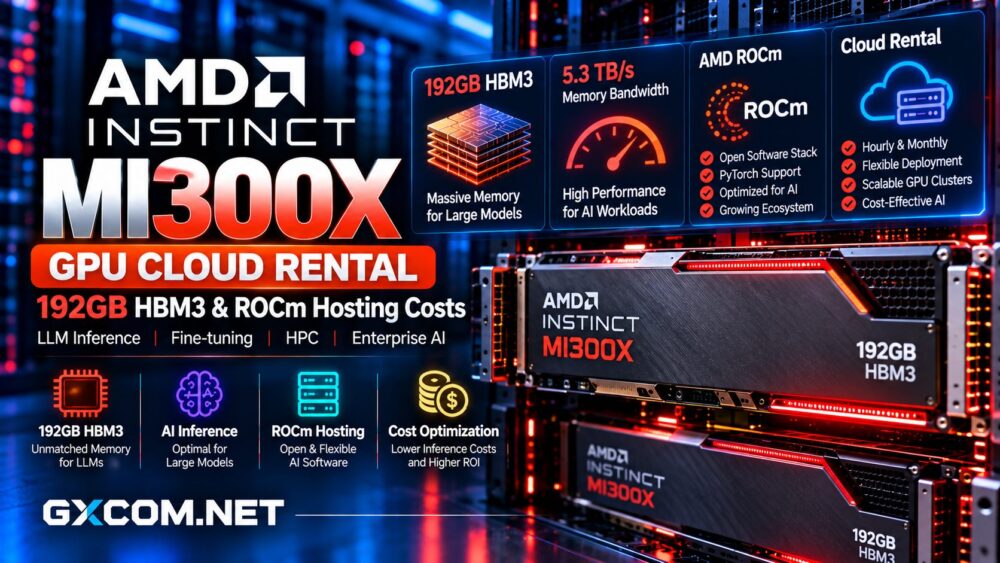
The MI300X uses AMD CDNA 3 architecture and provides 192GB HBM3 memory with up to 5.3TB/s theoretical memory bandwidth. It supports FP8, BF16, and FP16 workloads through AMD’s ROCm software ecosystem.
Its unusually large memory capacity is especially attractive for inference deployments where model weights and key-value caches consume substantial GPU memory.
| Specification | AMD MI300X |
|---|---|
| Architecture | AMD CDNA 3 |
| Memory | 192GB HBM3 |
| Peak Memory Bandwidth | 5.3TB/s |
| Software Platform | AMD ROCm |
| Eight-GPU Platform Memory | Approximately 1.5TB HBM3 |
These are hardware capabilities, not guaranteed application benchmarks. Effective performance depends on model architecture, software optimization, and deployment settings.
For infrastructure fundamentals, consult our AI server guide.
Best MI300X GPU Cloud Rental Providers
Vultr: Enterprise AMD GPU Cloud
Vultr offers cloud GPU infrastructure powered by AMD Instinct MI300X accelerators. Its published materials describe MI300X instances and self-service GPU clusters for demanding AI and high-performance computing workloads.
Vultr is particularly relevant to businesses that require scalable infrastructure, cloud networking, and support for production AI services.
Before ordering, verify the available region, GPU allocation, instance type, storage configuration, and applicable commercial terms.
Teams considering multi-GPU deployment should also request details about interconnect topology and cluster networking rather than comparing GPU counts alone.
RunPod: MI300X Rental for ROCm Workloads
RunPod publishes an MI300X GPU rental offering with 192GB HBM3 and ROCm support.
Its cloud environment is worth evaluating for developers testing large-model inference, PyTorch applications, and compatible AI frameworks.
However, a published GPU listing does not guarantee that capacity is available when a customer attempts deployment.

Check live inventory, the relevant cloud tier, storage charges, and the supported software image before budgeting a production project.
Our RunPod GPU Cloud review provides additional context about its deployment and billing approach.
Cherry Servers: Dedicated GPU Infrastructure Alternative
Cherry Servers provides dedicated bare-metal infrastructure that may appeal to teams requiring server-level control and predictable resource allocation.
Its inclusion here is as an infrastructure alternative, not a confirmed MI300X rental listing.
Buyers should request the exact accelerator model, memory configuration, provisioning timeline, networking, and monthly commitment before considering a quotation comparable to MI300X cloud offers.
MI300X Rental Pricing: What Determines the Bill?
Hourly GPU rates are useful for initial comparisons, but they rarely represent the complete deployment expense.
Use this formula:
Monthly Compute Cost = GPU Hourly Rate × GPU Count × Billable Hours
For example, at a hypothetical $2.50 per GPU-hour, running one MI300X for 200 billable hours would cost $500 in compute charges. An eight-GPU deployment over the same period would cost $4,000.
These figures are illustrative, not live provider prices. Persistent storage, networking, reservations, and additional services may increase the bill.
Compare the complete quotation against our affordable GPU server options rather than selecting infrastructure solely by hourly rate.
Is 192GB HBM3 Enough for Large Language Models?
A 70-billion-parameter model stored at BF16 precision requires approximately 140GB for weights alone, before accounting for runtime overhead and other memory requirements.
That makes the MI300X’s 192GB capacity appealing for certain single-GPU deployments.
Nevertheless, KV cache, context length, concurrent requests, temporary buffers, and framework overhead can substantially change actual memory usage.
Quantization may reduce memory requirements, but it should be validated against output quality and throughput targets.
Always test the intended model and serving configuration rather than assuming that advertised GPU memory guarantees production capacity.
ROCm Hosting: Compatibility Before Cost
MI300X uses AMD ROCm rather than NVIDIA CUDA. This distinction can influence deployment time and engineering costs.
PyTorch and popular inference frameworks such as vLLM have ROCm support, but supported versions, kernels, containers, and optimization features must be checked.
Applications relying on custom CUDA extensions may require additional development or replacement libraries.
Before renting long-term capacity, run a representative proof of concept covering model loading, inference throughput, memory usage, and application stability.
A lower GPU rate offers limited savings if migration work or software incompatibilities delay deployment.
MI300X vs NVIDIA H100 Rental Economics
The MI300X provides 192GB HBM3, compared with 80GB HBM3 on an NVIDIA H100 SXM accelerator.
Its larger memory capacity can simplify workloads that otherwise require model partitioning across multiple GPUs.
However, H100 infrastructure benefits from the mature CUDA ecosystem, and performance comparisons depend heavily on software implementation.
For workloads that fit comfortably on both accelerators, benchmark cost per completed inference request or training job rather than treating memory capacity as a performance ranking.
See our NVIDIA H100 GPU rental deals comparison for an alternative purchasing route.
When Does an Eight-GPU MI300X Cluster Make Sense?
AMD’s eight-accelerator MI300X platform combines approximately 1.5TB of HBM3 memory and high-speed Infinity Fabric connectivity.
Such infrastructure can support distributed inference, large-model training, and demanding scientific computing workloads.
Nevertheless, eight separate cloud GPU instances should not automatically be treated as equivalent to one interconnected eight-GPU server.
Verify the topology, communication bandwidth, collective operations, and workload scaling efficiency before purchasing multi-GPU capacity.
Start with a smaller benchmark where possible, then scale only when measured throughput justifies the additional expense.
Calculate Real MI300X Inference Costs
For production inference, cost per million output tokens can be more meaningful than the hourly rental rate.
Cost per Million Output Tokens = Total Infrastructure Cost ÷ Output Tokens × 1,000,000
Suppose a deployment costs $25 during a test and produces five million output tokens. Its measured infrastructure cost is $5 per million output tokens.
This example excludes expenses not captured in the test. Real comparisons should also record latency, concurrency, GPU utilization, and failed requests.
Teams should repeat measurements under realistic traffic patterns rather than relying on peak theoretical performance.
MI300X Rental Checklist
- Confirm the exact MI300X GPU allocation and available region.
- Check ROCm, framework, driver, and container compatibility.
- Measure actual model memory requirements and throughput.
- Review hourly billing, storage, and termination policies.
- Verify networking and Infinity Fabric topology for clusters.
- Compare production costs at realistic utilization levels.
Final Verdict: Which MI300X Rental Option Is Best?
Vultr is a strong candidate for enterprise MI300X cloud deployments and GPU clusters. RunPod offers another documented MI300X rental route for teams evaluating ROCm-based workloads, subject to available capacity.
Cherry Servers can be considered for dedicated GPU infrastructure when buyers are willing to verify hardware availability and request a tailored quotation.
The best AMD MI300X GPU cloud rental is not simply the cheapest advertised instance. It is the configuration that runs your workload reliably, supports your software stack, and delivers the lowest sustainable cost per useful result.