Managed hosting total cost is more than the price displayed on a hosting comparison page. Businesses pay for infrastructure, technical support, backups, software licenses, security services, and the time required to keep websites operating. A seemingly expensive managed plan may reduce administration, while a cheap introductory offer can become costly after renewals and optional services.
Understanding total cost of ownership helps you compare managed hosting with shared hosting, unmanaged VPS plans, and managed cloud services on equal terms. This guide explains the main expenses and offers a practical budgeting framework.
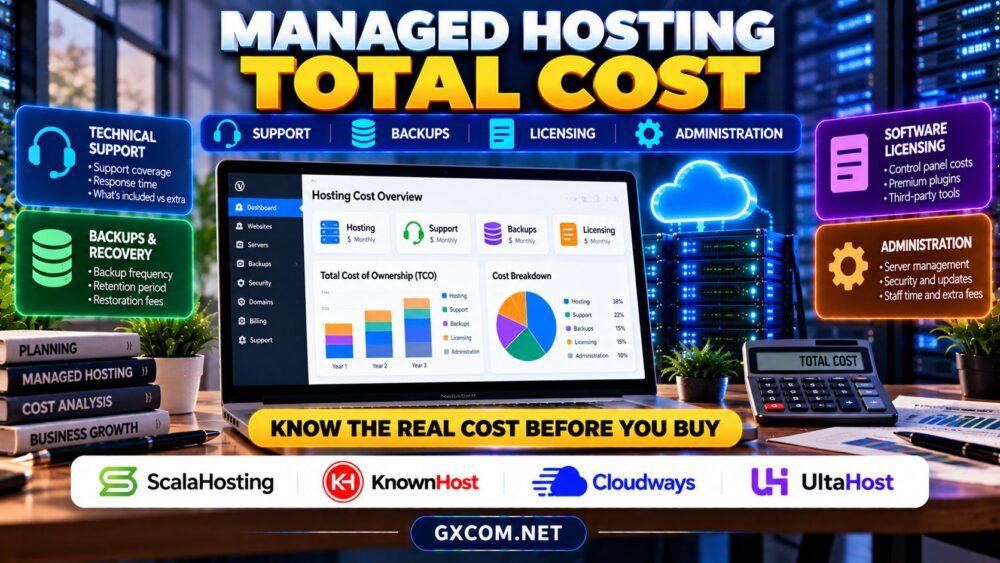
What Counts Toward Managed Hosting Total Cost?
Total cost of ownership, or TCO, includes direct payments and the operational work necessary to maintain a reliable website. Hosting invoices are straightforward to measure. Staff time, troubleshooting, downtime, and migration effort are harder to estimate but can influence the decision.
Start with a defined workload: website count, expected traffic, application stack, support requirements, and recovery objectives. Compare plans that meet the same needs instead of ranking packages by advertised monthly prices alone.
1. Infrastructure Pricing and Renewal Terms
Managed shared hosting, managed VPS, and managed cloud platforms have different pricing structures. Shared environments generally offer less infrastructure control, while VPS and cloud products may provide greater configuration flexibility. Management coverage also varies within each category.
Check introductory discounts, renewal rates, billing commitments, taxes, currency conversion, and cancellation conditions. A monthly equivalent calculated from a three-year prepayment is not the same as a flexible month-to-month price.
Ask whether CPU, RAM, storage, bandwidth, and backups are included in the base charge. Usage-based cloud billing may introduce variable costs for traffic, storage, or additional services.
2. Technical Support: Included Help vs Paid Work
Technical support is often the biggest reason to choose managed hosting, but support does not mean unlimited developer assistance. Providers may handle server monitoring and operating-system maintenance while excluding custom plugin debugging, code changes, or third-party integrations.
Review support hours, ticket priorities, emergency escalation, and whether live assistance is available. Clarify what qualifies as a managed task and whether advanced troubleshooting incurs fees.
For agencies, support quality affects staff workload. A provider that resolves infrastructure problems quickly may save billable engineering hours, even if its hosting invoice is higher. Our managed hosting for agencies guide explains client workflows and service boundaries.
3. Backups, Retention and Restoration Fees
Backups are essential, but the phrase automatic backups reveals little about recoverability. Compare backup frequency, retention duration, offsite storage, restore access, and the ability to recover individual databases or files.

Some products include basic backups while charging for longer retention, additional storage, or assisted recovery. Others place backup configuration on the customer. Ask whether backup copies survive account suspension or service cancellation.
Estimate the business impact of lost orders, membership changes, or customer submissions. A recovery plan should address both the acceptable amount of lost data and the time required to restore service.
Our WordPress backup and restore guide covers database consistency and recovery planning.
4. Control Panel and Software Licensing
Licensing can materially change the price of managed VPS or dedicated hosting. Depending on the product, control panels, operating systems, security tools, and commercial backup software may require separate subscriptions.
Ask whether the advertised price includes the control panel you intend to use, how many accounts its license supports, and whether upgrades trigger additional fees. Check license portability if you plan to migrate.
WordPress itself does not require a commercial software license, but premium themes, membership plugins, backup products, and monitoring services can increase operating costs. Record these subscriptions separately from hosting charges.
5. Four Managed Hosting Providers to Compare
ScalaHosting
ScalaHosting is relevant for businesses considering managed VPS resources. Compare the selected plan’s management coverage, control panel arrangement, backup provisions, and renewal pricing. Confirm whether the features you need are included rather than assuming all managed products share the same terms.
KnownHost
KnownHost is worth reviewing for managed hosting and technical support. Ask which server administration tasks are included, how restoration assistance works, and whether specialized software or application troubleshooting creates extra charges.
Cloudways
Cloudways provides another comparison point for managed cloud hosting. Examine the billing model, underlying infrastructure options, backup settings, support tiers, and any usage-related charges. Forecast costs using realistic traffic rather than a quiet test website.
UltaHost
UltaHost can be evaluated for managed VPS and related hosting requirements. Verify control panel licensing, backup scope, administration responsibilities, and renewal conditions for the exact package. Our UltaHost managed hosting review provides additional context for this supplier.
6. Administration Time and Security Responsibilities
Unmanaged hosting may require your team to install updates, monitor services, respond to incidents, and troubleshoot failures. Managed services can reduce some of that work, but customers often remain responsible for application updates, credentials, and custom code.
Estimate monthly administration hours and multiply them by a realistic internal labor rate. Include the time spent coordinating with support, testing updates, and maintaining documentation. Do not treat staff time as free simply because no outside invoice arrives.
Review our managed hosting security responsibilities guide before assigning patching or malware cleanup to a provider.
7. Calculate Twelve-Month and Three-Year TCO
Use this formula: total hosting payments plus licenses, backup services, monitoring, administration labor, migration costs, and expected support extras. Calculate the first twelve months separately from years two and three to expose introductory discounts.
Consider a hypothetical example: $30 monthly hosting, $10 monthly software licenses, $5 monthly backup services, and two hours of administration at $25 per hour. The annual operating total is $1,140 before migration or exceptional incidents. These figures are illustrative, not supplier quotations.
For a three-year estimate, replace promotional rates with documented renewal prices and allow for storage growth or changing workloads. Compare equal service levels and record assumptions beside every estimate.
8. When Is Managed Hosting Worth the Premium?
Managed hosting becomes attractive when the provider can reliably handle work that would otherwise consume valuable staff time or create operational risk. However, a plan with limited support and expensive extras may not deliver the expected savings.

Compare current promotions through our web hosting deals guide, but choose based on the full service scope and renewal costs.
Compare Managed Hosting Costs
Review support coverage, backup retention, licensing, and renewal terms before choosing a managed plan.
Managed Hosting Cost FAQ
Does managed hosting include all technical support?
No. Providers define support scope differently, and custom application work may be excluded.
Are backups always included in managed hosting?
Not necessarily. Frequency, retention, storage, and restoration assistance depend on the selected service.
Is managed hosting cheaper than an unmanaged VPS?
The invoice may be higher, but total cost can be lower when saved administration time and reduced operational burden justify the difference.
Final Verdict
Managed hosting total cost should be evaluated over multiple years, not just the promotional term. Compare ScalaHosting, KnownHost, Cloudways, and UltaHost using documented support boundaries, backup recovery, software licensing, and administration requirements. The best value is the plan that meets your workload and reduces predictable operational costs.