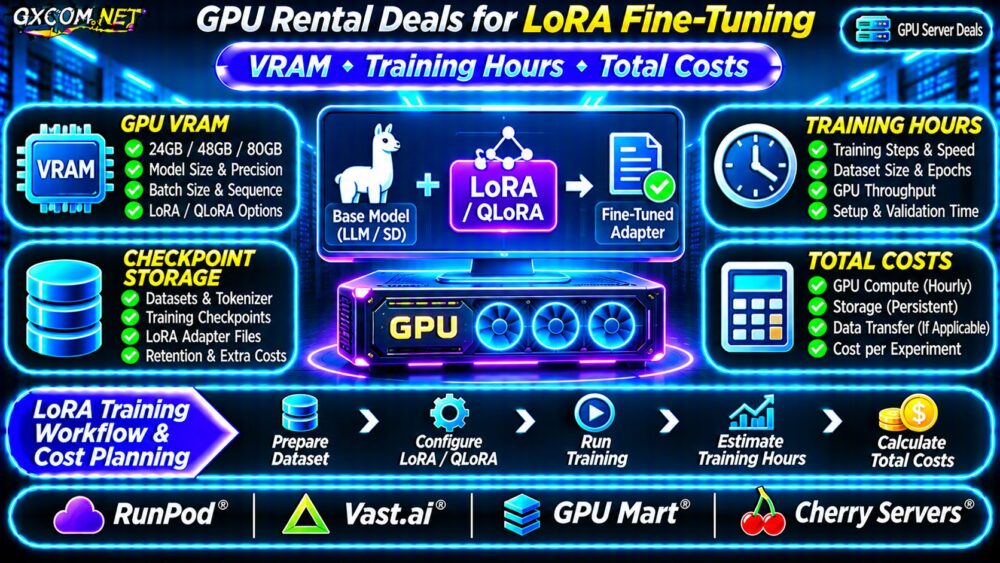
Finding competitive GPU server deals for LLM inference requires more than comparing hourly rental rates. A cheaper accelerator may support fewer concurrent requests, generate fewer tokens, or require aggressive quantization that compromises application quality.
For AI developers and SaaS businesses, the relevant purchasing metric is the cost of delivering useful inference within acceptable latency limits. This guide compares three GPU providers and explains how to evaluate memory, concurrency, billing models, and effective token costs.

Choose GPU Memory Before Comparing Rental Prices
Model weights establish the minimum memory budget, but production inference also requires KV cache, temporary activations, runtime buffers, and framework overhead. A model that loads successfully may still fail under concurrent traffic.
| Model Size | FP16 Weight Estimate | 4-Bit Weight Estimate |
|---|---|---|
| 8B | 16 GB | 4 GB |
| 14B | 28 GB | 7 GB |
| 32B | 64 GB | 16 GB |
| 70B | 140 GB | 35 GB |
These theoretical estimates use decimal units and exclude quantization metadata and runtime memory. They are not complete deployment requirements. Quantized models also require compatible kernels, and their output quality should be validated against representative tasks.
For detailed sizing, consult our GPU VRAM requirements for LLM inference guide.
Concurrent Requests: Measure Capacity Within Latency Targets
Concurrency describes simultaneous outstanding requests, not necessarily the number of sequences actively executing on a GPU. Requests may wait in a queue while available memory and scheduling capacity are exhausted.
Inference engines such as vLLM use continuous batching to improve resource utilization by admitting and removing sequences during generation. However, increasing concurrency can introduce longer queues and higher latency.
Measure time to first token, inter-token latency, aggregate output tokens per second, request completion rates, and peak memory usage. Include realistic prompt lengths, output lengths, and traffic bursts in your workload.
For purchasing decisions, define an acceptable latency target before testing. A configuration that produces more tokens while violating response-time requirements may be unsuitable for interactive applications.
Compare Three GPU Hosting Providers for LLM Inference
Affiliate disclosure: GXCOM.NET may earn a commission from qualifying purchases through affiliate links.

The following candidates represent different rental models rather than a measured performance ranking. Public product information was reviewed on November 22, 2026. Rates and availability can change.
RunPod: Flexible Pods and Serverless Inference
RunPod offers GPU Pods and serverless inference deployments. Its pricing page lists Community Cloud A100 PCIe rentals from $1.19 per hour and H100 PCIe rentals from $1.99 per hour.
Pods are worth evaluating for persistent inference endpoints and controlled benchmarking. Serverless workers may suit variable demand, although startup time, active worker settings, storage, and idle policies influence total spending.
Compare the complete deployment cost rather than assuming that Pod rental prices also apply to serverless workers.
Vast.ai: Marketplace Pricing and Rental Flexibility
Vast.ai provides marketplace-based GPU rentals with on-demand, interruptible, and reserved options. Individual offers depend on available hosts and market conditions.
Compare GPU memory, host reliability, network connectivity, disk charges, and contract duration. Interruptible instances may be useful for retryable batch inference but require additional safeguards for customer-facing APIs.
Assess data handling requirements before deploying proprietary models or sensitive customer prompts on third-party infrastructure.
GPU Mart: Dedicated Capacity for Persistent Services
GPU Mart offers dedicated GPU servers and virtual GPU hosting. Its published pricing page lists an RTX A6000 dedicated configuration with 48GB of GPU memory at $409 per month and an A100 80GB dedicated configuration at $1,559 per month.
Check the applicable commitment, setup charges, renewal terms, driver compatibility, and replacement procedures before ordering. Dedicated capacity can be attractive for sustained demand, but unused capacity still generates rental expenses.
Explore GPU Mart dedicated GPU server options.
Calculate GPU Cost per Million Output Tokens
Divide total infrastructure expenditure by successfully delivered output tokens, then multiply by one million. Include input processing, failed requests, idle time, and other billed resources in the numerator.
For a simplified compute-only comparison, use the hourly rental rate and average delivered output throughput across the entire billed period.
| Hypothetical Server | Hourly Cost | Average Output Tokens/s | Cost per Million Output Tokens |
|---|---|---|---|
| A | $0.60 | 100 | $1.67 |
| B | $1.20 | 300 | $1.11 |
| C | $2.40 | 400 | $1.67 |
These figures are illustrative assumptions, not measured GPU benchmarks or provider quotations. Server B has the lowest unit cost despite charging twice as much per hour as Server A.
Compare equivalent model versions, quantization settings, output quality, and latency targets. Otherwise, the apparent savings may reflect a weaker service rather than better efficiency.
Our L40S GPU rental deals guide provides additional context for evaluating 48GB accelerators.
Hourly vs Monthly GPU Rentals: Find the Break-Even Point
Suppose an hourly GPU costs $1.20 and equivalent dedicated capacity costs $480 monthly. Ignoring additional charges, the break-even point is 400 billed hours per month.
Below that threshold, hourly rental is cheaper. Above it, fixed monthly capacity becomes less expensive under the same assumptions. Equivalence must be established through workload testing, not GPU model names alone.

Request-driven deployments can reduce idle computing expenses, but cold starts and minimum active capacity may affect responsiveness. Persistent services may also need redundant instances, increasing their effective cost.
See our new GPU rental offers guide for additional billing and deployment considerations.
Check Deployment Costs Before Claiming a GPU Deal
Budget for persistent storage, model downloads, network traffic, monitoring, and engineering time. Determine which charges continue after stopping an instance and whether promotional pricing expires before your planned deployment ends.
For multi-GPU deployments, verify interconnect bandwidth and inference framework support. Combined memory does not automatically behave as one contiguous memory pool, and cross-device communication can reduce throughput.
Production teams should also account for redundancy, request retries, traffic spikes, and maintenance windows. Capacity planning based exclusively on average demand can underestimate the infrastructure needed during peak periods.
Review our LLM hosting requirements guide before committing to a larger configuration.
Final Verdict: Buy Useful Inference Capacity
RunPod is a useful candidate for flexible deployment, Vast.ai for marketplace-based procurement, and GPU Mart for persistent dedicated capacity. The best option depends on workload variability, security requirements, and measured service performance.
Start with a representative inference benchmark, establish latency and quality targets, and calculate costs using successfully delivered tokens. A GPU server deal is valuable only when its complete operating cost supports your application’s requirements.