


Fine-Tuning LLMs on GPU Servers: LoRA, QLoRA and Hardware Requirements
Choosing the right GPU infrastructure for large language model fine-tuning requires a different approach from ordinary LLM inference. Training workloads must account for model weights, gradients, optimizer states, activations, sequence length, and batch size. As…
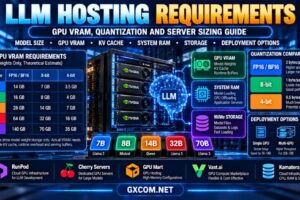
LLM Hosting Requirements: GPU VRAM, Quantization and Server Sizing Guide
Understanding LLM hosting requirements is essential before deploying a large language model on a GPU server, cloud instance, or private infrastructure. Choosing too little GPU memory can prevent a model from loading, while renting unnecessarily…

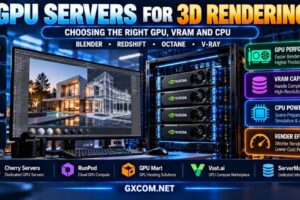
GPU Servers for 3D Rendering: Choosing the Right GPU, VRAM and CPU
Choosing the right GPU servers for 3D rendering can make a major difference to production workflows, render completion times, scene compatibility, and infrastructure costs. However, the most expensive graphics processor is not automatically the best…

AI Inference Server Hosting: GPU Memory, Latency and Cost Compared
Choosing the right AI inference server hosting solution is essential for developers and businesses deploying large language models, AI chatbots, retrieval-augmented generation (RAG) applications, and production AI APIs. Unlike AI training, inference focuses on running…
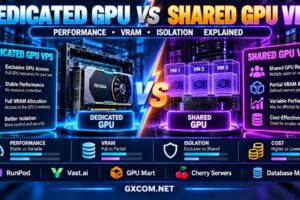
Dedicated GPU vs Shared GPU VPS: Performance, VRAM and Isolation Explained
Choosing between a dedicated GPU vs shared GPU VPS can significantly affect application performance, available VRAM, workload isolation, and hosting costs. Two GPU hosting plans may advertise similar graphics hardware yet deliver very different levels…
