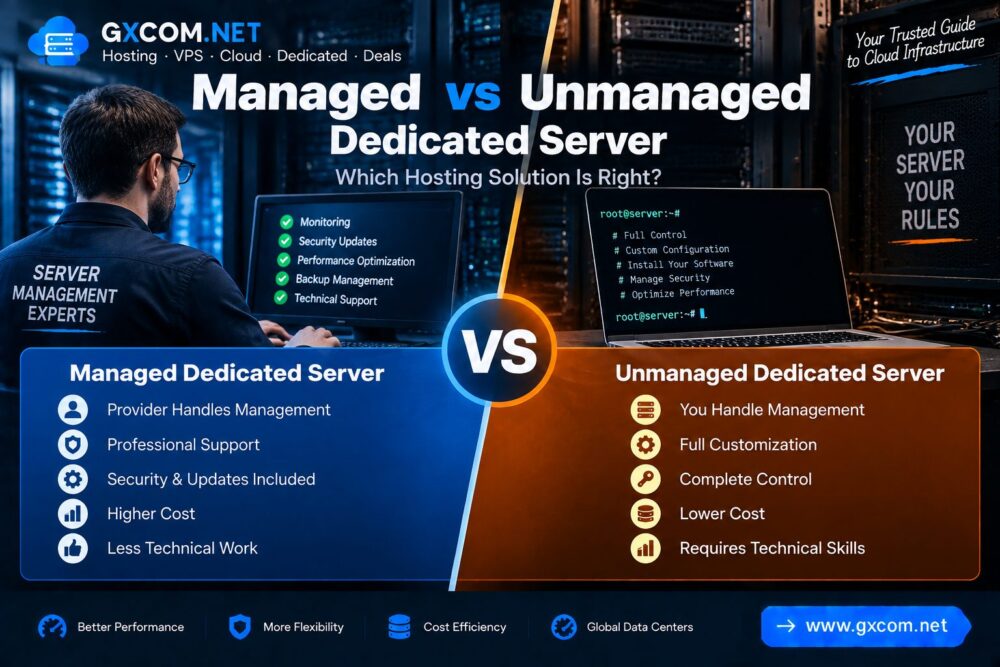
Unmanaged dedicated servers give experienced users something managed hosting cannot fully provide: direct control over the operating system, software stack, security configuration, and physical server resources. Instead of paying a hosting company to administer the server, you manage the infrastructure yourself while the provider maintains the underlying hardware and network.
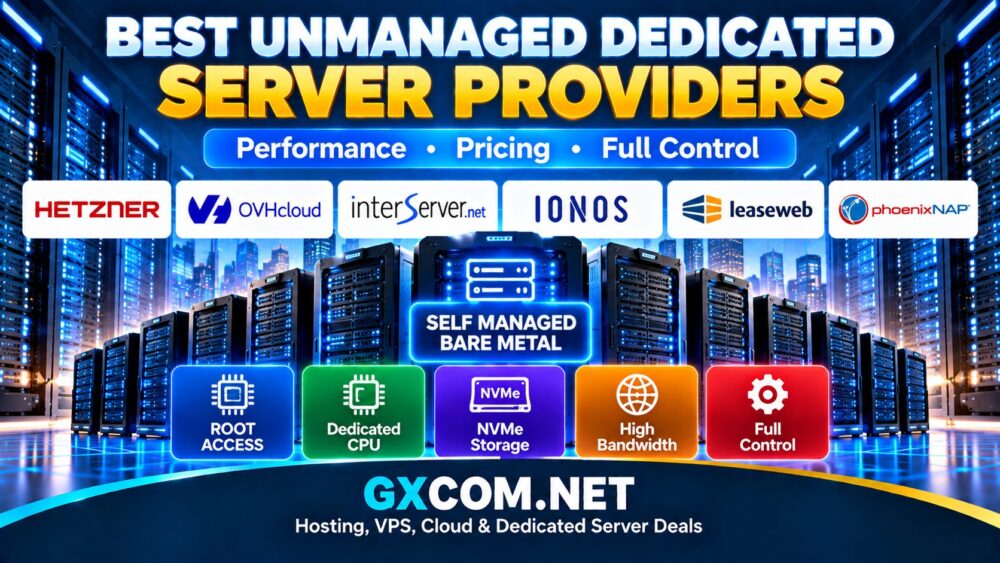
The Best Unmanaged Dedicated Server Providers combine powerful hardware, reliable networking, flexible storage, remote management tools, and competitive pricing without forcing customers into expensive management packages.
This guide compares Hetzner, OVHcloud, InterServer, IONOS, Leaseweb, and phoenixNAP for developers, system administrators, hosting companies, virtualization environments, databases, game servers, and other workloads that benefit from self-managed bare metal infrastructure.
What Is an Unmanaged Dedicated Server?
An unmanaged dedicated server is a physical machine assigned to a single customer, but most operating system and software administration remains the customer's responsibility.
The hosting company normally maintains areas such as:
- Physical server hardware
- Data center infrastructure
- Power and cooling
- Network connectivity
- Hardware replacement
- Remote management infrastructure
The customer is generally responsible for:
- Operating system configuration
- Security updates
- Firewall configuration
- Web server software
- Database administration
- Application installation
- Monitoring
- Backup strategy
- Performance optimization
- Server troubleshooting
The exact division of responsibility varies by provider, so always review the support policy before purchasing.
If you want the provider to handle more administration, compare our
Best Managed Dedicated Server Hosting
guide instead.
Best Unmanaged Dedicated Server Providers Compared
| Provider | Best For | Control Level | Key Strength |
|---|---|---|---|
| Hetzner | Price-conscious technical users | High | Hardware value |
| OVHcloud | Global bare metal infrastructure | High | Network and server range |
| InterServer | Custom US configurations | High | Hardware customization |
| IONOS | Business and developer workloads | High | Bare metal ecosystem |
| Leaseweb | Network-intensive infrastructure | High | Global infrastructure options |
| phoenixNAP | Enterprise bare metal workloads | High | Infrastructure flexibility |
The right provider depends on location, hardware requirements, bandwidth, storage, deployment model, and technical experience. Dedicated server inventory and pricing can also change frequently.
1. Hetzner
Hetzner is a popular option among experienced developers, hosting companies, and system administrators seeking dedicated hardware without paying for extensive server management.
Its dedicated server portfolio is particularly attractive when hardware value is a major consideration. Hetzner also operates a Server Auction where previously deployed dedicated machines can sometimes provide an economical way to obtain physical hardware.
Hetzner Highlights
- Competitive dedicated server pricing
- AMD and Intel hardware options
- NVMe and SSD configurations
- Server Auction options
- Root-level server control
- Suitable for experienced administrators
Hetzner can work particularly well for virtualization, web hosting, development environments, storage projects, and other workloads where the customer is comfortable administering Linux or Windows infrastructure.
2. OVHcloud
OVHcloud offers one of the broader dedicated bare metal portfolios, with server ranges designed for general business infrastructure, game hosting, virtualization, high-performance computing, storage, and enterprise workloads.
Its dedicated servers give customers administrative control over their environments. OVHcloud also provides infrastructure features such as private networking and anti-DDoS capabilities on its dedicated server platform.
OVHcloud Highlights
- Multiple dedicated server ranges
- AMD and Intel processor options
- NVMe configurations
- Global data center availability
- Private networking options
- Built-in network protection features
- Suitable for virtualization and large infrastructure projects
OVHcloud is particularly interesting when you need more than a single isolated server and expect to build clusters, private networks, virtualization environments, or hybrid infrastructure.
3. InterServer
InterServer provides dedicated and bare metal servers with a strong emphasis on hardware configuration flexibility.
Customers can choose servers based on processor, memory, storage, networking, and data center location, making the service useful when standardized hosting packages do not match the workload.
InterServer Highlights
- Custom dedicated server builds
- Multiple CPU configurations
- Flexible RAM and storage options
- US data center choices
- Remote server management capabilities
- Network-level DDoS protection
InterServer is worth considering for US-focused websites, databases, virtualization platforms, and custom applications that require specific hardware configurations.
4. IONOS
IONOS offers bare metal servers alongside its cloud, VPS, and hosting services. Its bare metal model provides dedicated hardware and administrative control for customers who want to manage their own software environments.
IONOS Highlights
- Dedicated physical resources
- Intel and AMD hardware options
- Root-level administration
- Private networking capabilities
- Business infrastructure ecosystem
- DDoS protection
IONOS can make sense for businesses that want dedicated hardware while retaining access to a broader infrastructure platform.
5. Leaseweb
Leaseweb has a long history in hosting and infrastructure services and provides dedicated server solutions for customers requiring physical hardware and network connectivity.
It can be especially relevant to technically experienced organizations running hosting platforms, applications, content delivery workloads, and other network-intensive infrastructure.
Leaseweb Highlights
- Dedicated hardware configurations
- Multiple geographic locations
- Network-focused infrastructure
- Suitable for high-bandwidth workloads
- Enterprise infrastructure options
Before purchasing, compare available server inventory, traffic policies, port speeds, remote management capabilities, and support scope for your selected location.
6. phoenixNAP
phoenixNAP provides bare metal infrastructure aimed at businesses, developers, and enterprise workloads requiring physical server resources and infrastructure automation.
phoenixNAP Highlights
- Bare metal infrastructure
- Dedicated physical resources
- Automation-oriented deployment options
- Enterprise workload support
- Suitable for infrastructure-heavy applications
phoenixNAP can be worth evaluating for organizations that need more infrastructure flexibility than conventional website-oriented dedicated hosting provides.
Unmanaged Dedicated Server Performance
Unmanaged hosting gives you administrative control, but performance still depends heavily on the physical hardware and network.
CPU Performance
Do not judge a server only by the number of cores. Processor architecture, generation, clock speed, cache, and workload characteristics all influence performance.
High-frequency processors can be attractive for game servers and certain web applications, while high-core-count CPUs may be more appropriate for virtualization, container environments, rendering, and parallel workloads.
RAM
Memory requirements become especially important when using a dedicated server for virtualization, large databases, hosting multiple websites, or running memory-intensive applications.
Check both the included RAM and the maximum upgrade capacity.
NVMe Storage
NVMe drives are increasingly important for applications requiring high storage throughput and low latency.
Databases, ecommerce platforms, virtualization environments, and dynamic websites can benefit from fast storage, but capacity and redundancy should be considered alongside raw speed.
Network Performance
A powerful physical server can still perform poorly for remote users if network connectivity is inadequate.
Compare:
- Port speed
- Included bandwidth
- Monthly traffic allowance
- Data center location
- Network peering
- DDoS protection
- Private networking
How Much Does an Unmanaged Dedicated Server Cost?
Unmanaged dedicated hosting can cost less than equivalent fully managed hosting because you are not paying the provider to perform routine system administration.
Pricing is primarily influenced by:
- CPU model and generation
- Number of CPU cores
- RAM capacity
- NVMe or SSD storage
- RAID configuration
- Bandwidth
- Network port speed
- Server location
- IPv4 requirements
- Windows or commercial software licenses
Older hardware can sometimes provide excellent value for lightweight workloads, while current-generation enterprise CPUs, large amounts of ECC memory, high-capacity NVMe storage, and high-speed networking can substantially increase monthly costs.
Budget-focused buyers should also review our
Dedicated Server Deals
section when comparing current offers.
Unmanaged vs Managed Dedicated Servers
| Feature | Unmanaged Dedicated | Managed Dedicated |
|---|---|---|
| Physical Hardware | Dedicated | Dedicated |
| Root/Admin Access | Yes | Usually available, depending on service |
| OS Administration | Customer | Provider assists |
| Security Updates | Customer | Often provider-assisted |
| Monitoring | Customer | Often included |
| Application Configuration | Customer | May be supported |
| Technical Skill Required | High | Lower |
| Management Cost | Lower | Higher |
Unmanaged hosting is generally appropriate when you already know how to secure, monitor, update, and troubleshoot a production server.
If you would rather pay the provider to handle those responsibilities, the additional cost of managed hosting may be justified.
Unmanaged Dedicated Server vs VPS
Both VPS and dedicated servers can provide root access, but the underlying infrastructure is different.
A VPS normally operates inside a virtualized environment, while a dedicated bare metal server provides access to physical server resources assigned to one customer.
Dedicated hardware can be useful for predictable high-performance workloads, large databases, virtualization, game hosting, and applications that need substantial CPU, memory, or storage resources.
However, many websites do not require an entire physical server. Our
Dedicated Server vs VPS
comparison explains when moving to bare metal makes sense.
Who Should Use an Unmanaged Dedicated Server?
Unmanaged dedicated hosting is best suited to users such as:
- System administrators
- Experienced developers
- DevOps teams
- Hosting companies
- SaaS businesses with infrastructure teams
- Game server operators
- Database administrators
- Virtualization users
- Companies running custom server stacks
It is usually not the best starting point for someone who has never administered a production Linux or Windows server.
What Are the Advantages of Unmanaged Dedicated Hosting?
Full Administrative Control
You decide which operating system, control panel, database, web server, security tools, and applications to install.
No Shared Hardware Resources
CPU, RAM, and storage resources belong to the dedicated machine rather than being divided among multiple VPS customers.
Custom Software Stack
Experienced administrators can build highly optimized environments without depending on a hosting company's standard software configuration.
Potentially Lower Management Costs
Businesses with their own technical team do not necessarily need to pay another company for routine administration they can perform internally.
What Are the Risks?
The same freedom that makes unmanaged dedicated hosting attractive also creates responsibility.
A poorly secured server can expose websites, customer data, applications, and network services to unnecessary risk.
Administrators need a strategy for:
- Security patches
- Firewall rules
- SSH or RDP security
- Malware protection
- Backups
- Monitoring
- Software updates
- Disaster recovery
Do not assume that “dedicated” automatically means secure. Hardware isolation does not replace proper system administration.
How to Choose an Unmanaged Dedicated Server Provider
Start with your workload rather than the provider's advertised starting price.
Compare these factors before ordering:
- Exact CPU model
- CPU generation
- RAM capacity and upgrade limits
- NVMe or SSD storage
- RAID options
- Network port speed
- Traffic limits
- Data center location
- DDoS protection
- Remote console or IPMI access
- Operating system installation options
- Hardware replacement policy
- Backup options
- Support boundaries
Remote management is especially important with unmanaged hosting. If an operating system becomes inaccessible, tools such as a remote console, rescue environment, or IPMI-style management interface can make recovery significantly easier.
Which Unmanaged Dedicated Server Provider Should You Choose?
Each provider approaches bare metal infrastructure differently.
Hetzner is attractive to technically experienced users looking for competitive hardware value. OVHcloud provides a broad range of bare metal infrastructure and networking capabilities. InterServer offers customizable US server configurations, while IONOS integrates bare metal into a broader business infrastructure platform.
Leaseweb can be considered for network-focused and geographically distributed infrastructure, while phoenixNAP targets more infrastructure-intensive and enterprise-oriented deployments.
Instead of selecting a provider based on brand alone, compare the exact server available in your preferred location. CPU generation, storage, bandwidth, remote management, and total monthly cost can matter more than the provider name.
Final Thoughts
Unmanaged dedicated servers provide powerful physical resources and extensive administrative freedom, but that freedom comes with responsibility.
For experienced administrators, they can deliver an excellent combination of performance, control, and cost efficiency. You can configure the operating system, security stack, databases, virtualization platform, and applications around the exact requirements of your workload.
For businesses without server administration expertise, however, the savings may not justify the additional operational burden.
Define your CPU, RAM, storage, bandwidth, location, and management requirements before comparing providers. The best unmanaged dedicated server is not simply the cheapest machine—it is the infrastructure that provides the right hardware, network, control, and recovery tools for your workload.