Choosing between an NVIDIA GPU vs AMD GPU Server is an important decision for businesses, developers and AI teams building GPU-accelerated applications. Both NVIDIA and AMD provide powerful graphics processors designed for high-performance computing, artificial intelligence, machine learning and advanced workloads.
However, the best GPU hosting solution depends on more than raw hardware specifications. Software compatibility, AI frameworks, pricing, availability, power efficiency and workload requirements all influence the right choice.
NVIDIA has established a strong position in AI computing through its CUDA ecosystem, while AMD offers competitive GPU hardware with an open software approach and attractive performance-to-cost options.
This guide compares NVIDIA GPU servers and AMD GPU servers across performance, AI compatibility, cost, scalability and real-world use cases.
Last updated: September 20, 2026. GPU availability, pricing and hardware configurations change frequently. Always verify current specifications before purchasing.
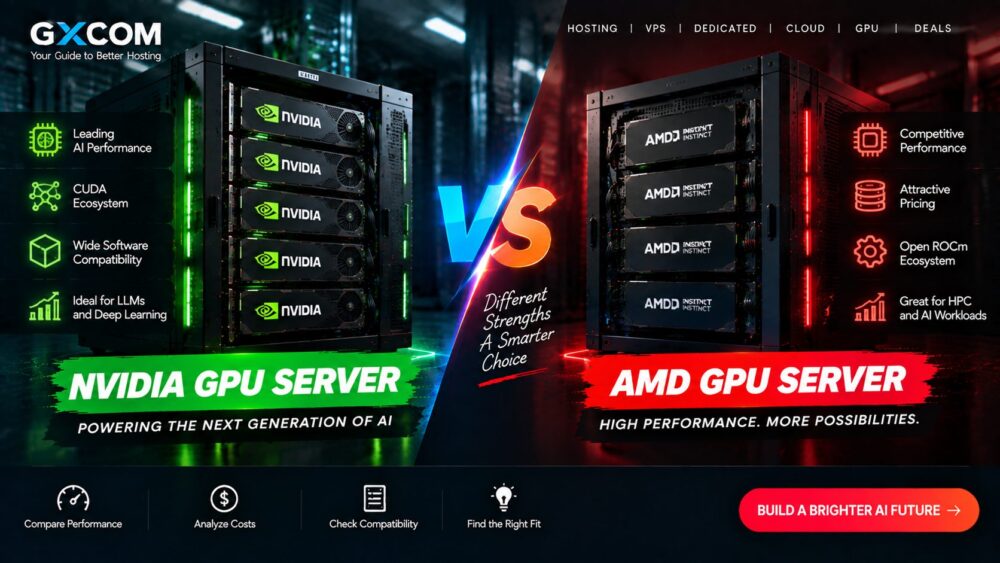
NVIDIA GPU vs AMD GPU Server: Quick Comparison
| Feature | NVIDIA GPU Server | AMD GPU Server |
|---|---|---|
| AI Ecosystem | Strong CUDA ecosystem | ROCm open software ecosystem |
| AI Compatibility | Very broad framework support | Growing support |
| Performance | High-performance AI accelerators | Competitive compute performance |
| Cost | Usually higher | Often competitive pricing |
| Best For | AI, ML and enterprise workloads | Cost-efficient GPU computing |
What Is an NVIDIA GPU Server?
An NVIDIA GPU server is a server equipped with NVIDIA graphics processing units designed for accelerated computing.
NVIDIA GPUs are widely used in artificial intelligence because of the company's CUDA programming platform and extensive developer ecosystem.
Popular NVIDIA server GPUs include:
- NVIDIA H100
- NVIDIA A100
- NVIDIA L40S
- NVIDIA RTX professional GPUs
- NVIDIA A-series accelerators
NVIDIA GPU servers are commonly used for:
- Large language models
- Deep learning training
- AI inference
- Computer vision
- Scientific computing
- Professional rendering
What Is an AMD GPU Server?
An AMD GPU server uses AMD Instinct or Radeon-based accelerators designed for high-performance computing and GPU workloads.
AMD focuses on providing competitive GPU performance with an open software ecosystem through ROCm.
Popular AMD GPU solutions include:
- AMD Instinct MI300X
- AMD Instinct MI250
- AMD Instinct MI210
- AMD Radeon Pro GPUs
AMD GPU servers are commonly used for:
- AI workloads
- High-performance computing
- Scientific research
- Data processing
- Rendering applications
Performance Comparison: NVIDIA vs AMD GPU Server
Both NVIDIA and AMD produce high-performance GPUs capable of handling demanding workloads.
However, performance depends on the specific GPU model, software optimization and workload type.
NVIDIA often performs strongly in AI applications because many frameworks and tools are optimized for CUDA.
AMD GPUs can deliver excellent compute performance, especially in workloads optimized for ROCm and open GPU computing environments.
Important performance factors include:
- GPU architecture
- VRAM capacity
- Memory bandwidth
- Tensor or AI acceleration capability
- Software optimization
- Interconnect technology
AI Compatibility: NVIDIA CUDA vs AMD ROCm
The software ecosystem is one of the biggest differences between NVIDIA and AMD GPU servers.
NVIDIA's CUDA platform has become one of the most widely adopted GPU computing ecosystems.
Many AI frameworks support CUDA optimization, including:
- PyTorch
- TensorFlow
- CUDA-based AI tools
- Deep learning frameworks
AMD uses ROCm, an open software platform designed for GPU computing.
ROCm support has expanded significantly, but compatibility varies depending on the application and framework.
AI Workload Comparison
For AI development, software compatibility can be as important as hardware performance.
| Workload | NVIDIA Advantage | AMD Advantage |
|---|---|---|
| Large AI Models | Extensive ecosystem | Competitive hardware |
| Machine Learning Research | Broad framework support | Open software approach |
| Custom AI Development | Large developer community | Flexible hardware options |
| High Performance Computing | Strong acceleration tools | High compute efficiency |
GPU Memory Comparison
GPU memory is critical for AI workloads because larger models require more VRAM.
When comparing GPU servers, check:
- Total GPU memory
- Memory bandwidth
- Number of GPUs
- GPU interconnect technology
A GPU with more memory may support larger models even if its raw processing performance differs.
Cost Comparison: NVIDIA GPU Server vs AMD GPU Server
Pricing is one area where AMD GPU servers can be attractive.
NVIDIA's strong AI market position often results in higher demand and premium pricing for popular accelerators.
AMD GPUs can provide competitive performance at potentially lower infrastructure costs depending on availability and workload requirements.
| GPU Solution | Cost Characteristics |
|---|---|
| NVIDIA GPU Server | Premium pricing with broad ecosystem |
| AMD GPU Server | Competitive hardware pricing |
The lowest hardware price is not always the lowest total cost. Software compatibility and development time should also be considered.
Power Efficiency Comparison
Power consumption is becoming increasingly important for large-scale GPU deployments.
GPU efficiency depends on:
- GPU architecture
- Workload optimization
- Cooling system
- Server configuration
Both NVIDIA and AMD continue improving performance per watt with newer generations of accelerators.
NVIDIA vs AMD GPU Server for Machine Learning
Machine learning users often prioritize framework compatibility and available tools.
NVIDIA currently has a mature ecosystem with extensive community support.
AMD can be an attractive choice for organizations with technical expertise and workloads compatible with ROCm.
NVIDIA vs AMD GPU Server for Large Language Models
Large language models require significant GPU memory and efficient acceleration.
Important factors include:
- VRAM capacity
- Memory bandwidth
- Multi-GPU scaling
- Software optimization
Organizations should evaluate the complete AI stack rather than selecting hardware based only on specifications.
NVIDIA vs AMD GPU Server for Rendering
Rendering workloads can benefit from GPU acceleration.
Professional applications may have different levels of optimization for NVIDIA and AMD hardware.
Before selecting a GPU server, verify whether your preferred software supports the chosen GPU platform.
Cloud GPU Availability Comparison
NVIDIA GPUs are widely available across major cloud GPU providers because of strong market adoption.
AMD GPU availability is increasing as more providers add alternative GPU options.
Availability can significantly affect pricing and deployment speed.
Explore our GPU server deals section for current GPU hosting offers.
When Should You Choose an NVIDIA GPU Server?
NVIDIA GPU servers are often suitable when you need:
- Maximum AI framework compatibility
- CUDA support
- Enterprise AI tools
- Large developer ecosystem
- Broad software support
When Should You Choose an AMD GPU Server?
AMD GPU servers can be suitable when you need:
- Competitive hardware pricing
- High compute performance
- Open software environments
- Specific HPC workloads
- Alternative GPU options
NVIDIA GPU vs AMD GPU Server: Which One Should You Choose?
| Choose NVIDIA GPU Server If | Choose AMD GPU Server If |
|---|---|
| You need CUDA compatibility | You prefer open GPU software |
| You run mainstream AI frameworks | Your workload supports ROCm |
| You want maximum ecosystem support | You prioritize hardware value |
| You need enterprise AI tools | You need alternative GPU solutions |
NVIDIA GPU vs AMD GPU Server: Final Checklist
The NVIDIA GPU vs AMD GPU Server decision depends on your workload, software environment and budget.
NVIDIA provides a mature AI ecosystem with extensive CUDA support, making it popular for many AI development scenarios.
AMD provides competitive GPU hardware and an expanding software ecosystem that can be valuable for specific workloads.
Before selecting GPU infrastructure, compare hardware specifications, software compatibility, pricing and long-term requirements.
GXCOM.NET will continue publishing GPU server comparisons to help developers and businesses choose the right AI computing solution.