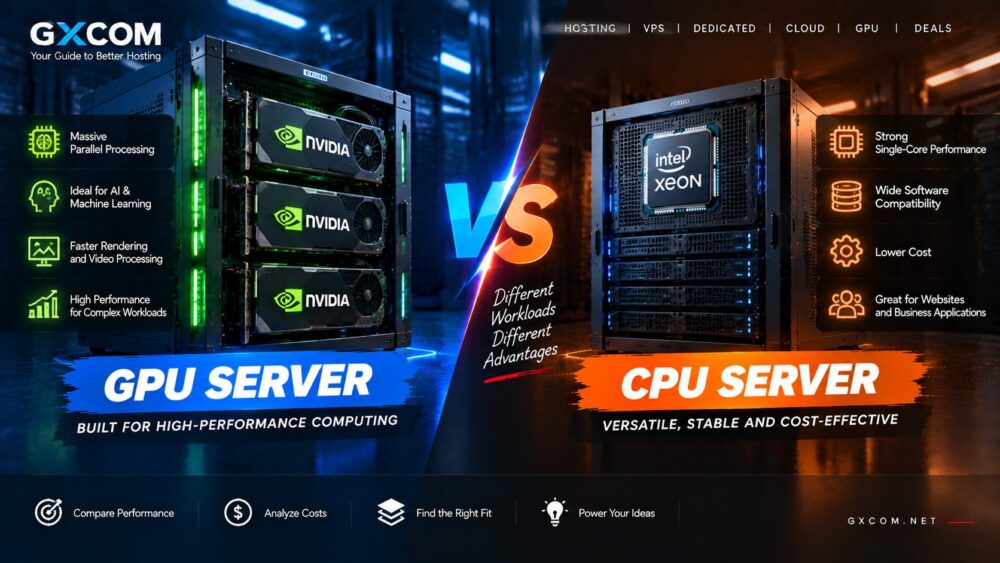
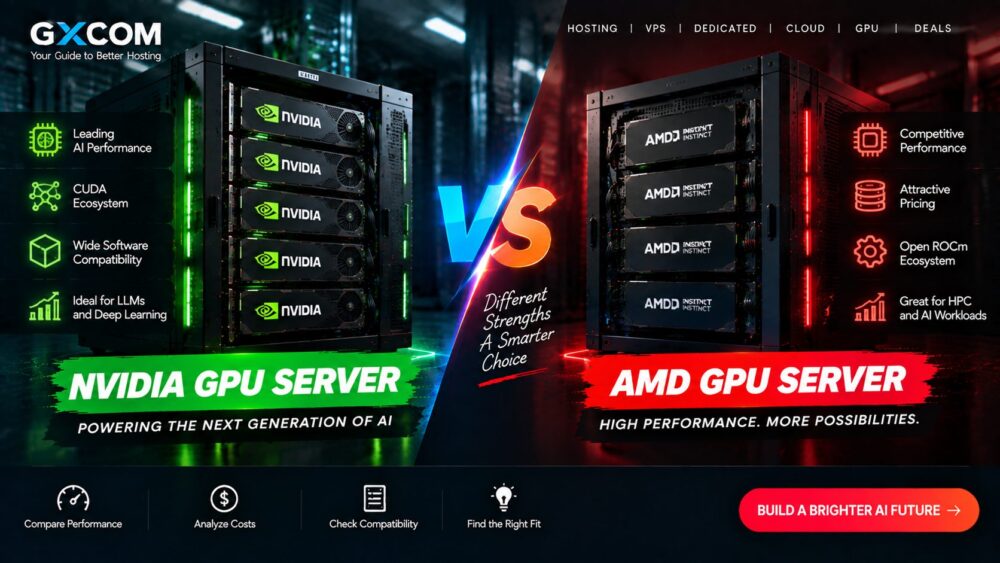
Choosing between a GPU Server vs Cloud GPU is an important decision for businesses, developers and AI teams building modern computing workloads. Both solutions provide access to powerful GPU acceleration, but they differ significantly in ownership, pricing models, scalability and operational flexibility.
A dedicated GPU server provides exclusive access to physical GPU hardware, while cloud GPU services provide on-demand access to GPU resources through cloud platforms.
The right choice depends on your AI workload, budget, usage duration, scalability requirements and technical preferences.
This guide compares GPU servers and cloud GPUs across performance, cost, flexibility, security and real-world AI applications.
Last updated: September 20, 2026. GPU hardware availability, pricing and cloud services change frequently. Always verify current configurations before purchasing.
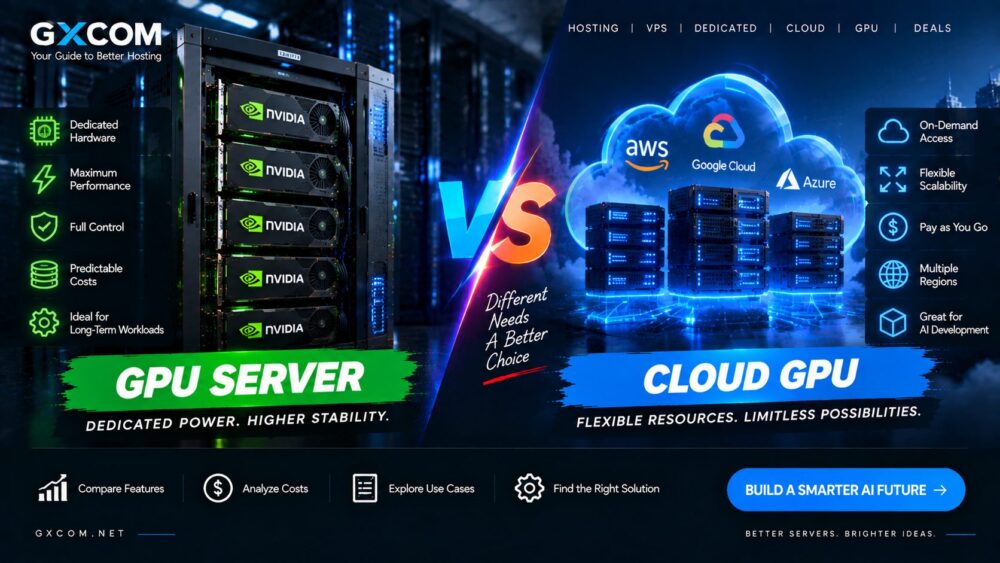
GPU Server vs Cloud GPU: Quick Comparison
| Feature | GPU Server | Cloud GPU |
|---|---|---|
| Hardware | Dedicated physical GPU machine | Virtual GPU cloud infrastructure |
| Ownership Model | Reserved hardware access | On-demand rental |
| Performance | Predictable dedicated performance | Flexible cloud performance |
| Scaling | Hardware-based expansion | Rapid resource scaling |
| Cost Model | Fixed monthly pricing | Hourly or usage-based pricing |
| Best For | Long-term AI workloads | Flexible AI development |
What Is a GPU Server?
A GPU server is a physical server equipped with one or more graphics processing units designed for accelerated computing.
The entire machine is dedicated to one customer, providing exclusive access to GPU resources, CPU, RAM, storage and network capacity.
GPU servers are commonly used for:
- AI model training
- Machine learning workloads
- Large language models
- Deep learning research
- 3D rendering
- Scientific computing
- Data processing
Dedicated GPU infrastructure is especially valuable when workloads run continuously for long periods.
What Is Cloud GPU?
A cloud GPU provides access to GPU acceleration through a cloud computing platform.
Instead of purchasing or renting an entire physical machine, users launch GPU-enabled virtual machines and pay based on usage.
Cloud GPU services are designed for flexibility, allowing users to:
- Create GPU instances quickly
- Increase or reduce resources
- Deploy across different regions
- Run temporary workloads
- Experiment with different GPU models
Cloud GPU infrastructure is popular among developers testing AI applications and companies with changing computing requirements.
Performance Comparison: GPU Server vs Cloud GPU
Performance depends on the GPU model, hardware configuration, virtualization technology and workload optimization.
A dedicated GPU server provides direct access to physical hardware, which can deliver consistent performance for long-running workloads.
Cloud GPU platforms can also provide powerful performance, especially when using high-end accelerators such as NVIDIA H100 or A100 GPUs.
The difference is usually related to resource availability and workload consistency.
For predictable heavy workloads, dedicated GPU servers can provide stable performance. For variable workloads, cloud GPUs provide more flexibility.
GPU Hardware Comparison
The GPU model is one of the most important factors when comparing AI infrastructure.
Common AI GPUs include:
- NVIDIA H100
- NVIDIA A100
- NVIDIA L40S
- NVIDIA RTX series
- AMD Instinct GPUs
When comparing GPU solutions, check:
- GPU memory capacity
- Number of GPUs
- CUDA or software compatibility
- CPU allocation
- System RAM
- Storage speed
The cheapest GPU option may not be the most cost-effective if it cannot efficiently run your workload.
Cost Comparison: GPU Server vs Cloud GPU
The biggest difference between these solutions is the pricing model.
| Solution | Pricing Style | Best Use Case |
|---|---|---|
| GPU Server | Fixed monthly cost | Continuous workloads |
| Cloud GPU | Hourly usage pricing | Temporary workloads |
For occasional AI experiments, cloud GPU pricing can be more economical because you only pay when resources are used.
For workloads running 24/7, a dedicated GPU server may provide better long-term cost efficiency.
GPU Server vs Cloud GPU for AI Training
AI model training can require significant GPU resources over long periods.
Dedicated GPU servers are often selected for:
- Large model training
- Continuous research workloads
- Private AI infrastructure
- Enterprise machine learning systems
Cloud GPUs are commonly used for:
- Testing models
- Short experiments
- Prototype development
- Temporary computing requirements
The optimal choice depends on training duration and resource requirements.
Scalability Comparison
Cloud GPU platforms have a major advantage in scalability.
Users can often launch additional GPU instances within minutes and select different hardware configurations.
Dedicated GPU servers scale differently. Increasing capacity may require:
- Adding another physical server
- Upgrading hardware
- Planning infrastructure expansion
Organizations with rapidly changing AI requirements may prefer cloud GPU flexibility.
Flexibility Comparison
Cloud GPU services provide greater flexibility because users can choose different GPU configurations depending on the project.
For example, a developer may use one GPU model for testing and a more powerful accelerator for production training.
A dedicated GPU server provides consistency because the same hardware remains available throughout the project.
Security Comparison
Both dedicated GPU servers and cloud GPU platforms can support secure AI environments.
Dedicated GPU servers provide physical hardware isolation.
Cloud GPU platforms provide security features such as:
- Identity management
- Network security controls
- Private environments
- Access permissions
- Encrypted storage
The right solution depends on your security requirements and infrastructure management approach.
GPU Server vs Cloud GPU for Businesses
Businesses should consider workload consistency when selecting AI infrastructure.
A company running continuous AI inference or model training may benefit from dedicated GPU hardware.
A startup experimenting with different AI applications may prefer cloud GPU because it reduces upfront commitment.
Explore our GPU server deals section for dedicated AI infrastructure options.
GPU Server vs Cloud GPU for Developers
Developers often prioritize flexibility and rapid experimentation.
Cloud GPU platforms allow developers to quickly test frameworks, models and different GPU configurations.
Once a workload becomes stable and predictable, moving to dedicated GPU infrastructure may reduce long-term costs.
GPU Server vs Cloud GPU for Large Language Models
Large language models require significant GPU memory and computing resources.
Factors to compare include:
- GPU VRAM capacity
- GPU interconnect technology
- Number of accelerators
- Storage performance
- Network bandwidth
Enterprise AI teams should evaluate infrastructure based on total training or inference cost rather than GPU rental price alone.
When Should You Choose a GPU Server?
A dedicated GPU server is suitable when you need:
- Long-term GPU workloads
- Predictable monthly costs
- Exclusive hardware access
- Stable AI environments
- Maximum resource control
When Should You Choose Cloud GPU?
Cloud GPU is suitable when you need:
- Short-term GPU access
- Rapid experimentation
- Flexible scaling
- Multiple regions
- No hardware commitment
GPU Server vs Cloud GPU: Which One Should You Choose?
| Choose GPU Server If | Choose Cloud GPU If |
|---|---|
| You run workloads continuously | You need temporary GPU access |
| You want fixed monthly pricing | You prefer usage-based billing |
| You need dedicated hardware | You need rapid scaling |
| You operate stable AI workloads | You experiment with AI models |
GPU Server vs Cloud GPU: Final Checklist
The GPU Server vs Cloud GPU decision depends on your workload duration, budget and scalability requirements.
Dedicated GPU servers provide predictable performance and long-term value for continuous AI workloads.
Cloud GPUs provide flexibility, rapid deployment and lower commitment for experimental or changing workloads.
Before choosing AI infrastructure, compare GPU hardware, pricing models, software compatibility and future requirements.
GXCOM.NET will continue publishing GPU server comparisons to help developers and businesses select the right AI computing solution.