Comparing managed VPS vs DevOps outsourcing helps businesses decide who should maintain their infrastructure, deploy applications, and respond when production systems fail. Both approaches reduce internal operational work, but their responsibilities and pricing models differ significantly.
Managed VPS hosting generally focuses on supported server administration. Outsourced DevOps teams may handle deployment automation, infrastructure as code, monitoring, and application delivery. Neither service automatically replaces the other.
This guide compares monthly costs, support coverage, incident response, and the situations where combining both approaches makes sense.
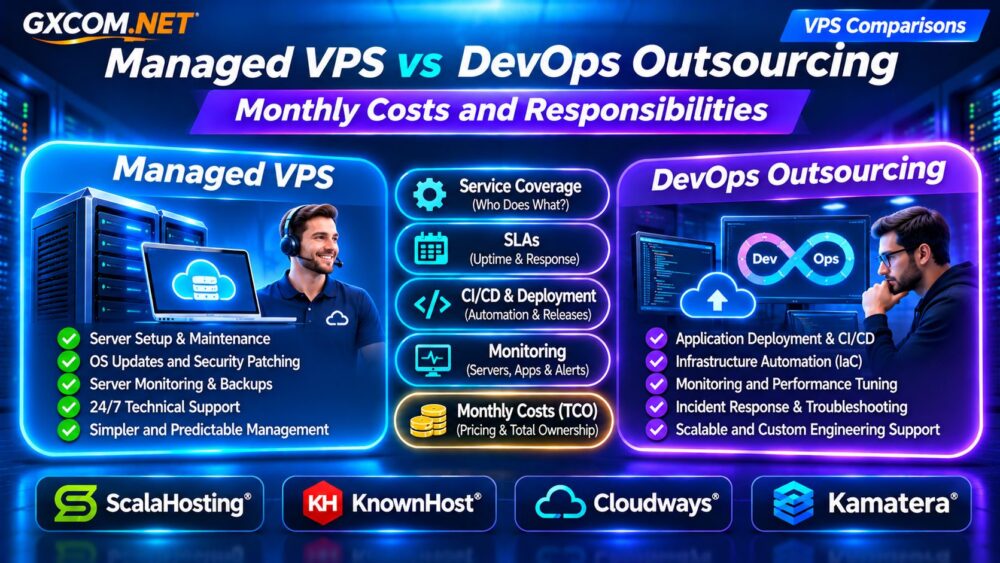
Managed VPS vs DevOps Outsourcing: Quick Comparison
| Factor | Managed VPS | DevOps Outsourcing |
|---|---|---|
| Primary focus | Server operations | Application delivery and infrastructure |
| OS patching | Often included | Contract-dependent |
| CI/CD pipelines | Usually excluded | Often available |
| Infrastructure as code | Usually excluded | May be included |
| Monitoring | Server-level coverage varies | Custom monitoring possible |
| Incident response | Within hosting support scope | Defined by agreement |
| Billing | Hosting subscription | Retainer, project, or hourly fees |
Always verify the written scope. A managed hosting label does not promise application engineering, while a DevOps contract may exclude hardware and provider-level incidents.
What Does Managed VPS Hosting Include?
A managed VPS combines virtual server resources with provider-defined administration. Depending on the package, services may cover initial configuration, operating system updates, supported web software, security assistance, and troubleshooting.
Management boundaries vary. Some providers offer control panel support and backups, while others restrict assistance to particular operating systems or software stacks.
Custom deployment pipelines, container orchestration, application bugs, and code releases often remain the customer’s responsibility.
Our Managed vs Unmanaged VPS Comparison explains these fundamental service differences.
What Does DevOps Outsourcing Cover?
DevOps outsourcing means engaging external specialists to improve software delivery and infrastructure operations. Typical projects include automated deployments, configuration management, logging, alerting, and reliability improvements.
Some contracts include continuous production support; others provide only implementation work or scheduled engineering hours.
An outsourced engineer might configure GitHub Actions, Terraform, Docker, or Kubernetes, but those technologies are not automatically included in every agreement.
Businesses should define deliverables, access permissions, documentation ownership, and emergency availability before hiring.

Who Is Responsible for Security and Updates?
Managed VPS providers may maintain supported operating system components. However, application dependencies, deployment secrets, source code, and custom integrations frequently remain outside their coverage.
DevOps contractors can automate security updates and configuration checks, but only when those duties are explicitly contracted.
Assign ownership for firewall rules, SSH access, vulnerability remediation, credentials, and backup verification. Avoid assuming another vendor handles an undocumented task.
Use our Unmanaged Server Security Checklist to identify essential safeguards.
CI/CD, Automation, and Application Deployments
Continuous integration and continuous delivery pipelines automate testing and deployment. They can reduce repetitive manual work, although poorly designed automation may introduce new failure risks.
Managed VPS support generally does not include building deployment pipelines or maintaining application-specific workflows.
DevOps specialists may implement infrastructure as code, deployment approvals, rollback procedures, and environment consistency across staging and production.
For a simple WordPress website, these services may be unnecessary. A SaaS application releasing updates several times daily may benefit substantially.
Monitoring, SLAs, and Incident Response
Server uptime monitoring does not necessarily detect failed checkout transactions, broken API endpoints, or slow database queries.
Managed VPS monitoring may focus on infrastructure availability and supported services. DevOps monitoring can extend to application metrics, logs, deployment failures, and business-specific alerts.
Compare response commitments carefully. A 24/7 help desk does not guarantee immediate engineering intervention, and an initial response target is not a guaranteed resolution time.
Define incident severity, escalation ownership, recovery objectives, and after-hours coverage. When using two vendors, document how they coordinate during outages.
Monthly Cost Comparison: Managed VPS vs DevOps
Consider a hypothetical small SaaS business comparing integrated managed hosting with an unmanaged VPS and external DevOps assistance.
| Monthly Expense | Managed VPS | VPS + DevOps |
|---|---|---|
| Server infrastructure | $85 | $35 |
| External DevOps retainer | $0 | $300 |
| Monitoring and backups | $15 | $25 |
| Internal coordination | $30 | $60 |
| Total monthly | $130 | $420 |
| Total annually | $1,560 | $5,040 |
These are illustrative budgeting assumptions, not current provider prices or representative DevOps market rates. The services are not equivalent: the second option includes engineering work that basic managed hosting may exclude.
Compare actual deliverables before interpreting the $290 monthly difference as savings.
Four Approved Infrastructure Providers to Evaluate
ScalaHosting: Managed VPS Operations
ScalaHosting is worth evaluating when businesses need VPS infrastructure and supported server administration. Compare management coverage, backup options, security assistance, and application compatibility.
KnownHost: Server Management Support
KnownHost is relevant for businesses prioritizing managed VPS maintenance and troubleshooting. Confirm supported software, escalation procedures, and whether specialized application tasks require additional expertise.
Cloudways: Managed Cloud Application Hosting
Cloudways offers a managed cloud platform approach that may reduce routine hosting administration for website and application teams. Review platform restrictions, deployment tools, and the boundaries of application-level support.
Kamatera: Configurable Cloud Infrastructure
Kamatera can be considered when a DevOps team needs flexible cloud server resources. Compare configurations, networking, management options, and operational responsibilities before deployment.
These providers are infrastructure candidates, not substitutes for a separately contracted DevOps engineering team.
When Is Managed VPS the Better Choice?
Managed VPS is often appropriate for websites, business applications, and small teams that need reliable server administration without complex deployment automation.
It can simplify billing and support coordination while reducing routine maintenance responsibilities.
For related purchasing options, explore our Managed Cloud Hosting Comparison.

When Should You Outsource DevOps?
DevOps outsourcing becomes more attractive when applications require frequent releases, multiple environments, infrastructure automation, or specialized observability.
It can also help teams lacking deployment engineering expertise, provided the contract includes documentation, access controls, and clear incident responsibilities.
Can Managed VPS and DevOps Work Together?
Yes. A managed VPS provider can maintain supported infrastructure while external DevOps specialists handle application pipelines and automation.
This hybrid approach requires clear responsibility boundaries to prevent duplicated fees and delayed incident escalation.
Our VPS Snapshot and Backup Recovery Guide can help define recovery responsibilities.
Frequently Asked Questions
Does Managed VPS Include DevOps?
Usually not full DevOps engineering. Application pipelines, infrastructure automation, and custom deployments commonly require separate services.
Is Outsourced DevOps Cheaper Than Managed VPS?
Not necessarily. Costs depend on engineering hours, required coverage, infrastructure complexity, and the services being compared.
Who Handles Production Outages?
Responsibility depends on the affected component and written agreements. Infrastructure providers and DevOps contractors may need to coordinate.
Final Verdict
Choose managed VPS when routine server administration and predictable support are the main requirements. Consider DevOps outsourcing when deployment automation, application reliability, and complex infrastructure engineering justify specialist costs.
Compare ScalaHosting, KnownHost, Cloudways, and Kamatera as infrastructure options, then document which operational tasks require additional engineering. The best decision matches actual responsibilities to your budget rather than treating both services as interchangeable.