Large language models have changed how businesses evaluate GPU servers. Raw compute performance remains important, but GPU memory capacity, memory bandwidth, interconnects, and infrastructure costs increasingly determine whether a deployment is practical.
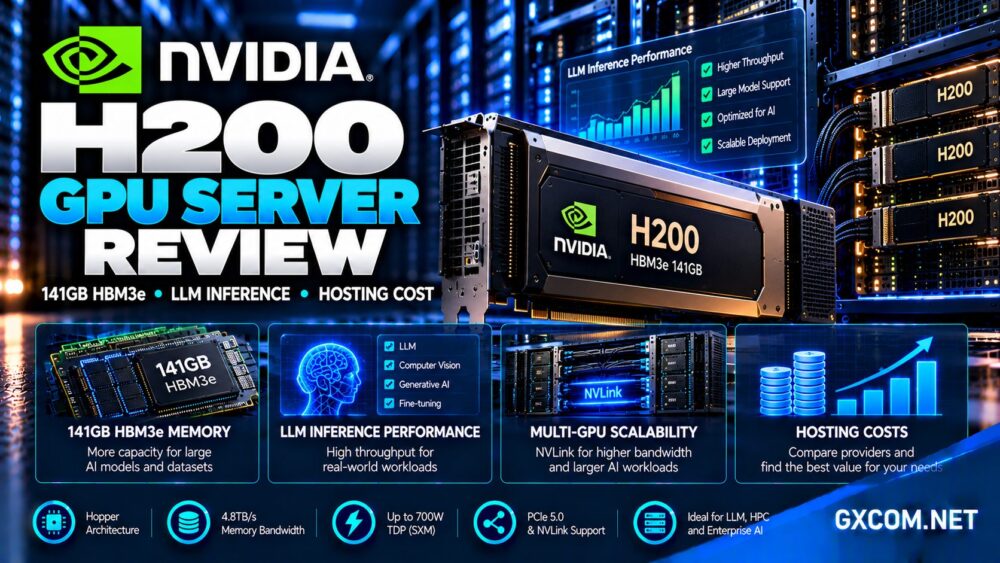
This NVIDIA H200 GPU Server Review examines the H200’s 141GB HBM3e memory, 4.8TB/s bandwidth, LLM inference capabilities, multi-GPU configurations, and hosting economics. It also explains when upgrading from an H100 makes financial sense.
NVIDIA H200 GPU Server Review: Quick Verdict
The NVIDIA H200 is a Hopper-generation data center accelerator designed for demanding AI and high-performance computing workloads.
Its defining advantage is a substantial increase in memory capacity and bandwidth compared with the H100 SXM, making it particularly attractive for memory-intensive inference and large datasets.
Our verdict: The H200 is an excellent candidate for large-model inference, high-throughput AI services, and selected training workloads. However, smaller models may run more economically on H100, L40S, or other GPUs.
Buyers should measure completed inference work per dollar rather than selecting hardware solely by memory size.
NVIDIA H200 Specifications Explained
The H200 builds on NVIDIA’s Hopper architecture and fourth-generation Tensor Cores. Its primary improvement over the H100 is the HBM3e memory subsystem.
| Specification | NVIDIA H200 |
|---|---|
| Architecture | NVIDIA Hopper |
| GPU memory | 141GB HBM3e |
| Memory bandwidth | 4.8TB/s |
| Tensor Cores | Fourth generation |
| Precision support | FP8, BF16, FP16 and others |
| Form factors | SXM and NVL/PCIe configurations |
| Maximum power | Up to 700W SXM; 600W NVL |
Peak specifications should not be confused with sustained application performance. Results depend on model architecture, batching, framework optimizations, and server configuration.
Why 141GB HBM3e Memory Matters
GPU memory capacity determines how much model data and runtime state can remain on the accelerator.
With 141GB of HBM3e, the H200 offers substantially more headroom than 80GB-class H100 configurations.
This can reduce the need to distribute certain models across multiple GPUs, simplifying deployment and potentially reducing communication overhead.
HBM3e Bandwidth and Inference
Memory bandwidth determines how quickly data can move between GPU memory and compute units.
Many autoregressive language-model inference workloads become memory-bandwidth-sensitive, particularly during token generation at lower batch sizes.
The H200’s 4.8TB/s bandwidth can therefore provide advantages beyond its larger memory capacity.
However, throughput improvements depend on the model, inference engine, precision, and request concurrency.
Model Weights Are Not the Whole Story
LLM serving requires memory for model weights, key-value caches, activations, temporary buffers, and runtime overhead.
Longer context windows and more simultaneous requests increase memory consumption.
A model that fits comfortably during a single-request test may require significantly more memory in production.
Our AI GPU VPS providers guide explains alternative deployment approaches.
H200 vs H100: Is the Upgrade Worth It?
The H100 remains a capable accelerator for AI training and inference. Moving to H200 should be justified by measurable workload improvements.
| Feature | H100 SXM | H200 SXM |
|---|---|---|
| Architecture | Hopper | Hopper |
| GPU memory | 80GB HBM3 | 141GB HBM3e |
| Memory bandwidth | Approximately 3.35TB/s | 4.8TB/s |
| Best consideration | Established AI workloads | Memory-intensive AI workloads |
H200 is particularly appealing when an application approaches the H100’s memory limit or spends significant time waiting on memory transfers.

For smaller models, an attractively priced H100 instance may deliver better cost efficiency.
Compare actual inference throughput and total rental expenses before upgrading.
LLM Inference Performance and Concurrency
Large language model inference involves two important phases: processing the input prompt and generating output tokens.
Prompt processing can be compute-intensive, while token generation may be constrained by memory bandwidth.
The H200’s larger memory subsystem can support more demanding model configurations and potentially greater concurrency.
What to Benchmark
Measure time to first token, output tokens per second, request latency, and throughput under realistic concurrent traffic.
Test different context lengths and batch sizes. Also monitor memory consumption, GPU utilization, and CPU bottlenecks.
Frameworks such as TensorRT-LLM and vLLM can influence performance through optimized kernels, batching, and memory management.
Do not assume published benchmark results will transfer directly to your application.
H200 SXM vs H200 NVL
NVIDIA offers different H200 deployment configurations, including SXM systems and H200 NVL products.
Both provide 141GB HBM3e memory, but their thermal design power, form factor, and multi-GPU connectivity differ.
SXM accelerators are commonly deployed in HGX platforms designed for tightly integrated multi-GPU computing.
H200 NVL supports PCIe-based server deployments and suitable NVLink bridge configurations.
When renting a server, confirm the exact accelerator variant and interconnect topology rather than relying on the generic label “H200.”
Multi-GPU H200 Servers and NVLink
Large AI models sometimes require multiple accelerators for memory capacity or throughput.
An eight-GPU H200 system offers an aggregate 1,128GB of GPU memory, but this capacity remains distributed across separate devices.
Applications need compatible tensor parallelism, pipeline parallelism, or other distributed execution methods.
NVLink and server topology influence communication efficiency, particularly for workloads exchanging large amounts of data between GPUs.
Our NVIDIA GPU server providers comparison explores infrastructure choices for multi-GPU deployments.
H200 for Training, Fine-Tuning and HPC
Although the H200 is attractive for inference, its memory capacity also benefits selected training and fine-tuning workloads.
Parameter-efficient techniques can reduce the memory needed to adapt large pretrained models.
Full training still requires substantial capacity for gradients, optimizer states, activations, and communication.
Beyond AI, the H200 can support scientific simulation, computational fluid dynamics, and other memory-intensive high-performance computing applications.
For these workloads, CPU resources, storage throughput, and interconnect performance remain important.
GPU Isolation and MIG Partitioning
NVIDIA H200 supports Multi-Instance GPU technology, allowing supported configurations to divide one accelerator into smaller isolated instances.
Partitioning can improve utilization when individual applications do not need the complete GPU.
However, a MIG instance does not expose the entire 141GB memory capacity.
Before ordering, confirm whether the rental includes a full dedicated H200, a partition, or another sharing arrangement.
Where to Rent NVIDIA H200 GPUs
GPU hosting providers differ in hardware availability, billing, networking, storage, and management options.
RunPod: Published H200 GPU Instances
RunPod lists H200 instances with 141GB memory in its cloud GPU catalog.
Its GPU Pods are relevant for developers seeking direct control over container environments and inference deployments.
Check the exact GPU configuration, available regions, storage requirements, and current rental terms.
Vast.ai: H200 Marketplace Rentals
Vast.ai provides marketplace listings for H200 and H200 NVL configurations.
It can be useful for comparing hardware availability and rental economics across hosts.
Evaluate host reliability, networking, storage charges, and maximum rental duration before deploying critical workloads.
GPU Mart: Dedicated GPU Infrastructure
GPU Mart is a relevant alternative for customers comparing GPU hosting and dedicated server solutions.
Buyers should confirm whether the required H200 SKU is actually offered, along with CPU, RAM, networking, and management specifications.
General GPU server availability should not be treated as proof of H200 inventory.
OVHcloud: Enterprise GPU Alternatives
OVHcloud offers cloud and dedicated GPU infrastructure relevant to organizations prioritizing established server operations and geographic deployment.
Compare its available accelerator models with H200 requirements rather than assuming an exact H200 instance is offered.
Our affordable GPU servers guide helps compare wider hosting options.
NVIDIA H200 Hosting Costs Explained
H200 rental pricing depends on provider inventory, region, accelerator configuration, commitment period, and included infrastructure resources.
Hourly GPU pricing alone does not capture the complete operating cost.
Persistent storage, snapshots, network transfers, reserved capacity, and idle resources may increase spending.
Calculate Cost Per Million Tokens
For LLM serving, measure total inference cost per million generated tokens at an acceptable latency and concurrency level.
For batch inference, compare completed jobs per dollar. For training, examine cost per successful experiment or completed training run.

A faster GPU can justify a higher hourly rental rate when it finishes substantially more work.
Our GPU vs CPU server comparison explains broader infrastructure economics.
When Should You Choose a Different GPU?
The H200 is not the most economical choice for every application.
Smaller inference services may fit comfortably on L4 or L40S hardware, while H100 instances can remain competitive for established AI workloads.
Newer accelerator families may offer additional advantages for specific low-precision inference and training applications.
Choose according to model memory requirements, actual throughput, deployment complexity, and total cost.
Frequently Asked Questions
How much VRAM does the NVIDIA H200 have?
The NVIDIA H200 provides 141GB of HBM3e GPU memory.
Is the H200 better than the H100?
The H200 offers more memory capacity and bandwidth, but the financial value of upgrading depends on workload performance and rental costs.
Can one H200 run a 70B language model?
Many appropriately configured 70B-class inference workloads can fit on a full H200, depending on precision, context length, concurrency, and runtime overhead.
Does the H200 support NVLink?
Yes. Supported SXM and NVL configurations provide high-speed GPU interconnect options, with topology depending on the server design.
Is H200 suitable for continuous inference?
Yes, particularly for memory-intensive workloads, but continuous operation should be evaluated using throughput, reliability, and complete hosting costs.
Final Verdict: Is NVIDIA H200 Hosting Worth It?
This NVIDIA H200 GPU Server Review finds a strong accelerator for memory-intensive LLM inference, multi-GPU AI infrastructure, and selected HPC workloads.
Its 141GB HBM3e memory and 4.8TB/s bandwidth provide meaningful advantages when model size and memory movement limit performance.
RunPod and Vast.ai offer identifiable H200 rental options, while GPU Mart and OVHcloud provide broader GPU infrastructure alternatives worth comparing.
Before committing, verify the exact H200 configuration, available memory, interconnect topology, benchmark performance, and total rental expenses. The best AI server is the one that meets production targets at a sustainable cost.