Server buyers often compare processors by core count, but a higher number of cores does not automatically deliver better application performance. Memory bandwidth, CPU frequency, virtualization overhead, storage, and software licensing can matter just as much.
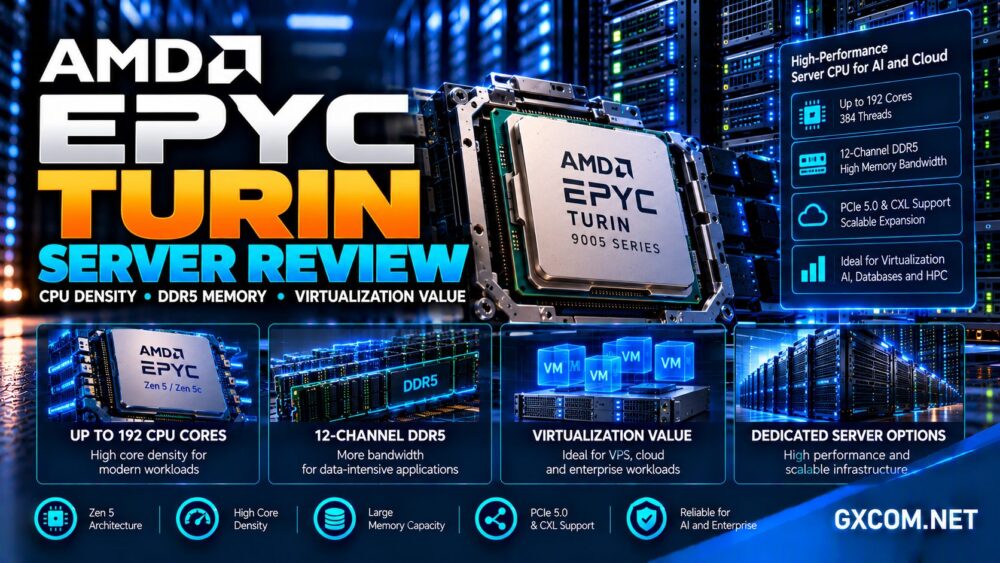
This AMD EPYC Turin Server Review examines the fifth-generation EPYC 9005 family, including CPU density, DDR5 memory, virtualization performance, and long-term server value. It also explains how to choose suitable dedicated and bare metal hosting infrastructure.
AMD EPYC Turin Server Review: Quick Verdict
AMD EPYC Turin processors offer a compelling foundation for virtualization, enterprise computing, databases, and high-density server environments.
The family includes Zen 5 and Zen 5c designs, with configurations reaching 192 physical cores per processor. Twelve DDR5 memory channels and extensive PCIe connectivity help support demanding multi-tenant workloads.
Our verdict: Turin is particularly attractive when organizations can keep many CPU cores productive. However, businesses running smaller databases, latency-sensitive applications, or lightly loaded websites may achieve better value from fewer, faster cores.
The correct choice depends on workload profiling rather than the largest available processor specification.
What Is AMD EPYC Turin?
Turin is the codename for AMD’s fifth-generation EPYC 9005 server processor family.
These CPUs build on the SP5 server platform and introduce Zen 5-based compute cores, updated platform capabilities, and higher core-density options.
AMD offers conventional Zen 5 models alongside dense Zen 5c configurations. This allows server buyers to prioritize either strong per-core performance or higher aggregate compute density.
Both approaches can be useful, but they serve different workloads.
AMD EPYC 9005 Specifications Compared
| Processor | Cores / Threads | Architecture | Typical Focus |
|---|---|---|---|
| EPYC 9965 | 192 / 384 | Zen 5c | Maximum compute density |
| EPYC 9755 | 128 / 256 | Zen 5 | High-throughput computing |
| EPYC 9655 | 96 / 192 | Zen 5 | Balanced enterprise workloads |
| EPYC 9575F | 64 / 128 | Zen 5 | Frequency-sensitive workloads |
These examples illustrate why model selection matters. A 192-core processor may provide exceptional density, while a frequency-oriented model can be more suitable for applications that do not scale efficiently across hundreds of threads.
Actual performance also depends on firmware, memory population, cooling, and power limits.
CPU Core Density: Where Turin Delivers Value
Core density measures how much processing capacity can be deployed within a server or rack footprint.
Turin’s high-core-count configurations are especially relevant for hosting providers, virtualization clusters, batch processing, and container platforms.
A single high-density system can consolidate workloads that previously required several smaller servers.
Consolidation may reduce rack space, network equipment, and administrative complexity, although it can also increase the impact of a single hardware failure.
More Cores Do Not Guarantee Faster Websites
Many web applications depend on database response times, storage latency, and individual request processing speed.
A lightly loaded WordPress website rarely benefits directly from access to hundreds of CPU cores.
High core counts become more valuable when many independent applications, virtual machines, or concurrent tasks can execute simultaneously.
Our dedicated server vs VPS comparison explains when additional physical resources justify the investment.
Zen 5 vs Zen 5c: Choosing the Right Architecture
Zen 5 and Zen 5c share important architectural capabilities, but their physical implementations prioritize different goals.
Zen 5 models offer a broad range of core counts and frequencies for enterprise applications, databases, and demanding computational tasks.

Zen 5c emphasizes density, enabling AMD to fit more cores into supported server configurations.
For virtualization providers serving many moderate-sized instances, Zen 5c can be particularly attractive.
For applications constrained by serial processing or demanding strong per-thread performance, a higher-frequency Zen 5 configuration may be preferable.
Benchmark the actual application before treating either architecture as universally superior.
DDR5 Memory Channels and Bandwidth
Modern server performance depends heavily on memory capacity and bandwidth.
AMD EPYC 9005 processors support twelve DDR5 memory channels per socket, providing substantial memory connectivity for enterprise workloads.
However, the installed DIMM configuration determines how much of that potential bandwidth becomes available.
Why Memory Population Matters
A server with many CPU cores but insufficient memory channels populated may suffer from bandwidth limitations.
Virtual machines, analytics engines, and databases can compete for memory access even when overall RAM capacity appears adequate.
Before renting a Turin server, ask about installed RAM capacity, DIMM population, supported memory speed, and upgrade options.
Memory bandwidth is especially important when workloads repeatedly process large datasets or operate across many cores.
AMD EPYC Turin for VPS Virtualization
Virtualization is one of Turin’s most commercially relevant applications.
Hypervisors such as KVM, VMware, and Hyper-V can use large EPYC systems to host numerous virtual machines.
High core counts provide scheduling flexibility, while substantial memory capacity supports more guest operating systems.
Nevertheless, the number of advertised vCPUs should not be confused with guaranteed physical CPU capacity.
Shared vCPU vs Dedicated CPU Allocation
Hosting providers may allocate virtual CPUs using different scheduling and oversubscription policies.
A shared-vCPU instance can experience contention when neighboring workloads become active.
Dedicated CPU allocation offers a different resource model, although customers should still verify the provider’s exact definition and isolation policies.
For business-critical workloads, compare sustained performance rather than relying only on advertised vCPU counts.
NUMA and Virtual Machine Placement
Non-uniform memory access, or NUMA, becomes increasingly important in large multi-core servers.
CPU cores and memory resources may be organized into locality domains. Accessing remote memory can introduce additional latency.
Virtualization administrators should consider CPU pinning, memory locality, and guest NUMA topology when configuring demanding virtual machines.
Incorrect placement can reduce performance even on expensive hardware.
Our bare metal server comparison covers additional infrastructure considerations.
PCIe 5.0, NVMe Storage and Network Expansion
Turin’s platform supports PCIe 5.0 connectivity for high-performance storage, networking, and accelerator devices.
This is valuable for servers combining fast NVMe arrays, high-speed network adapters, and GPU acceleration.
However, PCIe support alone does not guarantee that a rented server includes the fastest available SSDs or network connections.
Check actual drive models, RAID configurations, port speeds, traffic allowances, and network routing.
For databases and virtualization, storage latency can be more important than maximum sequential throughput.
EPYC Turin vs Previous-Generation EPYC
Turin improves AMD’s server portfolio through architectural updates, increased core-density options, and platform refinements.
Yet previous-generation EPYC servers can remain competitive when available at substantially lower rental costs.
A well-configured Genoa system may outperform a poorly configured Turin server for certain workloads.
Compare processor models, RAM bandwidth, storage, and sustained application performance before upgrading.
Our bare metal server providers guide helps evaluate infrastructure beyond processor branding.
Where to Rent AMD EPYC Dedicated Servers
Several established infrastructure providers are relevant when comparing AMD-powered dedicated and bare metal servers.
OVHcloud: Enterprise Dedicated Infrastructure
OVHcloud offers dedicated server product families with different processor, memory, networking, and storage configurations.
It is worth evaluating for businesses prioritizing established infrastructure, network protection features, and regional deployment choices.
Verify whether the exact EPYC 9005 model is offered in the required location before ordering.
Hetzner: Cost-Conscious Dedicated Hosting
Hetzner is a relevant comparison for buyers evaluating dedicated server economics and European infrastructure.
Its product range includes AMD-powered systems, although processor generations and available hardware vary.
Compare the complete configuration rather than assuming every AMD server uses Turin.
Cherry Servers: Configurable Bare Metal
Cherry Servers focuses on dedicated bare metal infrastructure with configurable hardware options.
It is relevant for teams needing control over operating systems, virtualization software, and physical resource allocation.
Ask for the exact CPU SKU, memory layout, storage specifications, and provisioning conditions.
NovoServe: Dedicated Server Alternatives
NovoServe provides dedicated server infrastructure for customers comparing deployment locations, hardware resources, and networking.
Its offerings are worth examining alongside other bare metal providers, particularly for sustained workloads.
Availability of any specific Turin configuration should be confirmed directly.
Our affordable dedicated server deals guide provides a broader purchasing perspective.
AMD EPYC Turin Pricing and Total Cost of Ownership
The cheapest monthly server is not necessarily the most economical platform.
Calculate cost per completed workload, per active virtual machine, or per sustained transaction rather than cost per advertised core alone.
High-density systems may reduce the number of physical servers required, but they can introduce larger memory requirements, higher power consumption, and greater failure concentration.
Software licensing can also change the calculation. Some commercial applications are licensed by physical core, processor, or virtual machine.
For these workloads, an oversized CPU may increase licensing expenses without delivering equivalent business value.
How to Benchmark a Turin Server
Test representative workloads using the intended operating system and software stack.
Measure sustained CPU throughput, per-thread latency, memory bandwidth, storage performance, and network behavior.
For virtualization, run several guest systems concurrently and monitor CPU scheduling delays, memory pressure, and noisy-neighbor effects.
Repeat tests under sustained load and confirm BIOS power settings, SMT configuration, and NUMA policies.
Frequently Asked Questions
How many cores does AMD EPYC Turin support?
The EPYC 9005 family includes configurations reaching 192 physical cores and 384 threads per processor.
Is Turin good for VPS hosting?
Yes. High core density, DDR5 connectivity, and virtualization capabilities make suitable Turin configurations attractive for hosting many virtual machines.
Is Zen 5c better than Zen 5?
Neither is universally better. Zen 5c emphasizes density, while Zen 5 configurations can offer advantages for workloads requiring different frequency and performance characteristics.
Does Turin support DDR5 and PCIe 5.0?
Yes. The EPYC 9005 platform supports twelve DDR5 memory channels and PCIe 5.0 connectivity, subject to processor and server configuration.
Final Verdict: Is AMD EPYC Turin Worth It?
This AMD EPYC Turin Server Review finds a strong platform for virtualization, high-density computing, and memory-intensive enterprise workloads.
Its strengths include flexible core configurations, substantial DDR5 connectivity, and modern server I/O capabilities.
OVHcloud, Hetzner, Cherry Servers, and NovoServe provide relevant infrastructure alternatives, but buyers should verify exact Turin availability rather than relying on general AMD server listings.
Choose a Turin server when real workload measurements justify its resources. For smaller applications, a less expensive dedicated server or appropriately configured VPS may deliver better overall value.