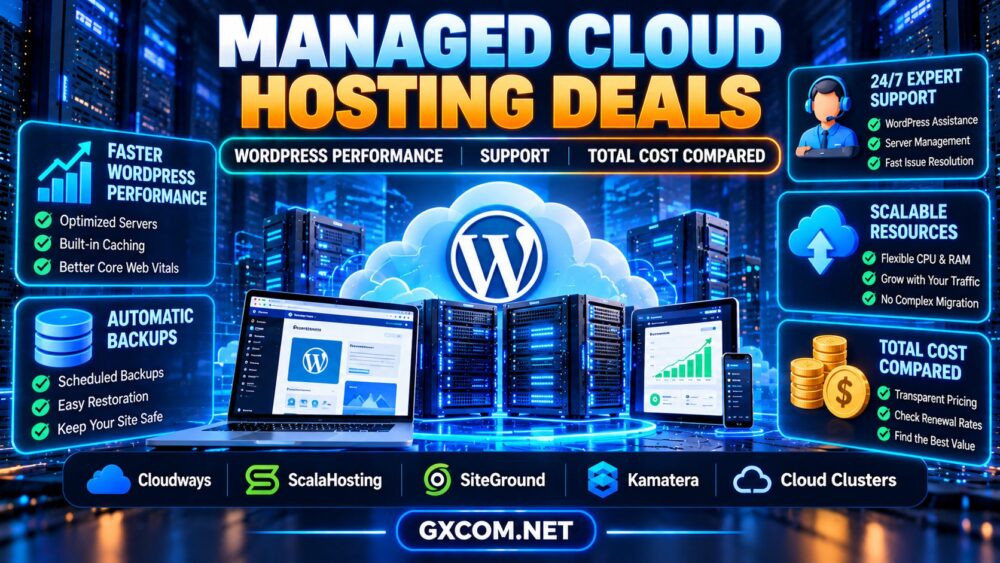
Finding the best managed cloud hosting deals involves more than comparing promotional discounts or monthly server prices. For WordPress websites, the real value of managed cloud hosting depends on performance, technical support, security, backups, scalability, and the total cost of running a website over time.
A low introductory price may appear attractive, but additional charges for backups, email hosting, premium support, storage, or traffic can change the overall value. Similarly, a more expensive managed cloud plan may reduce maintenance work and provide features that would otherwise require separate services.
This guide explains how to compare managed cloud hosting offers and examines five providers worth considering: Cloudways, ScalaHosting, SiteGround, Kamatera, and Cloud Clusters.
What Is Managed Cloud Hosting?
Managed cloud hosting combines cloud-based infrastructure with a defined level of server administration, maintenance, or application support.
Depending on the provider, management may include operating system updates, server monitoring, security configuration, backups, performance optimization, and assistance with WordPress-related problems.
However, the term “managed” does not have one universal meaning. Some providers manage the underlying server while leaving website maintenance to the customer. Others provide more extensive application-level support.
Before comparing deals, identify exactly which responsibilities the hosting company accepts.
For a broader overview of service models, read our managed cloud hosting providers comparison.
What Makes a Managed Cloud Hosting Deal Worth Buying?
A good managed cloud hosting offer should provide a suitable combination of computing resources, operational support, and predictable billing.
Important purchasing considerations include:
- CPU and RAM: Sufficient resources for WordPress, databases, plugins, and peak traffic.
- Storage: SSD or NVMe capacity appropriate for website files, databases, and growth.
- Management: Clear responsibility for server maintenance, updates, and troubleshooting.
- Backups: Documented frequency, retention, restoration, and associated charges.
- Security: Firewall controls, malware protection options, access management, and patching.
- Scalability: Practical resource upgrades without unnecessary migration.
- Support: Availability, communication channels, and the scope of assistance.
- Billing: Introductory offers, renewal rates, add-ons, and cancellation conditions.
The best value is not necessarily the plan with the largest advertised resource allocation. It is the plan that meets the website's needs without creating avoidable operating costs.
Best Managed Cloud Hosting Providers and Deals to Compare
The following providers represent different approaches to managed cloud hosting. They are comparison candidates rather than a performance ranking based on independently measured benchmarks.
| Provider | Primary Strength to Evaluate | Important Buying Check |
|---|---|---|
| Cloudways | Managed cloud platform for WordPress | Infrastructure choice, backups, add-ons |
| ScalaHosting | Managed cloud and VPS hosting | Resource allocation, management scope |
| SiteGround | Managed WordPress and cloud hosting | Plan limits, included features, renewal terms |
| Kamatera | Configurable cloud infrastructure | Optional management, licensing, total cost |
| Cloud Clusters | Application-oriented hosting options | WordPress support, service scope, backups |
1. Cloudways: Managed Cloud Hosting for WordPress
Cloudways is a strong candidate for WordPress website owners who want a managed hosting platform without handling every aspect of server administration themselves.
Its platform approach makes it relevant for agencies, developers, and businesses evaluating cloud infrastructure alongside WordPress-oriented management tools.
When comparing Cloudways offers, examine the underlying infrastructure options, server resources, backup settings, scaling process, and any separately billed services.
Best for: WordPress websites and agencies seeking a managed cloud platform with operational tools.
Check before buying: Current promotions, backup charges, email requirements, support coverage, and total monthly cost.
2. ScalaHosting: Managed Hosting With Resource Flexibility
ScalaHosting is worth considering for businesses that want managed hosting with clearly defined server resources and technical assistance.
For WordPress deployments, compare CPU allocation, memory, storage, control panel features, backup policies, and the extent of server management.
Buyers should also determine whether the selected product is a managed VPS, a cloud-based hosting service, or another hosting configuration.
Best for: Growing websites that need more resource control than conventional shared hosting.

Check before buying: Management coverage, included software, resource upgrades, data center location, and renewal conditions.
3. SiteGround: Managed WordPress and Cloud Hosting
SiteGround is another relevant option for WordPress-focused businesses evaluating managed hosting and cloud services.
Its appeal should be assessed through practical website-management features, support arrangements, caching capabilities, backup policies, and available cloud resources.
When comparing deals, distinguish standard WordPress hosting from dedicated cloud hosting products. They may have different resource models, management features, and billing structures.
Best for: WordPress-focused businesses that value an integrated hosting and website-management experience.
Check before buying: Exact product category, traffic and resource policies, included tools, and promotional versus renewal terms.
4. Kamatera: Configurable Cloud Infrastructure
Kamatera is relevant for buyers who prioritize configurable cloud resources and deployment flexibility.
However, cloud infrastructure and fully managed WordPress hosting are not automatically equivalent. Customers should confirm which administrative tasks are included and whether additional management services are required.
Its infrastructure model may appeal to technically capable teams or businesses with specific CPU, RAM, storage, and operating system requirements.
Best for: Organizations seeking flexible cloud configurations and willing to evaluate management requirements separately.
Check before buying: Management options, backup services, traffic billing, software licensing, and the full configured cost.
5. Cloud Clusters: Application-Oriented Hosting Options
Cloud Clusters can be considered when evaluating hosting services designed around particular applications and deployment requirements.
For a WordPress project, verify that the selected offering supports the intended application, required plugins, database configuration, and maintenance responsibilities.
Application hosting should not be assumed to include every feature associated with fully managed WordPress services.
Best for: Buyers researching application-oriented hosting alongside broader managed cloud alternatives.
Check before buying: Current WordPress-compatible products, support scope, backup features, resource limits, and contract terms.
WordPress Performance: What Actually Matters?
WordPress performance depends on more than the hosting provider's advertised CPU and RAM.
Database queries, caching configuration, plugins, PHP execution, storage latency, and traffic patterns can all affect how quickly pages load.
CPU and PHP Processing
CPU performance matters for dynamic requests, WordPress administration, WooCommerce checkout operations, and uncached pages.
A website with many active plugins may require more processing capacity than a simple brochure website receiving similar traffic.
RAM and Database Workloads
Memory supports application processes, database caching, and concurrent activity. Insufficient RAM can create performance problems during traffic spikes.
However, purchasing excessive RAM will not automatically fix inefficient plugins or slow database queries.
Storage and Caching
SSD or NVMe storage can help with database and file operations, but effective page caching and object caching may have a larger impact on certain WordPress workloads.
Test both cached and uncached requests when evaluating a hosting platform.
Our cloud hosting for high-traffic websites guide explores infrastructure considerations for growing traffic and demanding applications.
Managed Support: What Should Be Included?
Support quality can influence the long-term value of a managed cloud hosting plan, especially for businesses without dedicated system administrators.
Before purchasing, ask whether support includes:
- Operating system security updates.
- Web server and PHP configuration.
- Database service maintenance.
- Server monitoring and incident response.
- Backup restoration assistance.
- WordPress installation and migration.
- Plugin conflicts and application-level troubleshooting.
- Security incident investigation.
A provider may include infrastructure support while excluding third-party plugin troubleshooting or custom development work.
Review the service agreement rather than assuming every technical problem is covered by the word “managed.”
Backups, Security and Website Reliability
Managed cloud hosting can simplify maintenance, but website owners remain responsible for understanding how their data is protected.
Backup policies should specify frequency, retention, storage location, restoration procedures, and whether recovery carries an additional charge.
For business websites, test restoration before relying on backups as a disaster recovery strategy.
Security considerations include access controls, software updates, firewall configuration, malware detection, and protection of administrative accounts.
No hosting platform can guarantee that every WordPress plugin, theme, or application will remain secure without ongoing maintenance.
Managed Cloud Hosting Pricing: Introductory Deals vs Total Cost
Promotional pricing can make managed cloud hosting more attractive, but the initial advertised amount may not represent the ongoing cost.
Compare the following expenses:
| Cost Component | What to Verify |
|---|---|
| Base hosting plan | CPU, RAM, storage and included services |
| Promotional discount | Eligibility, duration and renewal price |
| Backups | Retention, storage and restoration fees |
| Email hosting | Included mailboxes or external service costs |
| Bandwidth | Traffic allowances and overage rules |
| Support | Standard assistance and premium service charges |
| Scaling | Cost of additional CPU, RAM and storage |
For an accurate comparison, estimate the cost of running the same WordPress workload for an equivalent period on each provider.
Our cloud hosting vs VPS comparison explains the infrastructure differences that can influence pricing and resource allocation.
Managed Cloud Hosting vs Unmanaged Cloud VPS
Unmanaged cloud VPS hosting may offer lower infrastructure costs, but the customer generally takes on more responsibility for operating system maintenance, security, backups, and troubleshooting.
Managed cloud hosting may reduce the time spent on routine administration, although the exact responsibilities depend on the provider and service plan.
The right choice depends on technical expertise, available staff, application complexity, and the cost of downtime.
For a developer with established automation, an unmanaged VPS may be economical. For a business owner who needs reliable WordPress operations without maintaining a server, a managed solution may provide better overall value.
How to Compare Managed Cloud Hosting Deals Fairly
- Define your workload: Record website traffic, WordPress plugins, database activity, and expected growth.
- Choose comparable resources: Evaluate CPU, RAM, storage, and traffic allowances.
- Confirm management scope: Identify exactly which server and application tasks are covered.
- Review backup policies: Include retention, restoration, and off-site storage costs.
- Compare renewal terms: Calculate the ongoing price after any introductory promotion.
- Evaluate scalability: Check upgrade options and whether resizing requires downtime or migration.
- Test performance: Measure real WordPress workloads instead of relying on marketing claims.
- Calculate total cost: Include infrastructure, management, software, backups, and support.
For additional purchasing options, explore our cloud hosting offers guide, which covers broader cloud hosting deal considerations.
Frequently Asked Questions
Are managed cloud hosting deals worth it for WordPress?
They can be worthwhile when included management, security, backups, and support reduce operational work. The value depends on the website's needs and the services actually included.
Is managed cloud hosting faster than shared hosting?
It can provide greater resource flexibility, but performance depends on the configuration, workload, caching, and infrastructure quality. Managed hosting is not automatically faster in every situation.
Do managed cloud hosting plans include backups?
Backup availability and pricing vary. Some services include backups, while others charge separately for storage, retention, or restoration.
What is the difference between Cloudways and a traditional cloud VPS?
Cloudways provides a managed cloud hosting platform, while a conventional unmanaged cloud VPS generally requires customers to handle more server administration themselves.
Are managed cloud hosting promotions available to existing customers?
Eligibility depends on the specific campaign. Some promotions are restricted to new customers, selected products, or particular billing arrangements.
Should I choose managed cloud hosting or a dedicated server?
Managed cloud hosting can suit websites needing flexible resources and operational assistance. Dedicated servers may be more appropriate when physical hardware control or specific performance requirements are essential.
Final Verdict: Choose Long-Term Value, Not Just a Discount
The best managed cloud hosting deal is the one that delivers suitable WordPress performance, clearly defined technical support, dependable backup options, and predictable operating costs.
Cloudways, ScalaHosting, and SiteGround are relevant candidates for WordPress-focused managed hosting. Kamatera offers a different infrastructure-oriented approach, while Cloud Clusters may suit specific application hosting requirements.
Compare each provider's actual product, not just the brand name. Confirm what is included, what costs extra, and what happens when a promotional period ends.
WORDPRESS WORKLOAD → CLOUD RESOURCES → MANAGEMENT → SUPPORT → BACKUPS → SCALABILITY → TOTAL COST
A well-matched managed hosting plan can provide better long-term value than a cheaper server that requires additional tools, administration, and troubleshooting.