Finding the best unmetered dedicated server deals requires more than comparing advertised bandwidth or network port speeds. A dedicated server with a 1 Gbps or 10 Gbps connection may appear attractive, but the actual value depends on traffic policies, guaranteed capacity, network quality, DDoS protection, and the total cost of hosting.
Unmetered bandwidth can be useful for websites, media delivery, large file distribution, game infrastructure, and other applications with sustained network demand. However, unmetered does not necessarily mean unlimited throughput, unrestricted usage, or a dedicated network connection.
This guide explains how to compare unmetered dedicated hosting offers, understand bandwidth limits, evaluate port speeds, and identify hidden costs before choosing a provider.
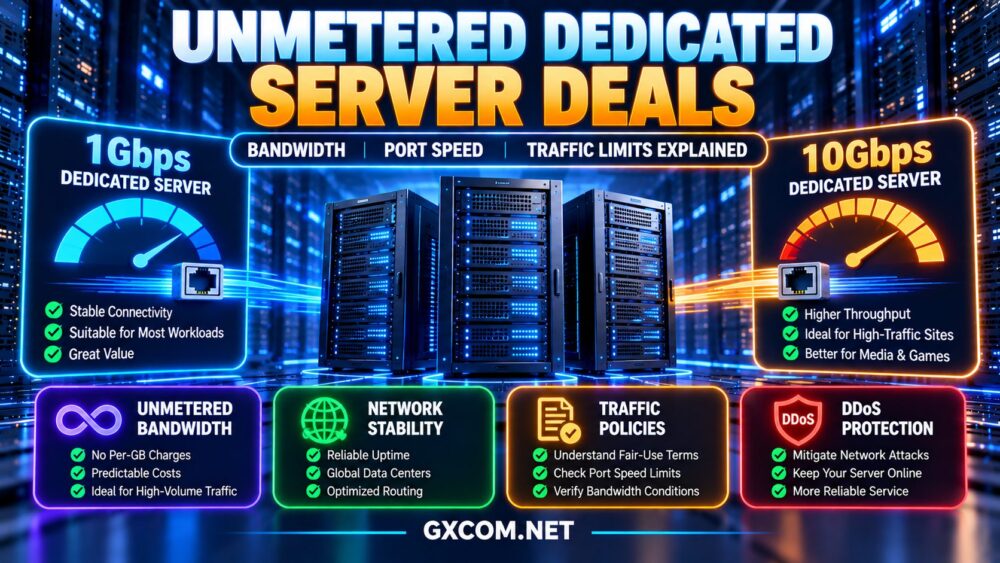
What Is an Unmetered Dedicated Server?
An unmetered dedicated server is a physical server offered with a network traffic arrangement that generally does not charge customers according to the total amount of data transferred, subject to the provider's contractual conditions.
Instead of paying for every additional terabyte, customers typically operate within a specified network port capacity or bandwidth policy.
However, the precise meaning of unmetered varies between providers and products.
Some plans provide a specified port speed with no stated monthly transfer quota. Others apply fair-use rules, shared network capacity, sustained utilization restrictions, or additional conditions.
Before purchasing, confirm whether the advertised bandwidth is shared, dedicated, guaranteed, or subject to congestion management.
For an introduction to physical hosting infrastructure, read our dedicated server hosting guide.
Unmetered vs Unlimited Bandwidth: What Is the Difference?
The terms “unmetered” and “unlimited” are often used in server marketing, but they should not be treated as interchangeable technical guarantees.
Unmetered Bandwidth
Unmetered generally refers to a billing arrangement in which traffic volume is not charged per gigabyte or terabyte within the agreed service conditions.
The server still has physical and contractual limits, including its network port speed and the provider's infrastructure capacity.
Unlimited Bandwidth
Unlimited is a marketing term that may describe an absence of a stated monthly transfer quota. It does not remove physical bandwidth constraints or contractual restrictions.
Even a plan marketed as unlimited may be subject to acceptable-use policies or traffic management.
Metered Bandwidth
Metered plans commonly include a defined traffic allowance or usage-based billing model. Exceeding the allowance may result in additional charges, reduced speeds, or other actions specified by the provider.
| Bandwidth Model | Typical Billing Approach | Main Risk to Check |
|---|---|---|
| Unmetered | No per-GB billing within plan terms | Port capacity and fair-use restrictions |
| Unlimited | No stated transfer quota in marketing | Acceptable-use and capacity conditions |
| Metered | Included traffic or usage-based charges | Overage fees and traffic allowances |
| Committed bandwidth | Contracted network capacity or billing commitment | Commitment, burst and overage rules |
Buying rule: Always read the service description and network policy rather than relying on the bandwidth label alone.
1 Gbps vs 10 Gbps Dedicated Server Ports
Network port speed describes the maximum signaling rate of a connection, not the guaranteed application throughput delivered to users.
A 10 Gbps port has a higher theoretical capacity than a 1 Gbps port, but actual throughput depends on upstream capacity, routing, congestion, packet processing, and the provider's service agreement.
1 Gbps Dedicated Server Port
A 1 Gbps port may be sufficient for many websites, business applications, moderate file distribution workloads, and game server environments.
However, operators expecting sustained high-volume transfers should estimate peak throughput and confirm whether the port is shared or dedicated.
10 Gbps Dedicated Server Port
A 10 Gbps port can be useful for high-throughput applications, large file distribution, storage transfers, and infrastructure serving significant concurrent traffic.
Nevertheless, a 10 Gbps physical port does not guarantee that the customer can continuously use the full capacity.
The provider may offer a 10 Gbps port with a lower committed bandwidth allocation, traffic shaping, or shared upstream resources.
How Much Data Can a Network Port Transfer?
The following estimates assume continuous utilization at the stated rate for 30 days, using decimal units and excluding protocol overhead.
| Continuous Throughput | Approximate Transfer in 30 Days |
|---|---|
| 100 Mbps | 32.4 TB |
| 250 Mbps | 81 TB |
| 500 Mbps | 162 TB |
| 1 Gbps | 324 TB |
| 10 Gbps | 3.24 PB |
These are mathematical capacity estimates, not provider performance benchmarks or guaranteed transfer allowances. Real applications experience variable traffic, network overhead, and other limits.

A server with a high-speed port but restricted sustained bandwidth may deliver substantially less traffic than its theoretical maximum.
Best Dedicated Server Providers to Compare for Unmetered Bandwidth
The following providers are relevant candidates when researching dedicated server infrastructure and network options. Specific unmetered plans, port speeds, and bandwidth policies must be verified individually before purchasing.
| Provider | Primary Evaluation Area | What to Confirm |
|---|---|---|
| Cherry Servers | Bare metal infrastructure and networking | Port speed, included traffic and bandwidth options |
| ServerMania | Dedicated infrastructure and network capacity | Unmetered availability, traffic policy and DDoS terms |
| Hostwinds | Dedicated hosting and management | Transfer limits, port capacity and upgrade conditions |
| DediXLAB | Hardware configurations and budget | Actual bandwidth allocation and network policies |
| GTHost | Regional dedicated server options | Location, network routing and traffic restrictions |
Cherry Servers: Bare Metal Networking Flexibility
Cherry Servers is worth evaluating for businesses that need dedicated physical resources and control over server infrastructure.
For bandwidth-intensive workloads, compare available network port configurations, included transfer allowances, upgrade options, and data center connectivity.
Best fit: Technically experienced teams seeking configurable bare metal infrastructure.
Verify before buying: Whether the selected plan includes unmetered traffic, the applicable network capacity, and any additional charges.
ServerMania: Dedicated Infrastructure for Network-Heavy Workloads
ServerMania is relevant for customers comparing dedicated server hardware and network requirements.
When evaluating a high-bandwidth configuration, examine the distinction between port speed, committed throughput, included data transfer, and any available custom networking arrangements.
Best fit: Organizations with defined network requirements and persistent infrastructure workloads.
Verify before buying: Current unmetered offerings, service locations, bandwidth commitments, DDoS mitigation, and contract terms.
Hostwinds: Dedicated Hosting and Operational Support
Hostwinds is another dedicated hosting candidate for buyers who want to evaluate infrastructure alongside management and support options.
Bandwidth-intensive applications should be assessed against the exact product's traffic allowance, network port capacity, and upgrade policies.
Best fit: Businesses comparing dedicated server resources and operational assistance.
Verify before buying: Whether traffic is metered or unmetered, available bandwidth upgrades, backup options, and management responsibilities.
DediXLAB: Hardware Value and Network Specifications
DediXLAB can be considered by buyers comparing dedicated hardware configurations and operating costs.
However, an attractive processor or memory configuration should not outweigh unsuitable network terms for a bandwidth-heavy workload.
Best fit: Buyers who need to balance physical hardware requirements with a defined budget.
Verify before buying: Network port capacity, transfer limits, data center location, DDoS protection, and support conditions.
GTHost: Regional Network and Dedicated Server Options
GTHost is relevant when geographic location and network connectivity are important purchasing factors.
For applications serving users across different regions, network routes and packet loss can matter as much as advertised port capacity.
Best fit: Buyers comparing regional dedicated server infrastructure.
Verify before buying: Available locations, bandwidth billing, network test information, traffic restrictions, and incident response procedures.
For a broader comparison of physical server options, see our bare metal server comparison.
Shared vs Dedicated Bandwidth: Why It Matters
A dedicated physical server does not automatically include dedicated network bandwidth.
Some providers connect dedicated servers to shared network infrastructure, where available throughput may vary with utilization.
Other services offer committed bandwidth arrangements with more explicit capacity guarantees.
Before buying, ask:
- Is the network port dedicated to the server?
- Is the advertised bandwidth shared or committed?
- Are sustained high-throughput workloads permitted?
- Are traffic shaping or rate limits applied?
- Is there an acceptable-use or fair-use threshold?
- Can additional capacity be purchased?
For consistent high-volume traffic, contractual network capacity may be more important than the advertised port speed.
Traffic Limits and Fair-Use Policies
Unmetered hosting does not eliminate the need to review the provider's acceptable-use policy.
Potential restrictions may involve sustained utilization, abusive traffic, network congestion, prohibited activities, or specific traffic categories.
These conditions differ between providers and products.
Businesses with continuous outbound transfers should obtain written clarification about permitted usage rather than assuming that all traffic patterns are acceptable.
DDoS Protection for High-Bandwidth Dedicated Servers
DDoS protection is especially important for public-facing infrastructure that may receive malicious network traffic.
However, an unmetered connection is not a substitute for attack mitigation.
A server with a large network port can still become unavailable if an attack overwhelms upstream capacity or targets application resources.
Check whether the selected plan includes network-layer mitigation, protected IP addresses, incident support, and filtering relevant to your application protocols.
Also verify whether mitigation is included in the base price or requires a separate service.
Which Workloads Benefit From Unmetered Dedicated Hosting?
Unmetered dedicated servers may provide value when traffic demand is predictable, consistently high, or difficult to manage under fixed transfer quotas.
Media and File Distribution
Applications distributing large files or streaming media can generate substantial outbound traffic. Operators should estimate average and peak transfer rates before selecting network capacity.
High-Traffic Websites
Large websites may benefit from dedicated infrastructure, but caching, content delivery networks, and application efficiency can reduce bandwidth requirements.
Read our dedicated servers for high-traffic websites guide for additional CPU, memory, and reliability considerations.
Game Server Infrastructure
Multiplayer game hosting requires stable connectivity and low latency, but game performance also depends on CPU speed, memory, and application behavior.
Unmetered bandwidth may simplify traffic planning, although it does not automatically improve ping or tick rates.
Backup and Data Transfer Workloads
Organizations transferring large datasets may benefit from predictable network billing. Storage performance, encryption overhead, and destination capacity must also be considered.
Hidden Costs in Unmetered Dedicated Server Deals
Monthly server rental is only one part of the total infrastructure expense.
Additional costs may include:
- Upgraded network port speeds.
- Committed or guaranteed bandwidth.
- DDoS mitigation services.
- Additional IP addresses.
- Backup storage and disaster recovery.
- Server management and technical support.
- Operating system and software licensing.
- Hardware upgrades or setup fees.
Compare the complete configuration over the same billing period rather than relying on promotional starting prices.
Our bare metal server pricing guide explains hardware, bandwidth, and other infrastructure cost components in more detail.
How to Choose the Best Unmetered Dedicated Server Deal
- Measure traffic: Estimate average throughput, peak demand, and monthly transfer volume.
- Identify the bandwidth model: Confirm whether the plan is metered, unmetered, or based on committed capacity.
- Compare port speeds: Choose 1 Gbps, 10 Gbps, or another configuration based on actual demand.
- Review fair-use terms: Confirm whether sustained utilization is permitted.
- Test network quality: Evaluate routing, packet loss, and latency from relevant regions.
- Verify DDoS protection: Understand coverage, restrictions, and additional costs.
- Check hardware: Ensure CPU, RAM, and storage can process the intended workload.
- Calculate total cost: Include bandwidth upgrades, management, backups, and licensing.
Frequently Asked Questions
Does unmetered bandwidth mean unlimited data transfer?
Unmetered typically means the provider does not charge by the total amount of transferred data within the agreed plan terms. Physical port capacity, fair-use policies, and other restrictions still apply.
Is a 10 Gbps port always faster than a 1 Gbps port?
A 10 Gbps port offers higher theoretical throughput capacity, but actual performance depends on network commitments, congestion, routing, and server capabilities. It does not necessarily reduce latency.
How much data can a 1 Gbps server transfer per month?
At continuous full utilization for 30 days, a 1 Gbps connection has a theoretical transfer capacity of approximately 324 TB. Real transfer volume is usually lower and may be restricted by service terms.
Do unmetered dedicated servers include DDoS protection?
Not necessarily. DDoS mitigation availability and coverage vary by provider and plan. Confirm whether protection is included and which attacks or protocols are covered.
Is unmetered hosting better than metered hosting?
It depends on traffic demand and pricing. Unmetered hosting may offer predictable billing for sustained high-volume transfers, while metered plans can be more economical for lower or intermittent usage.
Are unmetered dedicated servers suitable for streaming?
They can be suitable for some media workloads, but operators must verify sustained throughput policies, network quality, content delivery requirements, and applicable service restrictions.
Final Verdict: Compare Network Terms, Not Just Port Speed
The best unmetered dedicated server deal combines appropriate physical hardware, predictable traffic billing, reliable network connectivity, and clearly documented service conditions.
Cherry Servers, ServerMania, Hostwinds, DediXLAB, and GTHost are infrastructure candidates worth evaluating, but buyers must confirm which current products actually provide the required unmetered bandwidth arrangement.
A high-speed port does not guarantee unlimited throughput, and unmetered billing does not eliminate fair-use restrictions.
TRAFFIC REQUIREMENTS → PORT SPEED → BANDWIDTH POLICY → NETWORK QUALITY → DDoS PROTECTION → TOTAL COST
Choose a server based on the workload you need to support and the bandwidth capacity the provider is contractually prepared to deliver.