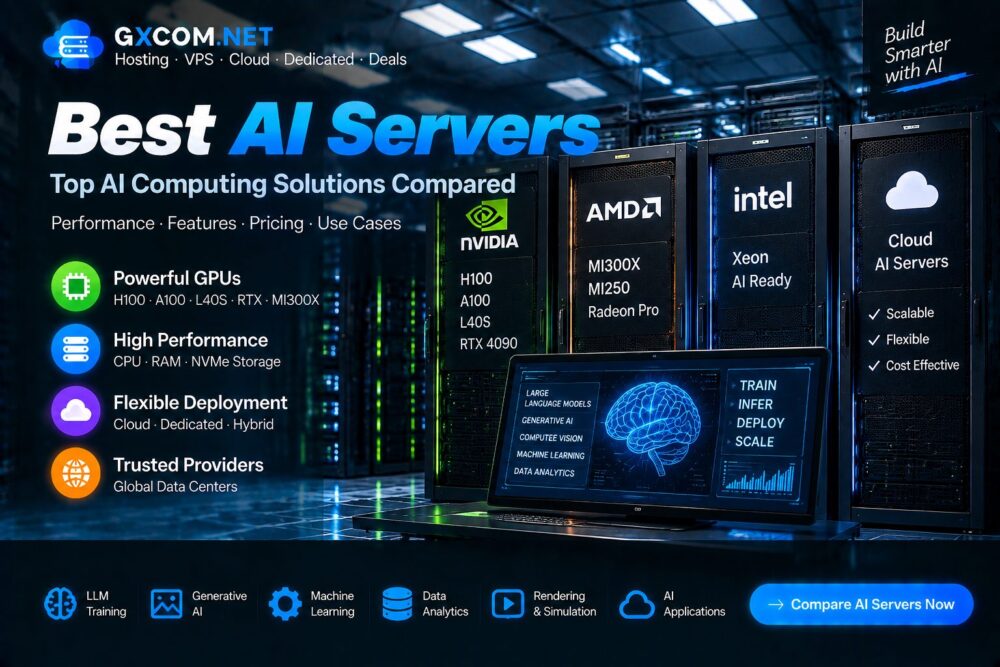
Artificial intelligence workloads require powerful computing infrastructure, but choosing between an AI server and a GPU server can be confusing.
Both solutions use advanced hardware acceleration and are designed for demanding workloads, but they focus on different requirements.
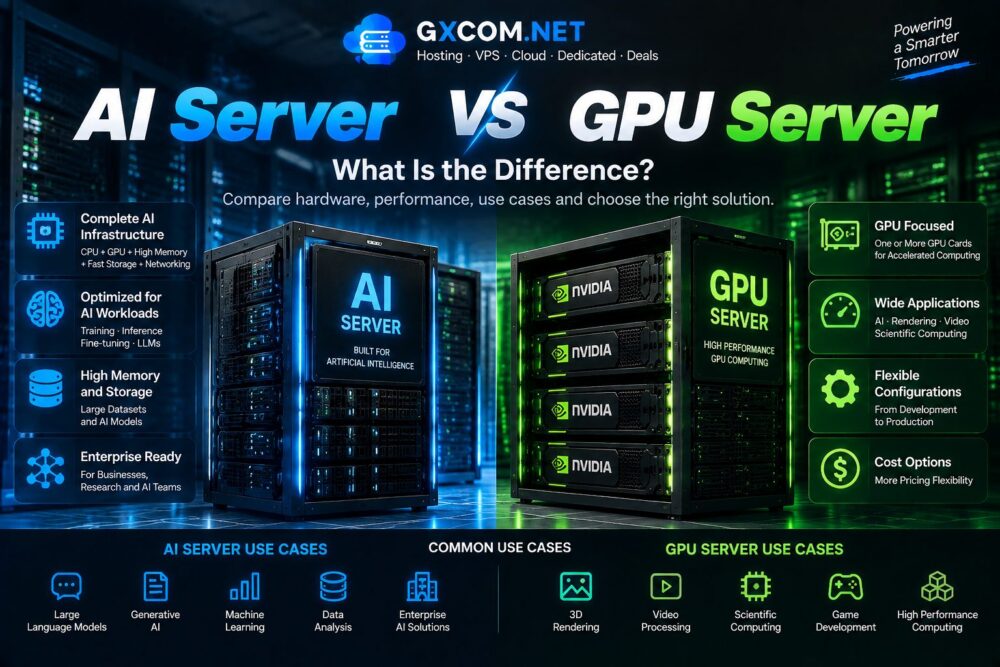
An AI server is designed as a complete artificial intelligence computing platform, while a GPU server focuses on providing high-performance GPU acceleration for various applications.
This guide explains the differences between AI servers and GPU servers, including hardware, performance, use cases and how to choose the right solution.
What Is an AI Server?
An AI server is a specialized computing system optimized for artificial intelligence workloads such as machine learning training, AI inference and large model deployment.
AI servers typically combine:
- High-performance GPUs
- Powerful CPUs
- Large memory capacity
- Fast NVMe storage
- High-speed networking
- AI software optimization
AI servers are designed to support complete AI workflows from model development to deployment.
What Is a GPU Server?
A GPU server is a server equipped with one or more graphics processing units to accelerate computing workloads.
GPU servers are commonly used for:
- Artificial intelligence
- Machine learning
- 3D rendering
- Video processing
- Scientific computing
- Cryptographic workloads
A GPU server focuses mainly on providing GPU computing power, while the final application depends on software and configuration.
AI Server vs GPU Server: Quick Comparison
| Feature | AI Server | GPU Server |
|---|---|---|
| Main Purpose | Complete AI workloads | GPU accelerated computing |
| Hardware | CPU + GPU + AI optimization | GPU-equipped server |
| Main Users | AI companies and researchers | Developers and businesses |
| Applications | Training and inference | AI, rendering and computing |
| Complexity | Higher | Flexible |
Hardware Differences Between AI Servers and GPU Servers
GPU Configuration
Both AI servers and GPU servers may use advanced GPUs such as NVIDIA H100, A100 and RTX series.
The difference is that AI servers are usually optimized around AI workloads, while GPU servers provide general GPU acceleration.
CPU Processing
AI servers often use powerful CPUs to handle large datasets, model preparation and distributed computing tasks.
Memory Requirements
AI workloads frequently require large amounts of RAM and GPU memory because modern models can contain billions of parameters.
Storage Performance
Both solutions benefit from NVMe storage for faster dataset loading and application performance.
AI Server vs GPU Server Performance
| Workload | AI Server | GPU Server |
|---|---|---|
| Large Language Models | Excellent | Excellent |
| AI Training | Excellent | Excellent |
| AI Inference | Excellent | Good |
| Rendering | Good | Excellent |
| General GPU Computing | Good | Excellent |
AI Server Use Cases
Large Language Models
AI servers provide the computing power required for training and deploying advanced language models.
Generative AI
AI servers support:
- Text generation
- Image generation
- AI assistants
- Content automation
Enterprise AI Applications
Companies use AI servers for:
- Business automation
- Data analysis
- Private AI systems
GPU Server Use Cases
Machine Learning Development
GPU servers provide flexible environments for developers testing and training models.
Rendering Applications
GPU servers are widely used for:
- 3D rendering
- Animation production
- Video processing
Scientific Computing
Researchers use GPU servers for simulations and high-performance calculations.
AI Server vs GPU Server Pricing
| Factor | AI Server | GPU Server |
|---|---|---|
| Hardware Cost | Usually higher | Depends on GPU |
| Optimization | AI focused | General GPU focused |
| Deployment | Enterprise oriented | More flexible |
| Rental Options | Available | Widely available |
AI Server vs GPU Server: Which One Should You Choose?
Choose an AI Server If You Need:
- AI model training
- Large language model deployment
- Enterprise AI applications
- Dedicated AI infrastructure
Choose a GPU Server If You Need:
- Flexible GPU computing
- AI development environments
- Rendering workloads
- Scientific computing
AI Server Hosting Options
Organizations can deploy AI workloads through different infrastructure models.
| Option | Suitable For |
|---|---|
| Cloud AI Servers | Flexible scaling |
| Dedicated AI Servers | Long-term workloads |
| GPU Server Hosting | Developers and AI projects |
| Private Infrastructure | Enterprise environments |
Explore more AI infrastructure options in our
AI Server Guide
.
AI Server Security
AI systems often process valuable models and private datasets, making security an important consideration.
- Access control
- Network security
- Data protection
- System monitoring
- Regular updates
Read our
Server Security Guide
.
Common Mistakes When Choosing AI Infrastructure
- Choosing hardware without considering workload
- Ignoring GPU memory requirements
- Underestimating storage needs
- Focusing only on price
- Ignoring future scalability
Frequently Asked Questions
Is an AI server the same as a GPU server?
No. A GPU server focuses on GPU acceleration, while an AI server is optimized as a complete artificial intelligence computing platform.
Are GPU servers good for AI?
Yes. GPU servers are widely used for AI training, inference and machine learning workloads.
Which is better for AI workloads?
The right choice depends on workload requirements, budget and deployment goals.
Can I rent AI and GPU servers?
Yes. Many providers offer cloud and dedicated AI computing solutions.
Final Thoughts
AI servers and GPU servers both provide powerful computing capabilities, but they serve different purposes.
AI servers focus on complete artificial intelligence workflows, while GPU servers provide flexible accelerated computing resources.
Understanding your workload, hardware requirements and budget will help you choose the right AI infrastructure solution.