Choosing the right GPU server has become an important decision for artificial intelligence, machine learning, cloud computing and high-performance workloads.
AMD and NVIDIA are two major GPU technology providers competing in the accelerated computing market. Both companies offer powerful solutions for AI servers, data centers and enterprise applications.
However, AMD GPU servers and NVIDIA GPU servers have different advantages in hardware architecture, software ecosystem, pricing and workload compatibility.
This guide compares AMD GPU vs NVIDIA GPU, including performance, AI capabilities, software platforms and which GPU server solution may fit different use cases.
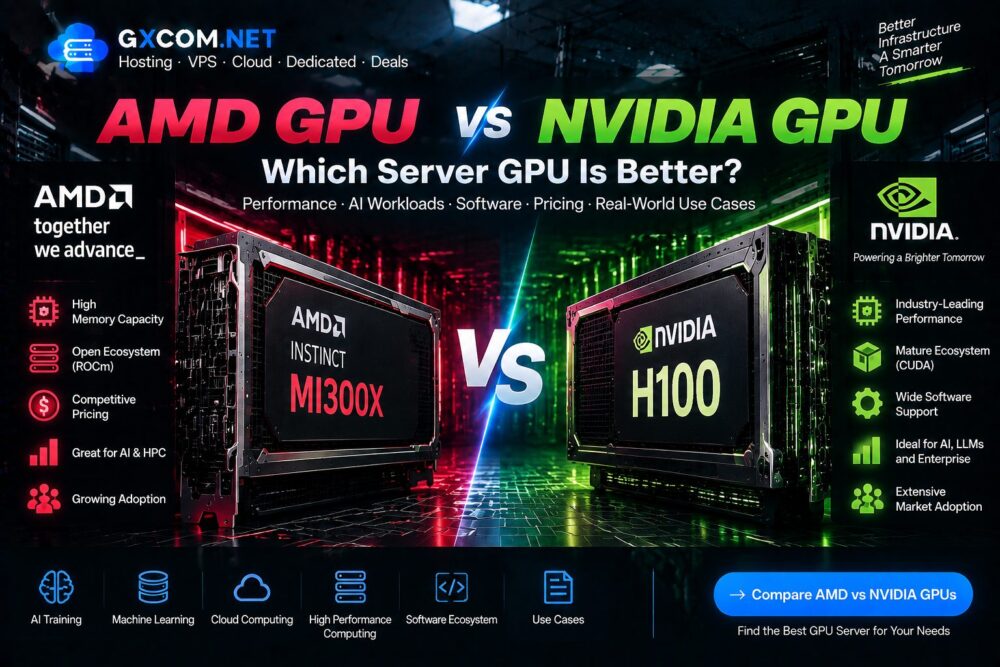
AMD GPU vs NVIDIA GPU Overview
| Feature | AMD GPU | NVIDIA GPU |
|---|---|---|
| Main AI Products | Instinct MI300X, MI250 | H100, A100, L40S |
| Software Platform | ROCm | CUDA |
| Main Strength | Hardware flexibility | Software ecosystem |
| Main Markets | AI, HPC, Enterprise | AI, Cloud, Enterprise |
| Server Availability | Growing | Extensive |
What Are AMD GPU Servers?
AMD GPU servers are high-performance computing systems equipped with AMD accelerators designed for artificial intelligence, scientific computing and enterprise workloads.
Popular AMD GPU products include:
- AMD Instinct MI300X
- AMD Instinct MI250
- AMD Instinct MI210
AMD GPU servers are commonly used for:
- AI model training
- Machine learning
- High-performance computing
- Scientific research
- Data processing
Learn more in our
AMD GPU Server Guide
.
What Are NVIDIA GPU Servers?
NVIDIA GPU servers use NVIDIA accelerators designed for AI computing, deep learning and accelerated applications.
Popular NVIDIA GPU products include:
- NVIDIA H100
- NVIDIA A100
- NVIDIA L40S
- NVIDIA RTX series
NVIDIA GPU servers are widely used for:
- Large language models
- Generative AI
- Cloud AI platforms
- Enterprise machine learning
Read our
NVIDIA GPU Server Guide
.
AMD GPU vs NVIDIA GPU Performance
GPU performance depends on workload, software optimization and hardware configuration rather than specifications alone.
| Workload | AMD GPU | NVIDIA GPU |
|---|---|---|
| AI Training | Strong | Excellent |
| AI Inference | Strong | Excellent |
| Large AI Models | Strong | Excellent |
| HPC Computing | Excellent | Excellent |
| Graphics Workloads | Good | Excellent |
AMD Instinct vs NVIDIA AI GPUs
AMD Instinct MI300X
AMD MI300X is designed for advanced AI workloads and large-scale computing.
Key features:
- Large memory capacity
- AI acceleration
- Enterprise computing support
- High-performance architecture
NVIDIA H100
NVIDIA H100 is designed for advanced AI training, inference and large model workloads.
Key features:
- Hopper architecture
- Transformer Engine
- AI acceleration optimization
- Strong software support
ROCm vs CUDA: Software Ecosystem Comparison
| Feature | AMD ROCm | NVIDIA CUDA |
|---|---|---|
| Platform | Open GPU computing ecosystem | Established GPU ecosystem |
| AI Framework Support | Growing | Extensive |
| Developer Adoption | Increasing | Very large |
| Industry Usage | Growing | Widely adopted |
AMD GPU vs NVIDIA GPU for AI Servers
AI Training
Both AMD and NVIDIA GPUs can support AI training workloads.
NVIDIA currently has a broad AI software ecosystem, while AMD provides competitive hardware alternatives for organizations evaluating different infrastructure options.
AI Inference
AI inference performance depends on model size, optimization and deployment environment.
Large Language Models
Large AI models require high memory capacity and efficient acceleration.
AMD GPU Server vs NVIDIA GPU Server Pricing
| Factor | AMD GPU Server | NVIDIA GPU Server |
|---|---|---|
| Hardware Cost | Competitive | Usually higher |
| Availability | Growing | Extensive |
| Software Support | Developing | Mature |
| Enterprise Adoption | Increasing | Very high |
Which GPU Server Should You Choose?
Choose AMD GPU Servers If You Need:
- Alternative AI hardware options
- High-performance computing
- Large memory configurations
- Open software environments
- Competitive hardware solutions
Choose NVIDIA GPU Servers If You Need:
- Maximum AI ecosystem compatibility
- CUDA-based applications
- Enterprise AI platforms
- Large developer support
- Widely available hosting options
AMD GPU vs NVIDIA GPU for Different Workloads
| Workload | Recommended Consideration |
|---|---|
| AI Research | AMD or NVIDIA depending on software |
| Large AI Models | NVIDIA ecosystem advantage |
| HPC | Both platforms |
| Enterprise AI | Evaluate ecosystem and support |
| Development Testing | Based on budget and compatibility |
How to Select the Right GPU Server
- Identify your workload requirements
- Check GPU memory needs
- Evaluate software compatibility
- Compare hosting providers
- Consider long-term costs
GPU Server Hosting Options
Both AMD and NVIDIA GPU servers are available through cloud platforms and dedicated hosting providers.
Common deployment options include:
- Cloud GPU servers
- Dedicated GPU servers
- AI infrastructure platforms
- Private GPU clusters
Frequently Asked Questions
Is AMD GPU better than NVIDIA GPU?
The better choice depends on workload requirements, software compatibility, performance needs and budget.
Is NVIDIA better for AI servers?
NVIDIA has a widely adopted AI software ecosystem, while AMD provides competitive GPU hardware options.
Can AMD GPUs run AI workloads?
Yes. AMD Instinct GPUs support many AI and high-performance computing workloads.
Which GPU is best for AI servers?
The best GPU depends on model size, software requirements, performance goals and infrastructure costs.
Final Thoughts
AMD GPU and NVIDIA GPU servers both provide powerful solutions for modern computing workloads.
NVIDIA benefits from a mature AI software ecosystem, while AMD provides competitive hardware and growing AI capabilities.
Choosing the right GPU server requires evaluating workload requirements, software compatibility, performance expectations and long-term infrastructure plans.