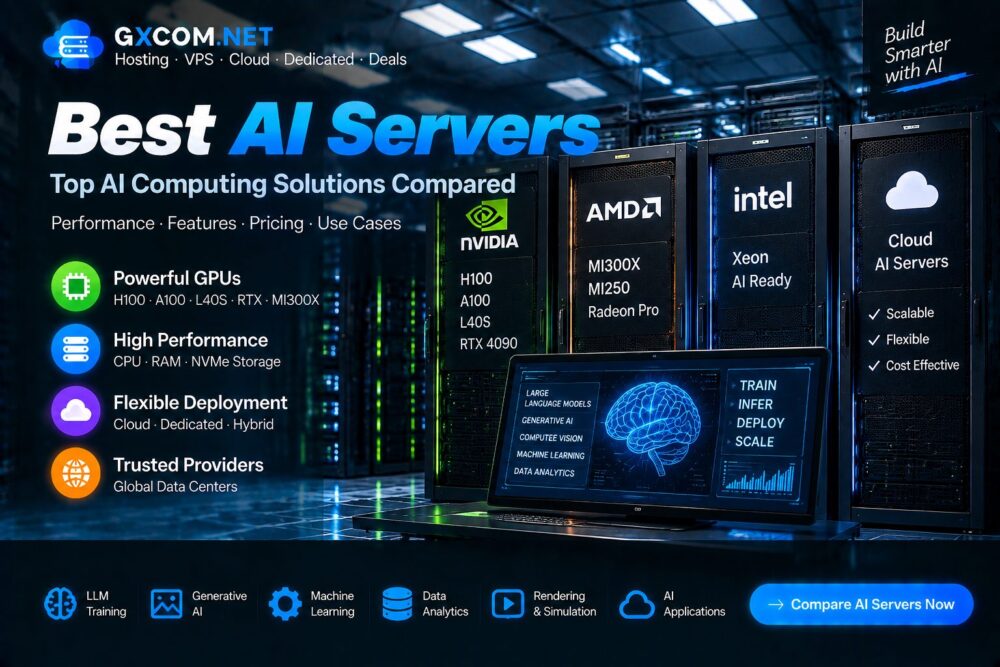
Artificial intelligence applications are rapidly increasing demand for powerful computing infrastructure. From machine learning models and generative AI to large language models and automation systems, traditional servers are often unable to provide enough computing power.
AI servers are designed specifically to accelerate artificial intelligence workloads by combining powerful CPUs, advanced GPUs, high-speed memory and optimized software environments.
This AI Server Guide explains what AI servers are, how they work, hardware components, common applications and how to choose the right AI infrastructure.
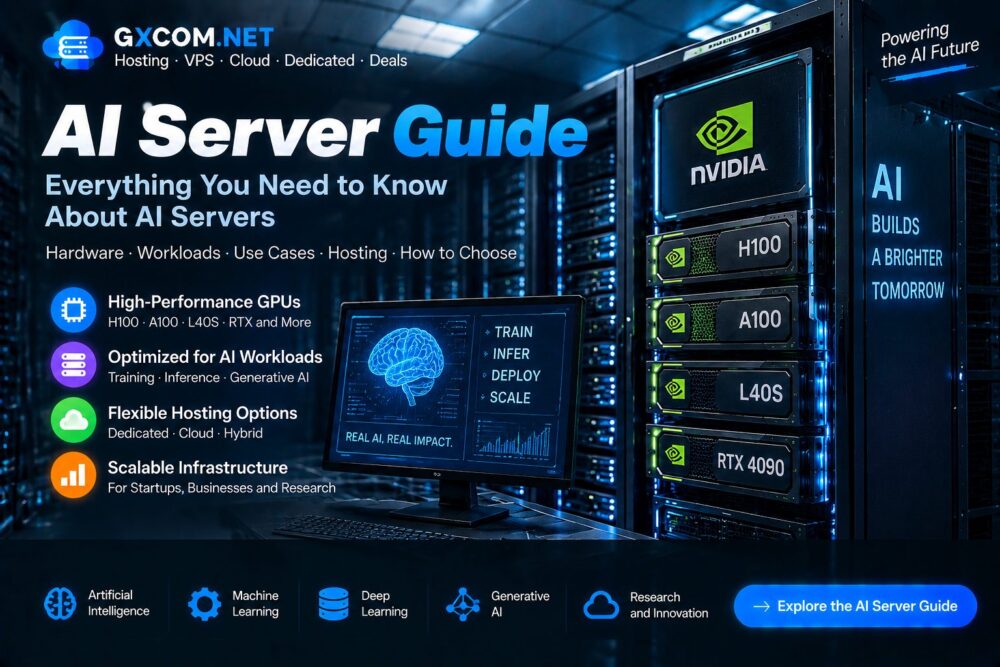
What Is an AI Server?
An AI server is a high-performance computing system designed to run artificial intelligence workloads such as machine learning training, deep learning, data processing and AI inference.
Unlike traditional servers that mainly rely on CPUs, AI servers typically use specialized accelerators such as GPUs to process large amounts of data efficiently.
How Do AI Servers Work?
AI servers combine several hardware components to accelerate artificial intelligence workloads.
The main components include:
- GPU accelerators
- High-performance CPUs
- Large memory capacity
- Fast NVMe storage
- High-speed networking
AI Server vs Traditional Server
| Feature | Traditional Server | AI Server |
|---|---|---|
| Main Processor | CPU focused | CPU + GPU acceleration |
| Main Usage | Websites and applications | AI workloads and machine learning |
| Computing Style | General processing | Parallel processing |
| Hardware Cost | Lower | Higher |
Key Components of an AI Server
GPU Accelerator
The GPU is the most important component in many AI servers because artificial intelligence workloads require massive parallel computing capability.
Popular AI GPUs include:
- NVIDIA H100
- NVIDIA A100
- NVIDIA L40S
- NVIDIA RTX 4090
- AMD Instinct MI300X
CPU Processor
Although GPUs handle accelerated computing, CPUs manage system operations, data preparation and application processes.
Memory
AI workloads often require large amounts of RAM because machine learning models and datasets can consume significant resources.
Storage
Fast storage improves data loading speed and AI workflow efficiency.
Common choices include:
- NVMe SSD
- Enterprise SSD
- High-capacity storage arrays
Networking
Large AI systems require fast network connections for data transfer and distributed computing.
Types of AI Servers
AI Training Servers
AI training servers are designed for building and optimizing machine learning models.
Typical workloads:
- Deep learning
- Large language models
- Computer vision
- Research projects
AI Inference Servers
Inference servers run already-trained models and provide AI services to users.
Common applications:
- AI assistants
- Recommendation systems
- Image recognition
- Natural language processing
Enterprise AI Servers
Enterprise AI servers are designed for organizations requiring reliable AI infrastructure.
Applications include:
- Business automation
- Data analysis
- Private AI platforms
- Research systems
AI Server GPU Options
| GPU | Common Usage |
|---|---|
| NVIDIA H100 | Large AI models and enterprise training |
| NVIDIA A100 | Deep learning and research |
| NVIDIA L40S | AI inference and graphics workloads |
| RTX 4090 | Development and testing |
| AMD MI300X | AI acceleration |
AI Server Use Cases
Artificial Intelligence Development
Developers use AI servers to train models, test algorithms and build AI-powered applications.
Large Language Models
Modern AI models require powerful GPU infrastructure for training and deployment.
Generative AI
AI servers support applications such as:
- Text generation
- Image creation
- Video processing
- AI assistants
Machine Learning
Machine learning workloads benefit from accelerated computing resources.
AI Server Hosting Options
Dedicated AI Servers
Dedicated AI servers provide exclusive hardware resources and consistent performance.
Cloud AI Servers
Cloud AI platforms provide flexible scaling and pay-as-you-use pricing.
GPU Server Hosting
GPU server hosting provides access to powerful AI accelerators without purchasing physical hardware.
Learn more about GPU infrastructure in our
GPU Server Deals
.
AI Server vs GPU Server
| Feature | AI Server | GPU Server |
|---|---|---|
| Main Purpose | AI workloads | GPU acceleration |
| Hardware | Complete AI infrastructure | GPU-powered server |
| Applications | Training and inference | AI, rendering, computing |
How to Choose an AI Server
Determine Your Workload
Training, inference and development workloads require different hardware configurations.
Select Appropriate GPU
GPU selection depends on model size, performance requirements and budget.
Consider Memory Requirements
Large AI models require sufficient GPU memory and system RAM.
Evaluate Storage Performance
Fast storage improves dataset processing and model loading speed.
Check Network Capability
High-speed networking is important for distributed AI workloads.
AI Server Security
AI servers often process valuable models and sensitive datasets, making security an important consideration.
Recommended practices:
- Secure authentication
- Network protection
- Access management
- Regular updates
- Data backup
Read our
Server Security Guide
.
Frequently Asked Questions
What is an AI server?
An AI server is a high-performance computing system designed for artificial intelligence workloads using GPUs and specialized hardware.
Do AI servers require GPUs?
Many AI workloads benefit from GPUs, although some applications can run on CPU-based systems.
What GPU is best for AI servers?
The best GPU depends on workload requirements, model size and budget.
Can businesses rent AI servers?
Yes. Businesses can use cloud AI platforms or dedicated AI hosting providers instead of purchasing hardware.
Final Thoughts
AI servers provide the computing foundation required for modern artificial intelligence applications.
From AI training and inference to generative AI and machine learning, selecting the right hardware configuration is essential for performance and cost control.
Understanding GPUs, memory, storage and deployment options helps businesses and developers build effective AI infrastructure.