UltaHost and Hostinger both compete for customers looking for affordable web hosting, WordPress hosting, VPS infrastructure, NVMe storage, and an easier way to manage websites and servers.
However, their product strategies are different.
Hostinger has built a highly integrated website ecosystem around hPanel, WordPress, website-building tools, cloud hosting, and self-managed KVM VPS infrastructure.
UltaHost offers web hosting alongside a broader server portfolio, with managed VPS options, dedicated servers, Windows hosting, and infrastructure aimed at customers who may want more server-side assistance.
So which provider makes more sense for your workload?
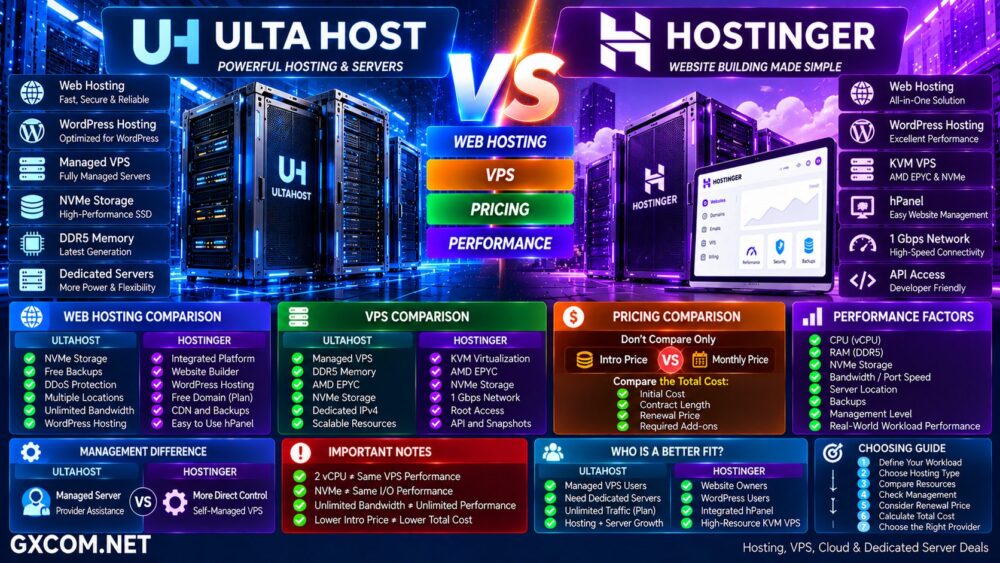
This UltaHost vs Hostinger comparison examines web hosting, VPS, performance, NVMe storage, bandwidth, management, pricing, renewals, and the differences that matter before purchasing.
UltaHost vs Hostinger: Quick Comparison
| Feature | UltaHost | Hostinger |
|---|---|---|
| Web Hosting | Yes | Yes |
| WordPress Hosting | Yes | Yes |
| VPS | Managed VPS options | KVM VPS |
| NVMe Storage | Widely used across server plans | Available across VPS and selected hosting plans |
| VPS RAM | DDR5 on current VPS plans | Plan dependent |
| VPS CPU | AMD EPYC infrastructure advertised | AMD EPYC |
| Dedicated Servers | Yes | Not a primary offering |
| Website Management | Traditional hosting/server approach | Strong hPanel ecosystem |
| Server Management | Managed VPS included on current plans | More self-managed VPS approach |
| Best Fit | Users wanting hosting plus managed server options | Website owners and users wanting high-resource KVM VPS |
UltaHost Overview
UltaHost offers a broad hosting portfolio rather than concentrating exclusively on shared website hosting.
Its current products include:
- Shared web hosting
- WordPress hosting
- VPS
- Windows hosting
- Dedicated servers
- Game hosting
- Email hosting
- Domain services
A major differentiator is its server-oriented product range.
UltaHost's current VPS plans advertise managed server service, NVMe storage, DDR5 memory, dedicated IPv4 addresses, backups, DDoS protection on applicable tiers, and scalable resources.
This makes UltaHost particularly interesting to customers who want more server control than shared hosting without necessarily managing every part of the VPS themselves.
Hostinger Overview
Hostinger approaches the market from a strongly website-focused direction.
Its ecosystem combines:
- Web hosting
- WordPress
- Website builder
- Cloud hosting
- KVM VPS
- Domains
- AI-assisted website and server tools
Hostinger's hPanel is a major part of this strategy, giving customers one integrated environment for managing websites, domains, email, backups, and related services.
Its VPS platform takes a more infrastructure-oriented direction, with AMD EPYC processors, NVMe storage, root access, firewall management, backups, snapshots, a public API, and a 1 Gbps network.
UltaHost → Hosting + Managed VPS + Dedicated Infrastructure
Hostinger → Website Ecosystem + Cloud Hosting + KVM VPS
UltaHost vs Hostinger for Web Hosting
Both providers can handle blogs, business websites, WordPress sites, ecommerce projects, and other conventional websites.
UltaHost currently emphasizes NVMe infrastructure, free SSL, backups, DDoS protection, global server locations, and unlimited bandwidth on applicable hosting plans.
Hostinger combines hosting with an especially integrated website-management environment. Depending on the plan, current features can include a domain, email, SSL, CDN, backups, WordPress, ecommerce capabilities, and AI tools.
Therefore, do not ask only:
Which Web Host Is Cheaper?
Ask:
Which Hosting Environment Better Matches How I Build and Manage My Website?
UltaHost vs Hostinger Pricing
Pricing needs careful comparison because promotional hosting prices can represent very different commitments.
Hostinger commonly advertises substantial discounts when customers purchase longer hosting terms upfront. The effective monthly price is calculated from the full prepaid contract, and renewal pricing can be higher.
UltaHost also offers discounts based on billing duration across some products, while certain plans advertise the corresponding renewal amount directly.
Instead of comparing only the number beside “per month,” calculate:
Initial Payment + Contract Length + Renewal Price + Add-ons = Real Hosting Cost.
Compare UltaHost and Hostinger Before Ordering
Both providers are relevant to GXCOM.NET readers, but the better commercial comparison starts with the workload.
| Requirement | UltaHost | Hostinger |
|---|---|---|
| Basic Website | Shared Hosting | Web Hosting |
| WordPress | WordPress Hosting | WordPress / Web Hosting |
| Managed VPS | Strong product focus | Different management model |
| High-RAM VPS | Multiple server tiers | Strong KVM resource scaling |
| Dedicated Server | Available | Not a core product |
| Integrated Website Tools | Available | Major platform strength |
Before purchasing, compare the exact checkout configuration rather than assuming two similarly named hosting plans provide equivalent resources.
UltaHost vs Hostinger VPS
VPS is where the differences become much more important.
UltaHost's current entry-level VPS configuration starts with relatively modest resources and scales through larger CPU, DDR5 RAM, and NVMe allocations. Its current VPS plans are marketed as managed servers and include a dedicated IPv4 address.
Hostinger's KVM VPS plans start with considerably more RAM on the current entry tier and scale up to larger CPU, RAM, NVMe, and bandwidth allocations.
Hostinger currently advertises:
- AMD EPYC processors
- KVM virtualization
- NVMe storage
- 1 Gbps network
- Weekly backups
- Snapshots
- Firewall management
- Public API
- Root access
UltaHost currently emphasizes:
- Managed server service
- DDR5 RAM
- NVMe storage
- AMD EPYC infrastructure
- Dedicated IPv4
- DDoS protection on applicable plans
- Backups
- Scalable server resources
This creates an important distinction:
More VPS Resources ≠ Better VPS for Every User.
Management, bandwidth, storage, support, and workload requirements also matter.
UltaHost vs Hostinger VPS Pricing
The cheapest VPS plan is not necessarily the best comparison point because entry-level configurations can contain very different resources.
For example, one provider may start with less RAM but include a managed server environment, while another may provide substantially more RAM but expect the customer to handle more system administration.
Normalize the comparison.
Compare:
- Price per vCPU
- Price per GB of RAM
- NVMe capacity
- Bandwidth allowance
- Management level
- Backup inclusion
- IPv4 inclusion
- Renewal price
For more context on server management, see our
Managed vs Unmanaged VPS comparison.
UltaHost vs Hostinger Performance
It would be misleading to say that one brand is universally faster than the other.
Hosting performance depends on the specific plan, server location, resource allocation, application, caching, storage configuration, and workload.
For web hosting, useful tests include:
- Time to First Byte
- Cached page loading
- Uncached page loading
- WordPress admin performance
- Database-heavy pages
- Performance under concurrent traffic
For VPS, benchmark:
- Single-core CPU performance
- Multi-core CPU performance
- Disk I/O
- RAM
- Network throughput
- Latency
- Sustained CPU load
Provider Name ≠ Performance Result.
UltaHost vs Hostinger NVMe Storage
Both providers make extensive use of SSD and NVMe storage across their current product ranges.
NVMe can reduce storage latency compared with older storage technologies, but simply seeing “NVMe” in a specification table does not tell you the actual application performance.
Real-world storage performance depends on:
- Underlying hardware
- Storage architecture
- IOPS limits
- Host utilization
- Filesystem
- Database workload
For a deeper technical comparison, see our
NVMe VPS vs SSD VPS comparison.
UltaHost vs Hostinger Bandwidth
Bandwidth is another area where headline specifications can be misleading.
UltaHost advertises unlimited or unmetered bandwidth on many current hosting and VPS products, subject to the provider's applicable terms and product configuration.
Hostinger's VPS plans use defined traffic allocations that increase with each KVM tier and currently advertise a 1 Gbps network speed.
These are different approaches.
For a real comparison, check:
- Monthly transfer allowance
- Port speed
- Acceptable-use policies
- Inbound and outbound traffic rules
- Server location
- Latency
Unlimited Bandwidth ≠ Unlimited Performance.
UltaHost vs Hostinger for WordPress
Both companies can host WordPress, but their user experiences differ.
Hostinger has invested heavily in an integrated WordPress and website-management experience through hPanel, AI tools, CDN, backups, and website-building functionality.
UltaHost offers WordPress hosting alongside conventional hosting and server products, which can appeal to customers who expect to move from website hosting toward VPS or dedicated infrastructure.
If you are deciding between general web hosting and a WordPress-focused environment, read our
Web Hosting vs WordPress Hosting comparison.
UltaHost vs Hostinger for Beginners
For beginners, raw server specifications are usually less important than the complete hosting workflow.
Consider:
- Control panel
- WordPress installation
- Website migration
- SSL
- Backups
- Support
- Billing simplicity
Hostinger's hPanel ecosystem is designed around simplifying website management.
UltaHost can become particularly interesting when a beginner expects to move into a managed VPS and wants more assistance with server management.
UltaHost vs Hostinger for Developers
Developers should evaluate the comparison differently.
Hostinger's KVM VPS provides root access, API functionality, firewall management, snapshots, and multiple operating-system templates.
UltaHost provides a broader range of managed server products and control-panel options across its VPS ecosystem.
The decision therefore depends partly on whether you want:
More Direct Server Administration
or:
More Provider-Assisted Server Management.
UltaHost vs Hostinger for Growing Websites
A growing website eventually needs more resources, but moving directly from shared hosting to VPS is not always necessary.
Hostinger offers a progression such as:
Web Hosting → Cloud Hosting → VPS
UltaHost offers a path that can extend further into server infrastructure:
Shared Hosting → VPS → VDS / Dedicated Server
The better upgrade path depends on whether your project remains primarily a website or evolves into an application requiring greater server control.
UltaHost vs Hostinger Security
Both providers advertise multiple security features, but security should always be evaluated at the exact plan level.
Depending on the service, features can include:
- SSL certificates
- DDoS protection
- Firewall tools
- Malware protection
- Backups
- Account security
VPS users also carry additional responsibility for operating-system updates, application security, SSH configuration, and access control depending on the management model.
Managed service does not eliminate the need for a secure application configuration.
UltaHost vs Hostinger Backups
Backups should be evaluated carefully because frequency and retention can vary between products.
Hostinger currently advertises weekly backups and snapshots with its VPS plans, while higher web hosting tiers can include more frequent backups.
UltaHost advertises free backups across various hosting and VPS products.
Before ordering, verify:
- Backup frequency
- Retention period
- Snapshot availability
- Restore process
- Restore fees
- Off-server backup options
Critical websites should maintain an independent backup regardless of the provider.
UltaHost vs Hostinger Server Locations
Server location can materially affect website and application latency.
Both providers operate geographically distributed infrastructure, while UltaHost currently advertises more than 30 global data center locations across its broader hosting network.
Do not choose the provider with the largest location count simply because the number is larger.
The important question is:
Does the provider have a suitable location close to your users?
A single well-positioned server can be more useful than dozens of locations you will never deploy in.
UltaHost vs Hostinger Support and Management
This is particularly important for VPS customers.
Web hosting support and VPS administration are different things.
Before buying, determine who is responsible for:
- Operating-system updates
- Web server configuration
- Database optimization
- Security hardening
- Application problems
- Control panel
- Backups
- Malware incidents
A cheaper VPS can become expensive if you later need to hire someone to manage it.
Server Price + Administration Cost = Real VPS Cost.
UltaHost vs Hostinger: Pros and Trade-Offs
| Area | UltaHost | Hostinger |
|---|---|---|
| Web Hosting | Broad traditional hosting portfolio | Highly integrated website ecosystem |
| WordPress | Dedicated hosting options | Strong hPanel integration |
| VPS | Managed server focus | High-resource KVM plans |
| Storage | NVMe across server products | NVMe across VPS and selected hosting tiers |
| Bandwidth Model | Unlimited/unmetered on applicable plans | Defined VPS traffic allocations |
| Dedicated Servers | Available | Not a core offering |
| Website Tools | Available | Major platform strength |
| Server Management | Major VPS selling point | More user-controlled VPS model |
Consider UltaHost If…
- You want a managed VPS option
- You value unlimited or unmetered traffic on applicable plans
- You need dedicated server upgrade options
- You want NVMe and DDR5 server configurations
- You prefer provider-assisted server management
- You want hosting and server infrastructure under one provider
Consider Hostinger If…
- You prioritize an integrated website-management experience
- You run WordPress or multiple websites
- You prefer hPanel
- You want high-resource KVM VPS configurations
- You need AMD EPYC and NVMe VPS infrastructure
- You want API-based VPS management
- You are comfortable administering your server environment
Questions to Ask Before Choosing UltaHost or Hostinger
- Do you need web hosting, cloud hosting, or VPS?
- How much CPU and RAM does your workload require?
- How much NVMe storage do you need?
- Do you need managed server administration?
- How much monthly traffic will you use?
- Which server location is closest to your users?
- How frequently are backups created?
- Do you need snapshots?
- Do you need a dedicated IPv4 address?
- Will you eventually need a dedicated server?
- What is the initial contract price?
- What is the renewal price?
- Which add-ons are required?
- What is your total 12-, 24-, or 48-month cost?
UltaHost vs Hostinger: Which Provider Fits Your Workload?
UltaHost and Hostinger overlap across web hosting, WordPress, and VPS, but their strongest use cases are not identical.
Hostinger provides a highly integrated website ecosystem and combines that with increasingly powerful KVM VPS infrastructure. It can be particularly attractive to website owners who value hPanel and users who want substantial VPS resources with direct server control.
UltaHost combines conventional website hosting with a broader server portfolio and places significant emphasis on managed VPS infrastructure. It can be attractive when server management, unmetered traffic on applicable plans, or a future path toward dedicated infrastructure matters.
Do not choose based on brand popularity or the lowest promotional number.
Instead use:
Workload → Hosting Type → Management → CPU/RAM → NVMe → Bandwidth → Location → Initial Price → Renewal Price → Total Cost.
For websites, focus on the complete hosting environment and long-term price. For VPS workloads, normalize the resources and include the cost of server administration before deciding which provider better matches your project.