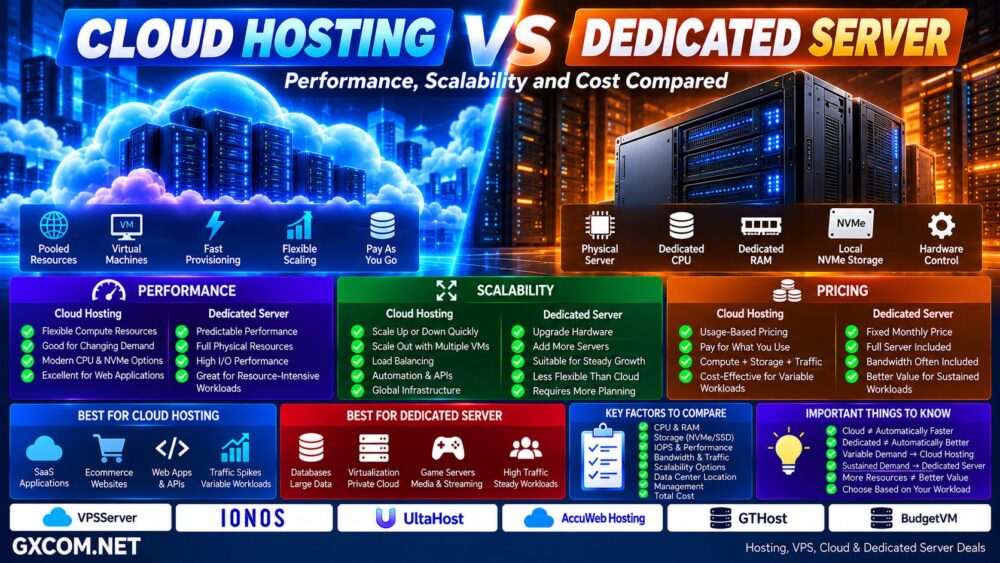
Public cloud and private cloud provide two different ways to deliver computing resources such as virtual machines, storage, databases, networking, and applications.
The biggest difference is not simply where the servers are located.
Public cloud infrastructure is operated by a cloud provider and shared across multiple customers through logically isolated environments. Private cloud infrastructure is dedicated to a single organization and can run on-premises, in a colocation facility, or through a hosted private cloud provider.
That distinction affects infrastructure control, security responsibilities, scalability, capital investment, operational complexity, and long-term cost.
In this Public Cloud vs Private Cloud comparison, we examine security, performance, pricing, scalability, compliance, management, and which cloud model fits different workloads.
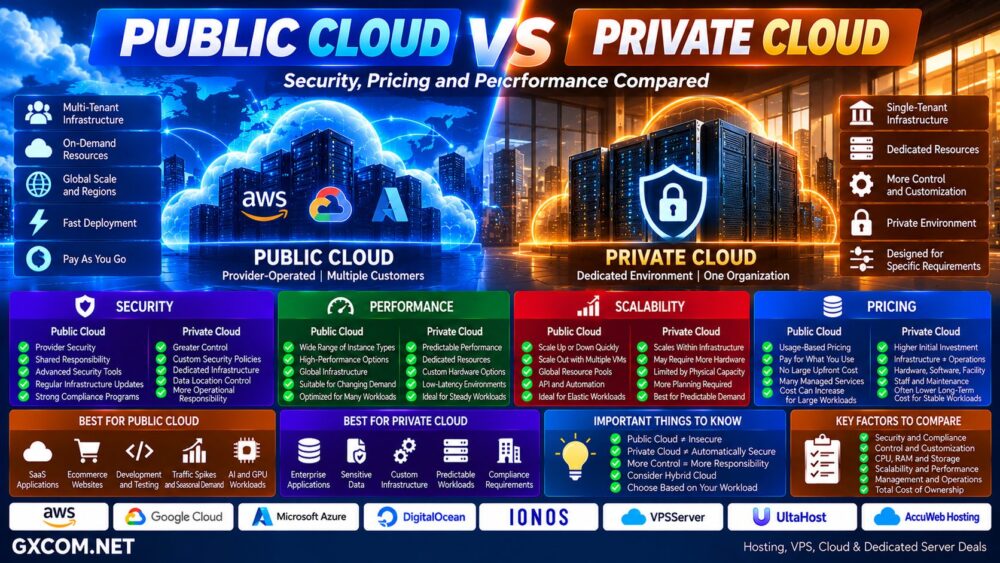
Public Cloud vs Private Cloud: Quick Comparison
| Feature | Public Cloud | Private Cloud |
|---|---|---|
| Infrastructure | Provider-operated | Dedicated to one organization |
| Tenancy | Typically multi-tenant | Single-tenant |
| Hardware Ownership | Cloud provider | Organization or hosting provider |
| Initial Investment | Usually low | Can be substantial |
| Scaling | Very flexible | Limited by available infrastructure |
| Deployment | Usually rapid | More planning required |
| Infrastructure Control | Lower | Higher |
| Security Control | Shared responsibility | Greater organizational control |
| Pricing Model | Often usage based | Infrastructure + operations |
| Best For | Elastic and rapidly changing workloads | Control-sensitive and specialized workloads |
What Is Public Cloud?
Public cloud is a cloud computing model where a third-party provider owns and operates large-scale computing infrastructure and delivers resources to customers on demand.
Common resources include:
- Virtual machines
- Cloud servers
- Block storage
- Object storage
- Managed databases
- Load balancers
- Containers
- Serverless computing
- AI and GPU infrastructure
Multiple customers use the provider's physical infrastructure, while virtualization, networking, identity systems, and other controls isolate customer environments.
A simplified model looks like:
Cloud Provider Infrastructure → Virtualized Resources → Multiple Isolated Customers
Public cloud platforms are designed around on-demand provisioning and large resource pools.
What Is Private Cloud?
Private cloud is a cloud computing environment dedicated to a single organization.
The infrastructure can exist:
- Inside the organization's own data center
- In a colocation facility
- On dedicated hosted infrastructure
- Through a private cloud service provider
The defining characteristic is therefore not location.
Private Cloud = Dedicated Cloud Environment for One Organization.
A private cloud can still provide many cloud-style capabilities:
- Self-service provisioning
- Virtual machines
- Resource pools
- APIs
- Automation
- Software-defined networking
- Elastic resource allocation
The organization receives greater control over how the underlying infrastructure is configured and operated.
Public Cloud vs Private Cloud Security
Security is one of the most misunderstood parts of this comparison.
Public cloud should not automatically be classified as insecure simply because multiple customers use the provider's infrastructure.
Major public cloud providers operate large security programs covering physical data centers, hardware, networking, virtualization, monitoring, and other infrastructure layers.
Customers still remain responsible for important parts of their environment, including areas such as:
- Identity and access
- Data protection
- Application security
- Operating-system security
- Firewall configuration
- Encryption choices
- Credentials
- Workload configuration
Public Cloud Security = Provider Security + Customer Security.
Private Cloud Gives More Control — and More Responsibility
Private cloud provides greater control over infrastructure design.
Organizations may be able to control:
- Physical hardware
- Hypervisors
- Network architecture
- Storage architecture
- Security policies
- Data location
- Access systems
- Hardware lifecycle
That control can be valuable for specialized security, regulatory, data-sovereignty, or legacy application requirements.
But control also creates responsibility.
A poorly patched or incorrectly configured private cloud is not automatically safer than a properly secured public cloud environment.
Private ≠ Automatically Secure.
Public Cloud Platforms and Infrastructure to Compare
For organizations that do not need to build their own private infrastructure, public cloud and cloud-oriented hosting platforms provide a much faster route to deploying compute resources.
Platforms such as AWS, Google Cloud, Microsoft Azure, DigitalOcean, IONOS, VPSServer, UltaHost, and AccuWeb Hosting represent different levels of cloud and virtual infrastructure that are worth comparing according to workload complexity.
| Platform Type | Typical Strength | What to Compare |
|---|---|---|
| AWS / Google Cloud / Azure | Large public cloud ecosystems | Compute, managed services, regions and automation |
| DigitalOcean | Developer-oriented cloud | Simple compute and cloud services |
| IONOS | Cloud / VPS infrastructure | Business workloads and pricing |
| VPSServer | Cloud VPS | Locations, deployment and resources |
| UltaHost | VPS / Dedicated infrastructure | Resources, management and cost |
| AccuWeb Hosting | Cloud / VPS / Dedicated | OS options, management and infrastructure |
The correct comparison depends on whether the workload actually requires a complete hyperscale cloud ecosystem or simply reliable virtual infrastructure.
Public Cloud vs Private Cloud Performance
Neither deployment model is automatically faster.
Performance depends on the actual infrastructure:
- CPU architecture
- CPU allocation
- RAM
- Storage technology
- Storage latency
- IOPS
- Network throughput
- Virtualization
- Resource contention
- Application design
A private cloud built on modern dedicated hardware can provide highly predictable performance.
A public cloud can provide access to an enormous range of compute configurations, including compute-optimized, memory-optimized, storage-optimized, and GPU instances.
Deployment Model ≠ Performance Benchmark.
Performance Consistency
Private cloud can be attractive when organizations want direct control over resource allocation and hardware utilization.
Resources are dedicated to one organization, allowing infrastructure teams to design capacity around known workloads.
Public cloud environments can also provide highly predictable performance when appropriate dedicated or workload-optimized instance types are selected.
Instead of asking which cloud is faster, ask:
What CPU, RAM, storage and network performance does the workload actually receive?
Public Cloud vs Private Cloud Scalability
Scalability is one of the strongest public cloud advantages.
Large providers operate enormous infrastructure pools across multiple regions.
Customers can often scale through:
More Resources → Larger Instance
or:
More Instances → Load Balancer → Horizontal Scaling
Capacity can frequently be provisioned through APIs or automation without purchasing physical hardware.
How Private Cloud Scales
Private cloud can provide cloud-style resource provisioning, but its total capacity is ultimately limited by the infrastructure available to the organization.
When the resource pool becomes full, scaling may require:
- Additional servers
- More storage
- Additional network capacity
- New racks
- Data-center capacity
- Software licenses
Private cloud therefore combines software-defined elasticity with physical infrastructure limits.
Public Cloud vs Private Cloud Pricing
The cost structures are fundamentally different.
Public Cloud:
Compute + Storage + Traffic + IP + Managed Services + Support
Private Cloud:
Servers + Storage + Network + Software + Facility + Power + Staff + Maintenance
Public cloud converts much infrastructure spending into operating expenditure and allows resources to be purchased on demand.
Private cloud can require significant upfront infrastructure investment when the organization owns the hardware.
Public Cloud Is Not Always Cheaper
Pay-as-you-go pricing is extremely attractive for workloads that change frequently.
However, a large environment running continuously can accumulate substantial compute, storage, traffic, and managed-service charges.
Private infrastructure can become economically attractive when an organization has large, stable, predictable workloads and can keep its hardware highly utilized.
The relevant calculation is not:
Hourly VM Price.
It is:
Total Infrastructure Cost / Useful Workload Delivered.
Private Cloud Is Not Automatically Cheaper Either
Hardware purchase price is only part of private cloud cost.
Organizations may also need to account for:
- Networking
- Storage
- Virtualization software
- Cloud management software
- Backup infrastructure
- Power
- Cooling
- Rack space
- Hardware replacement
- Security
- System administrators
- Monitoring
A realistic comparison should use total cost of ownership rather than server purchase price alone.
CAPEX vs OPEX
The traditional financial distinction can be summarized as:
Private Cloud → Higher CAPEX Potential + Ongoing Operations
Public Cloud → Lower Initial CAPEX + Usage-Based OPEX
Hosted private cloud can blur this distinction because organizations may rent dedicated infrastructure rather than purchase it.
Public Cloud for Variable Workloads
Public cloud is particularly attractive when resource requirements change frequently.
Examples include:
- Seasonal ecommerce
- Product launches
- Development environments
- Software testing
- Data processing
- Temporary projects
- AI experiments
- Traffic spikes
Resources can be deployed when required and removed when they are no longer needed.
Private Cloud for Predictable Workloads
Private cloud can make sense when organizations have substantial infrastructure requirements that remain relatively stable.
Examples may include:
- Enterprise databases
- Internal business applications
- Virtual desktop infrastructure
- Legacy enterprise software
- Data-sensitive applications
- Specialized regulated workloads
- Large internal virtualization environments
In these cases, dedicated infrastructure can provide control and predictable capacity.
Public Cloud vs Private Cloud for Compliance
Compliance requirements should be evaluated individually rather than assuming one deployment model automatically satisfies them.
Public cloud providers support extensive compliance programs and security controls, but customers remain responsible for configuring their workloads appropriately and meeting their own regulatory obligations.
Private cloud can provide greater control over data location, hardware, networks and operational policies, which can be useful when an organization has specific regulatory or sovereignty requirements.
Compliance Requirement → Architecture Decision.
Not:
Private Cloud → Automatically Compliant.
Public Cloud vs Private Cloud for Data Sovereignty
Organizations may need to control where particular data is stored or processed.
Public cloud providers offer many geographic regions, but customers must correctly select and configure the relevant services.
Private cloud can provide more direct control over physical data location when infrastructure is operated in a specific facility.
The right model depends on applicable regulations, contracts, customer requirements and technical architecture.
Which Infrastructure Fits Different Workloads?
For websites, SaaS, development, temporary workloads, rapidly growing applications and infrastructure requiring geographic flexibility, public cloud or cloud-oriented services from platforms such as AWS, Google Cloud, Azure, DigitalOcean, IONOS, VPSServer, UltaHost, and AccuWeb Hosting can provide a practical starting point.
Organizations considering private cloud should evaluate whether they genuinely require dedicated infrastructure control or whether dedicated servers, bare metal, virtual private networking, or a hybrid architecture can meet the same requirement with less complexity.
For physical infrastructure alternatives, see our
Dedicated Server Hosting Guide.
The decision path should be:
Workload → Security Requirements → Compliance → Control → Scale → Performance → Operations → Total Cost.
Public Cloud vs Private Cloud Management
Public cloud providers manage the underlying physical infrastructure and provide APIs, dashboards, automation and managed services.
Customers still manage responsibilities appropriate to the services they select.
Private cloud requires an organization or its service provider to operate much more of the cloud stack.
This can include:
- Physical servers
- Hypervisors
- Storage
- Networking
- Cloud management software
- Monitoring
- Capacity planning
- Hardware lifecycle
Private cloud therefore requires infrastructure expertise unless those responsibilities are outsourced to a managed private cloud provider.
Public Cloud vs Private Cloud Availability
Neither architecture automatically provides application-level high availability.
Public cloud provides infrastructure components that can make resilient architectures easier to build across multiple servers, zones, or regions.
Private cloud can also provide high availability when designed with sufficient redundancy.
Both may require:
- Redundant compute
- Redundant storage
- Multiple network paths
- Load balancing
- Database replication
- Backups
- Failover
- Monitoring
Cloud Model ≠ High Availability Architecture.
Public Cloud vs Private Cloud for AI
AI illustrates one of the most interesting infrastructure tradeoffs.
Public cloud allows organizations to access GPU resources without purchasing large amounts of hardware upfront.
This can work particularly well for experimentation, temporary training jobs and changing GPU requirements.
Private infrastructure can become attractive when GPU workloads are large, sustained and predictable enough to justify dedicated hardware.
Again, utilization matters:
Occasional GPU Demand → On-Demand Cloud
Continuous High GPU Utilization → Evaluate Dedicated Infrastructure
Public Cloud vs Private Cloud vs Hybrid Cloud
The final decision does not have to be all public or all private.
Hybrid cloud combines private infrastructure with public cloud resources.
For example:
Private Cloud → Sensitive Core Workloads
Public Cloud → Web Applications / Scaling / Temporary Compute
This can allow organizations to retain control over selected workloads while using public cloud elasticity where it provides the greatest value.
However, hybrid environments also introduce additional networking, identity, monitoring, security and operational complexity.
Public Cloud vs Private Cloud: Pros and Cons
| Public Cloud | Private Cloud | |
|---|---|---|
| Main Advantage | Scale and flexibility | Control and customization |
| Tenancy | Multi-tenant infrastructure | Single organization |
| Initial Cost | Usually lower | Potentially higher |
| Scaling | Excellent | Infrastructure limited |
| Control | Provider-defined infrastructure | Extensive control |
| Operations | Provider handles physical infrastructure | More organizational responsibility |
| Deployment | Rapid | More planning required |
| Best For | Elastic workloads | Control-sensitive workloads |
Choose Public Cloud If…
- You need rapid deployment
- Your workloads change frequently
- You want global infrastructure access
- You need many managed cloud services
- You want to avoid purchasing hardware
- You need temporary compute
- You want API-driven infrastructure
- You need rapid horizontal scaling
Consider Private Cloud If…
- You require dedicated infrastructure
- You need extensive hardware or network control
- You have specialized compliance requirements
- You have strict data-location requirements
- You run large predictable workloads
- You already operate substantial infrastructure
- You require highly customized infrastructure
- You have the technical team to operate it
Questions to Ask Before Choosing
- How sensitive is the workload?
- What regulatory requirements apply?
- Where must data be stored?
- How much infrastructure control is required?
- Is demand predictable or variable?
- How quickly must capacity scale?
- Do you need global regions?
- Do you need specialized hardware?
- What internal infrastructure expertise is available?
- How much downtime can the application tolerate?
- What are the bandwidth requirements?
- What is the expected hardware utilization?
- What is the three-to-five-year total cost?
Public Cloud vs Private Cloud: Which Fits Your Workload?
Public cloud is particularly effective when organizations value rapid deployment, elastic capacity, global infrastructure, managed services, and the ability to consume computing resources without building physical infrastructure.
Private cloud provides greater infrastructure control and customization and can be appropriate for organizations with specialized security, compliance, data-sovereignty, or sustained infrastructure requirements.
But neither model should be selected from a simple security assumption.
Public Cloud ≠ Insecure.
Private Cloud ≠ Automatically Secure.
More Control ≠ Less Operational Responsibility.
For many organizations, hybrid cloud can also combine the strengths of both models.
Use this decision path:
Workload → Security → Compliance → Control → Performance → Scalability → Operations → Total Cost → Cloud Model.
The appropriate cloud architecture is the one that provides the required level of control, security, performance and scalability without creating unnecessary infrastructure cost or operational complexity.