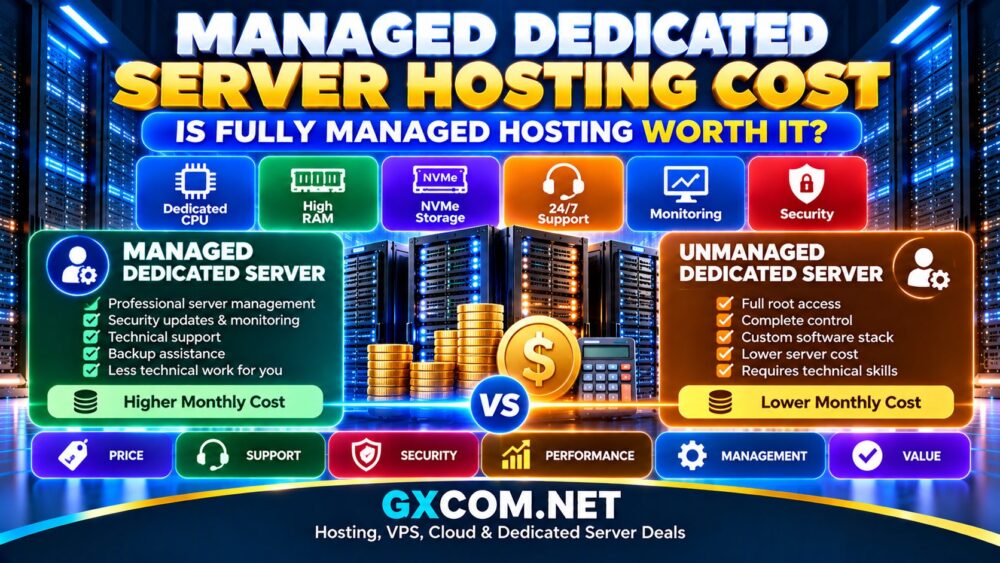
Managed dedicated server hosting combines the performance and resource isolation of physical server hardware with professional administration from the hosting provider. It can reduce the technical workload for businesses, but that convenience comes at a higher price than most unmanaged dedicated servers.
The real Managed Dedicated Server Hosting Cost is more than the advertised monthly server price. CPU, RAM, NVMe storage, bandwidth, operating system licenses, control panels, backups, security services, and the level of server management can all affect the final bill.
This guide explains what fully managed dedicated hosting costs, which services you are actually paying for, how managed pricing compares with unmanaged servers, and when paying extra for professional server administration makes financial sense.
What Is Managed Dedicated Server Hosting?
Managed dedicated hosting gives one customer access to a physical server while the hosting company handles some or many administrative tasks.
Depending on the provider and plan, management may include:
- Operating system installation
- Security patches and updates
- Server monitoring
- Firewall assistance
- Web server configuration
- Control panel administration
- Database troubleshooting
- Backup configuration
- Performance optimization
- Technical troubleshooting
The important phrase is “depending on the provider.” There is no universal definition of fully managed hosting. One company may include proactive monitoring and extensive software support, while another may provide a much narrower management service.
You can compare different approaches in our
Best Managed Dedicated Server Hosting Providers
guide.
How Much Does a Managed Dedicated Server Cost?
There is no single monthly price for managed dedicated hosting because physical hardware and management services vary considerably.
A server using an older processor, moderate RAM, and basic storage can cost much less than a modern enterprise machine with high-core-count CPUs, large ECC memory capacity, multiple NVMe drives, high-speed networking, backups, and advanced management.
The final cost generally includes several layers:
- Physical server rental
- Server management
- Operating system licensing
- Control panel licensing
- Backup services
- Additional storage
- Bandwidth or network upgrades
- Additional IP addresses
- Security services
- Optional software
This is why comparing providers by their lowest advertised starting price can produce a misleading result.
What Determines Managed Dedicated Server Pricing?
1. CPU
The processor is one of the biggest hardware cost factors. Newer AMD EPYC, AMD Ryzen, Intel Xeon, and other server processors can have very different prices depending on generation, core count, frequency, and platform.
Do not pay for additional cores simply because the specification looks impressive. A workload that depends heavily on per-core performance may benefit more from a newer high-frequency processor than an older CPU with more cores.
2. RAM
Memory requirements vary dramatically between workloads.
A conventional business website may need considerably less memory than a large database, virtualization host, ecommerce platform, or application server.
Higher RAM configurations increase server cost, so estimate actual usage and future growth before selecting a machine.
3. NVMe and Storage
NVMe storage is valuable for databases, ecommerce, virtualization, and applications performing frequent disk operations.
The number of drives, capacity, storage technology, and RAID configuration can all affect the monthly price.
Backup or archive workloads may prioritize capacity over maximum storage speed, making different storage configurations more economical.
4. Bandwidth and Networking
Network specifications can significantly affect dedicated hosting value.
Compare:
- Network port speed
- Included monthly transfer
- Bandwidth limits
- Data center location
- DDoS protection
- Private networking
Bandwidth-heavy applications should examine traffic policies carefully rather than focusing only on hardware.
5. Management Level
Management is the defining difference between a conventional self-managed dedicated server and fully managed hosting.
Basic management may cover only a limited set of operating system and control panel tasks. More comprehensive plans may include monitoring, security updates, troubleshooting, optimization, and supported software administration.
The broader the management scope, the more value the service can provide—but potentially at a higher price.
What Are You Paying for with Fully Managed Hosting?
The additional cost of managed hosting is essentially payment for technical expertise, monitoring, and administrative time.
Instead of requiring your own staff to perform every maintenance task, the provider's technical team handles supported server administration.
This may reduce the time spent on:
- Installing updates
- Investigating server alerts
- Configuring services
- Resolving operating system issues
- Maintaining supported control panels
- Monitoring infrastructure
- Responding to server-related problems
For a business without a system administrator, these services can be more important than the difference between two CPU models.
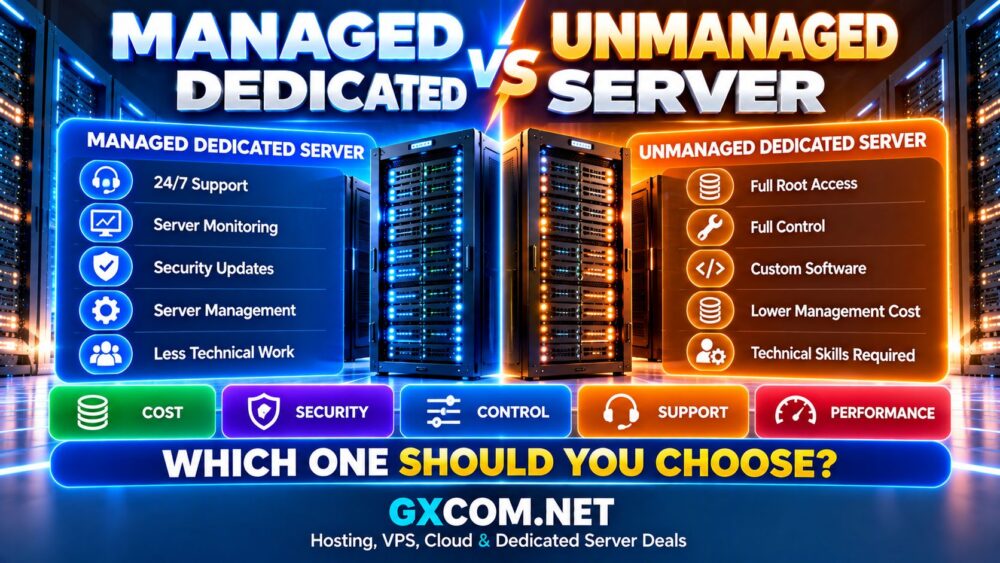
Managed vs Unmanaged Dedicated Server Cost
| Cost Area | Managed Dedicated | Unmanaged Dedicated |
|---|---|---|
| Physical Hardware | Included | Included |
| Server Management | Included or added to plan | Customer handles |
| Monitoring | Often included | Customer configures |
| OS Maintenance | Often provider-assisted | Customer |
| Security Administration | May be included | Customer |
| Technical Labor | Partly included in service | Internal or external administrator |
| Monthly Hosting Bill | Usually higher | Usually lower |
| Internal Administration Time | Usually lower | Usually higher |
The comparison becomes more useful when you include labor.
An unmanaged server may save money on the hosting invoice, but if your company must pay an administrator to maintain it, the total operating cost may be much closer to—or higher than—a managed solution.
Our
Managed vs Unmanaged Dedicated Server
comparison examines these operational differences in more detail.
Hidden Costs of Managed Dedicated Hosting
Even a fully managed server can have additional charges beyond the headline monthly price.
Control Panel Licenses
Commercial control panels can add recurring costs. Check whether your preferred panel is included or billed separately.
Windows Server Licensing
Windows-based dedicated servers may involve licensing costs that Linux configurations do not have in the same way.
Backup Storage
Do not assume that “managed” automatically means unlimited off-server backups. Backup capacity, retention, and restoration policies should be checked separately.
Additional IP Addresses
Extra IPv4 addresses may involve setup or recurring fees depending on the provider and justification requirements.
Extra Management Services
Some providers support only specific operating systems, control panels, or software under the standard management package. Custom applications may require additional services or remain entirely your responsibility.
Fully Managed Does Not Mean Everything Is Managed
This is one of the most important points to understand before purchasing.
A provider may manage the operating system and supported server stack without managing your WordPress plugins, custom PHP application, ecommerce code, third-party SaaS integrations, or business data.
Before ordering, ask exactly who is responsible for:
- Operating system updates
- Web server configuration
- Database administration
- Firewall rules
- Malware response
- Control panel updates
- Application troubleshooting
- Backups
- Backup restoration
- Performance optimization
A clear support boundary makes it much easier to compare the real value of different managed hosting plans.
Is Managed Dedicated Hosting Cheaper Than Hiring a System Administrator?
For some businesses, this is the more relevant comparison.
A company operating only one or a few servers may not need a full-time infrastructure specialist. Purchasing management from the hosting provider can give the business access to technical assistance without maintaining the same level of internal staffing.
However, organizations operating many servers, complex private networks, custom software stacks, or specialized infrastructure may still benefit from an internal DevOps or system administration team.
Managed hosting does not completely replace internal IT expertise in every environment.
Does Managed Hosting Improve Performance?
Managed hosting does not magically make identical hardware faster.
Two servers with the same processor, RAM, storage, and network should not be judged differently simply because one carries a managed label.
However, experienced server administration can indirectly improve performance through better configuration.
This can include:
- Web server tuning
- Database optimization
- Caching configuration
- Resource monitoring
- Software maintenance
- Identifying performance bottlenecks
The value depends on what optimization services the management plan actually includes.
Does Managed Hosting Improve Security?
Professional administration can reduce some operational security risks when the management service includes regular patching, monitoring, and supported security configuration.
But managed hosting should not be interpreted as complete security outsourcing.
Application vulnerabilities, weak passwords, compromised user accounts, insecure custom code, and unsupported software can still create risks.
Businesses should understand which security responsibilities belong to the provider and which remain with the customer.
When Is Fully Managed Dedicated Hosting Worth It?
Managed dedicated hosting becomes particularly attractive when the cost of administration, downtime, or technical mistakes is more important than obtaining the lowest possible monthly server price.
It can make sense for:
- High-traffic business websites
- Ecommerce stores
- Digital agencies
- Membership platforms
- SaaS applications
- Businesses without system administrators
- Organizations running revenue-generating websites
- Companies that need dedicated hardware but limited infrastructure work
When Is Managed Dedicated Hosting Not Worth It?
Paying for full management may provide limited value if your company already has experienced administrators who prefer complete control over the infrastructure.
Unmanaged hosting can make more sense when:
- You have an internal DevOps team
- You are an experienced Linux or Windows administrator
- You need a highly customized software stack
- You prefer to manage security internally
- You operate many servers with centralized management tools
- Reducing infrastructure cost is a major priority
For these use cases, compare our
Best Unmanaged Dedicated Server Providers
before paying for management you may not need.
Managed Dedicated Server vs Managed VPS Cost
A managed VPS can provide professional administration at a lower infrastructure cost when an application does not require an entire physical server.
Dedicated hosting becomes more compelling when workloads need substantial CPU, RAM, storage, predictable physical resources, or specialized hardware configurations.
Before moving from VPS to dedicated hardware, determine whether the current bottleneck is actually CPU, memory, storage I/O, bandwidth, or application configuration.
Our
Dedicated Server Hosting Guide
explains when upgrading to physical hardware makes sense.
How to Calculate the True Cost of Managed Dedicated Hosting
A useful comparison should calculate total cost rather than only monthly server rental.
Estimate:
- Base server price
- Management fee
- Operating system licenses
- Control panel
- Backup storage
- Additional bandwidth
- Additional IP addresses
- Security services
- Internal IT labor
- External administrator costs
Then compare the managed solution against the complete cost of operating an unmanaged server.
For example, saving money on server management provides little benefit if your business then spends substantially more employee time maintaining the infrastructure.
How to Reduce Managed Dedicated Server Costs
Right-Size the Hardware
Avoid purchasing CPU cores, RAM, and storage that your workload does not use.
Choose the Right Storage
Use high-performance NVMe where the workload benefits from it rather than automatically selecting premium storage for every use case.
Review Software Licenses
Operating systems and commercial control panels can meaningfully increase recurring costs. Use only the software your environment requires.
Understand the Management Package
Do not pay for overlapping services that your own technical team already performs.
Review Resource Usage Regularly
A server selected for a previous workload may become oversized after applications are optimized or migrated.
How to Compare Managed Dedicated Hosting Providers
When comparing providers, look beyond the advertised server specification.
Evaluate:
- Exact CPU model
- RAM capacity
- NVMe or SSD configuration
- Network specifications
- Data center locations
- Management scope
- Monitoring
- Security responsibilities
- Backup policy
- Response times
- Supported software
- Upgrade options
- Total recurring cost
A more expensive provider can represent better value if its management service replaces technical work your company would otherwise need to purchase separately.
Is Fully Managed Dedicated Hosting Worth the Extra Cost?
For businesses without experienced server administrators, fully managed dedicated hosting can justify its higher monthly price by reducing routine infrastructure work and providing access to technical expertise.
For organizations with internal infrastructure teams, the calculation is different. Paying an additional management fee may provide little value if your administrators already perform the same tasks.
The decision should therefore be based on total operating cost rather than hosting price alone.
Compare the cost of hardware, management, software, backups, security, and internal technical labor. This gives you a much more realistic picture of whether managed hosting is financially worthwhile.
Final Thoughts
Managed dedicated server hosting costs more than self-managed infrastructure because you are purchasing two things: dedicated physical hardware and professional server administration.
That additional expense can be worthwhile when your business needs powerful dedicated resources but does not want to spend significant time maintaining the operating system, monitoring infrastructure, installing security updates, and troubleshooting server problems.
Before purchasing, identify exactly what the management package includes and calculate the complete monthly cost. A fully managed server that reduces operational workload can provide better business value than a cheaper unmanaged machine—but only when you actually need the management services you are paying for.