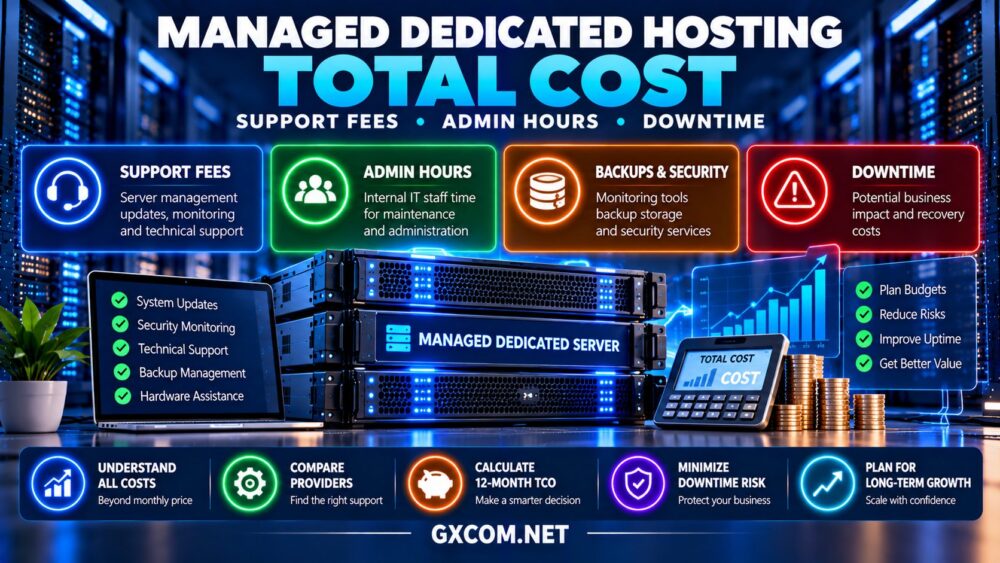
Understanding the managed dedicated hosting total cost requires looking beyond the advertised monthly server price. Management fees, administrator hours, monitoring tools, backup storage, software licensing, and potential downtime can substantially change the real cost of running dedicated infrastructure.
For businesses without a large IT department, managed hosting may reduce routine administration and improve access to technical assistance. However, paying for management does not automatically eliminate internal responsibilities or guarantee uninterrupted service.
This guide explains how to calculate dedicated hosting total cost of ownership (TCO), compare management arrangements, and evaluate Hostwinds, KnownHost, ServerMania, and InterServer.
What Is Included in Managed Dedicated Hosting?
Managed dedicated hosting combines rented physical server resources with an agreed scope of technical administration. Depending on the service, management may cover operating system updates, monitoring, security configuration, troubleshooting, and selected maintenance tasks.
Application development, database optimization, third-party software, and disaster recovery may remain outside the included service.
Before comparing prices, review our managed vs unmanaged dedicated hosting comparison to understand how responsibilities differ.
1. Calculate the True Monthly Server Cost
The physical server rental is only the foundation of the budget. A realistic calculation should include management, backups, monitoring, software licensing, and applicable setup charges.
Use the following formula:
Monthly operating cost = server rental + management fees + recurring services + internal administration costs.
Keep one-time migration and installation expenses separate, then distribute them across the period being evaluated.
For example, a hypothetical server renting for $125 monthly with a $70 management package and $25 backup service costs $220 monthly before internal labor and incident-related expenses.
2. Compare Management Fees and Support Scope
Management packages can vary significantly. Some cover operating system maintenance and basic troubleshooting, while others provide broader monitoring, configuration assistance, or emergency support.
A lower management fee is not necessarily better if important tasks are excluded or billed separately.
Request written clarification about supported operating systems, control panels, security updates, application assistance, and after-hours coverage.
Our managed dedicated server SLA guide explains response commitments, escalation procedures, and exclusions.
3. Include Internal Administrator Hours
Managed hosting rarely eliminates all internal technical work. Businesses still need someone to approve changes, manage application releases, review incidents, and coordinate with the provider.
Estimate the hours required each month and multiply them by a realistic loaded labor rate.
For example, six administrator hours at an illustrative $45 hourly cost add $270 monthly. This figure represents an internal planning assumption, not a market salary benchmark.

Compare that with the time required to operate an unmanaged server, including patching, monitoring, backups, and troubleshooting.
Businesses with experienced internal administrators may find self-management economical. Smaller teams may value the time saved through a well-defined management agreement.
4. Budget for Monitoring, Security and Backups
Security and recovery expenses should be evaluated separately from the hosting plan’s headline price.
Potential costs include log monitoring, vulnerability assessment, endpoint protection, offsite backup storage, and restoration assistance.
Confirm whether security alerts are actively investigated or simply forwarded to the customer. Similarly, a backup service is less valuable if restoration procedures have never been tested.
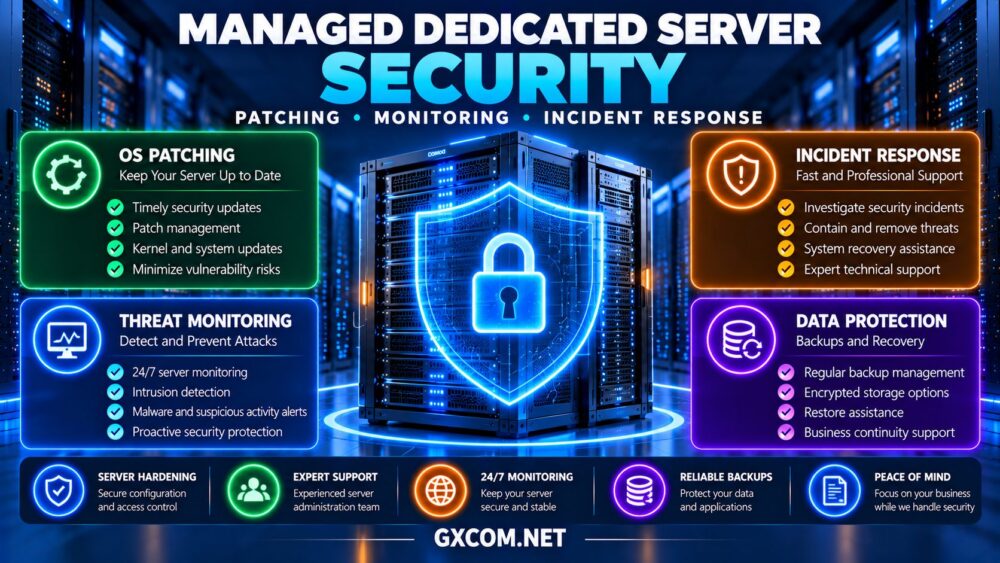
Review our managed dedicated server security guide for patching, monitoring, and incident response responsibilities.
5. Estimate Downtime Costs Without Inventing Guarantees
Downtime can create lost sales, interrupted employee productivity, support workload, and reputational damage. However, its financial impact depends heavily on the application.
A useful planning model is:
Estimated incident impact = disruption duration × estimated business loss per hour + recovery expenses.
For illustration, a business estimating $150 in losses per hour would calculate $450 for a three-hour interruption, excluding recovery labor.
These assumptions should come from the business’s own operations. Managed hosting may improve access to support, but it cannot guarantee that incidents will never occur.
Evaluate response procedures, backup restoration, and hardware replacement arrangements rather than relying solely on advertised uptime percentages.
6. Compare Managed Dedicated Hosting Providers
The following providers are relevant candidates for dedicated hosting and support evaluation. Management availability and included services must be confirmed for the exact product being purchased.
Hostwinds: Managed Support Evaluation
Hostwinds is worth investigating when comparing dedicated hardware with available administration and support services.
Review included maintenance tasks, operating system support, monitoring coverage, backup options, and additional service charges.
Best for: Businesses comparing infrastructure rental with ongoing technical assistance.
KnownHost: Management-Focused Purchasing
KnownHost is relevant for organizations researching managed hosting arrangements.
Confirm dedicated server availability, supported software, security responsibilities, and the specific management terms attached to the selected plan.
Best for: Buyers prioritizing clearly documented administration responsibilities.
ServerMania: Business Infrastructure Planning
ServerMania is worth evaluating for organizations with defined hardware, support, and operational requirements.
Request details about management options, technical escalation, replacement procedures, and any separately billed administration work.
Best for: Businesses seeking structured infrastructure and support planning.
InterServer: Hardware and Management Cost Comparison
InterServer is relevant for buyers comparing dedicated hardware costs with available support arrangements.
Determine which tasks are included, whether additional administration is available, and how optional services affect the recurring invoice.
Best for: Cost-conscious teams evaluating self-management against purchased support.
7. Compare 12-Month Total Cost of Ownership
The following hypothetical comparison illustrates why rental price alone can be misleading.
| Monthly Cost | Unmanaged | Managed |
|---|---|---|
| Server rental | $125 | $125 |
| Management fee | $0 | $70 |
| Backup and monitoring | $40 | $25 |
| Internal administration | $450 | $180 |
| Monthly total | $615 | $400 |
| 12-month total | $7,380 | $4,800 |
In this example, managed hosting saves $2,580 annually because fewer internal administration hours are assumed.
Actual results may differ considerably. Both scenarios exclude taxes, licensing, migration, and downtime costs, and neither guarantees a particular service level.

8. Consider Migration, Upgrades and Contract Changes
Long-term expenses may increase when applications require additional RAM, NVMe storage, processor capacity, or a replacement server.
Hardware changes can introduce technician fees, temporary overlapping rentals, migration labor, and planned maintenance windows.
Review our dedicated server upgrade paths guide before committing to hardware with limited expansion options.
Also confirm cancellation notice periods, renewal rates, and whether changing management packages affects the contract.
9. Decide When Managed Hosting Is Worth Paying For
Managed dedicated hosting may provide stronger economic value when internal administrator time is expensive, routine maintenance consumes substantial resources, or reliable technical assistance is important.
Unmanaged hosting may remain appropriate when a business already has skilled administrators, established automation, and sufficient incident response capacity.
Compare current infrastructure offers through our dedicated server deals comparison, then add management and operational costs before selecting a plan.
Final Verdict
The managed dedicated hosting total cost depends on much more than server rental and support fees. Administrator hours, security services, backups, downtime exposure, and hardware upgrades all influence long-term value.
Hostwinds, KnownHost, ServerMania, and InterServer are relevant providers to investigate. Compare written service scopes and realistic operating budgets rather than assuming that the lowest monthly price represents the lowest total cost.
The right choice is the arrangement that supports your applications while keeping administration, recovery, and financial risks manageable.