Minecraft Velocity vs BungeeCord hosting is an important comparison for communities planning to connect multiple game servers through one public address. Both proxies allow players to move between survival worlds, lobbies, creative servers and minigames without manually reconnecting to different addresses. However, their software architecture, security mechanisms and plugin compatibility create different hosting requirements.
Choosing the right proxy involves more than comparing memory allocations. Administrators must consider Java compatibility, backend protection, network capacity and the combined cost of operating several server instances.
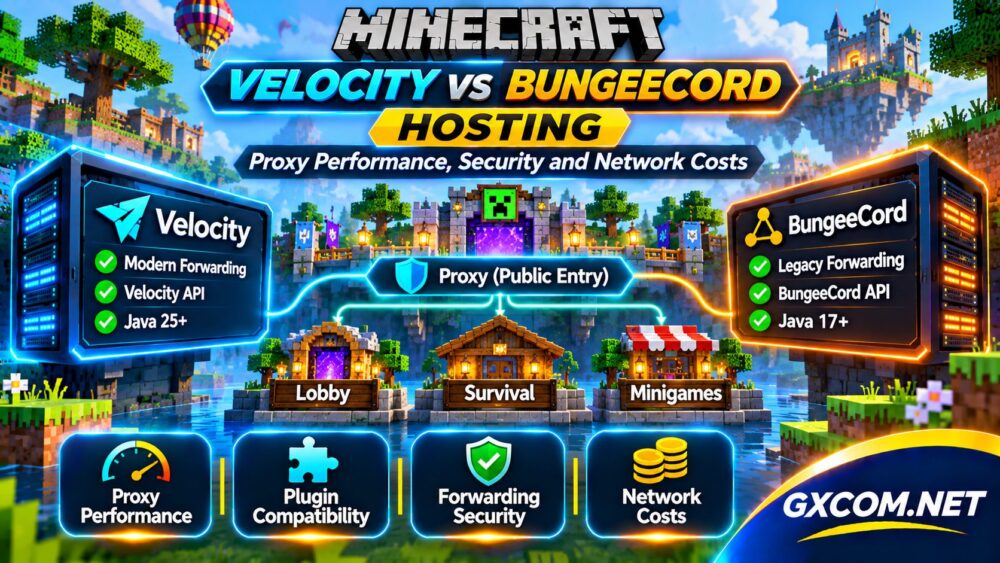
Minecraft Velocity vs BungeeCord Hosting: Key Differences
| Feature | Velocity | BungeeCord |
|---|---|---|
| Development project | PaperMC | SpigotMC |
| Current Java requirement | Java 25 for Velocity 4.x | Java 17 minimum for current builds |
| Configuration file | velocity.toml | config.yml |
| Player forwarding | Modern, legacy or BungeeGuard | Legacy forwarding |
| Plugin ecosystem | Velocity API | BungeeCord API |
| Typical deployment | New Minecraft networks | Existing networks with legacy dependencies |
As of November 26, 2026, current documentation identifies Java 25 as the minimum runtime for Velocity 4.x, while current BungeeCord builds require at least Java 17. Confirm the requirements of the exact downloadable build before purchasing hosting.
Understand Proxy and Backend Server Architecture
A Minecraft proxy manages player connections and routes them to separate game servers. It does not simulate survival worlds, generate chunks or process ordinary world entities. Those workloads belong to backend instances running software such as Paper or compatible modded implementations.
A typical community might operate one public proxy, one lobby and two gameplay servers. Each instance needs its own process, memory allocation and network endpoint, although several instances may share one physical machine.
Separating these workloads allows administrators to restart individual gameplay servers without necessarily shutting down the entire network. However, failure of a single public proxy can interrupt access to every connected backend. Our multiple community game server hosting guide explains alternative infrastructure arrangements and management costs.
Proxy Performance and Resource Allocation
Velocity is designed with efficient connection handling and modern Minecraft networking in mind. Nevertheless, architectural improvements do not establish a universal performance advantage under every workload. Actual results depend on concurrent connections, packet processing, compression, plugins and available CPU resources.

A proxy generally requires less memory than a busy survival server because it does not maintain a complete game world. A small network could evaluate a 1GB Java heap as an initial configuration, consistent with the Velocity documentation’s example startup allocation. Additional memory must remain available for non-heap consumption and operating overhead.
Monitor processor utilization, memory consumption, garbage collection and connection stability before increasing resources. A larger proxy allocation will not resolve low TPS caused by an overloaded backend.
Player slots should therefore be treated as commercial limits rather than reliable measurements of processing capacity.
Player Forwarding and Backend Security
When a proxy authenticates players, backend servers normally rely on forwarded identity information instead of independently authenticating each connection. Incorrectly exposing these backends can create serious impersonation risks.
Velocity Modern Forwarding
Velocity modern forwarding authenticates forwarded player information using a shared secret. Compatible Paper backends can verify this information and reject unauthorized forwarding attempts. The proxy secret must match the backend configuration and remain confidential.
Modern forwarding requires compatible backend software and is unsuitable for certain older Minecraft versions. Fabric deployments may require an additional forwarding mod.
BungeeCord Legacy Forwarding
Traditional BungeeCord forwarding communicates player IP addresses and identity information without equivalent built-in cryptographic authentication. Administrators must restrict direct access to backend ports.
Where appropriate, BungeeGuard provides an additional token-based protection mechanism. It should complement network isolation rather than replace it.
DDoS Protection and Network Isolation
Configure backend access so that only authorized proxy nodes can establish gameplay connections. Use private networking, restrictive firewalls or local interfaces where the infrastructure permits.
On shared hosting, customers may not control the underlying firewall. Ask whether the provider supports private allocations, authenticated forwarding and effective separation between unrelated customers.
DDoS protection advertised for the public proxy does not automatically protect independently exposed backend addresses. Confirm mitigation coverage, traffic restrictions and whether attacks can trigger temporary service suspension.
Keep the proxy and backend servers geographically close unless a distributed architecture has a demonstrated operational benefit. Excessive latency between these components can undermine the player experience.
Compare Minecraft Proxy Hosting Providers
The following providers offer documented Minecraft proxy options, but their services should be evaluated according to the specific software version and network configuration required.
Shockbyte: Entry-Level Proxy Network Options
Shockbyte documents support for Velocity and BungeeCord. Its Minecraft pricing page displays a promotional 1GB package at $2.79 monthly, alongside a $3.99 regular reference price.
The provider advertises DDoS protection and customizable Minecraft hosting. Confirm whether the selected package supports the required Java runtime, proxy installation and backend restrictions. Promotional eligibility and final recurring charges require checkout verification.
Sparked Host: Network Configuration Assistance
Sparked Host identifies both Velocity and BungeeCord among its supported Minecraft server types. Its commercial page lists a $5 BungeeCord configuration service requiring three server instances.
The setup service is separate from infrastructure rental. A dedicated IP or port option is also advertised at $4 monthly. Administrators should confirm which additional allocations are necessary and whether equivalent Velocity configuration assistance is available.
ScalaCube: BungeeCord Network Hosting
ScalaCube advertises BungeeCord support, multiple server management, custom JAR files and DDoS protection within its Minecraft hosting products.
Its separate Velocity product page currently indicates that the service is forthcoming. Buyers should not assume that a dedicated Velocity package is already available. Request confirmation of instance limits and complete network pricing before subscribing.
Plugin Compatibility and Migration Planning
Velocity and BungeeCord use different proxy plugin APIs. Existing BungeeCord plugins generally require compatible replacements or dedicated Velocity versions. Backend plugins using supported messaging channels may remain usable without installing the original proxy plugin.
Before migrating, inventory permissions, authentication integrations, server selectors and network communication tools. Test player identity consistency and preserve existing data. Review our modded game server hosting comparison for additional compatibility considerations.
Neither proxy automatically provides Bedrock crossplay. Communities requiring cross-platform access should also evaluate the integration options discussed in our Minecraft Java vs Bedrock hosting guide.
Calculate Complete Minecraft Network Hosting Costs
Consider a hypothetical network with a $4 monthly proxy, a $6 lobby, a $16 survival server and a $12 minigame server. Adding $5 for backups and networking produces a total monthly budget of $43, or $516 annually.
This example is a planning model rather than a provider quotation. Include additional databases, public addresses, migration assistance and infrastructure management when comparing real offers.
Which Minecraft Proxy Should You Choose?
Consider Velocity for new networks using compatible modern backends and authenticated forwarding. Retain BungeeCord where essential legacy plugins justify its continued use and appropriate security controls are available. Select hosting according to runtime compatibility, backend isolation, sustained resource availability and complete network costs rather than the cheapest advertised proxy package.