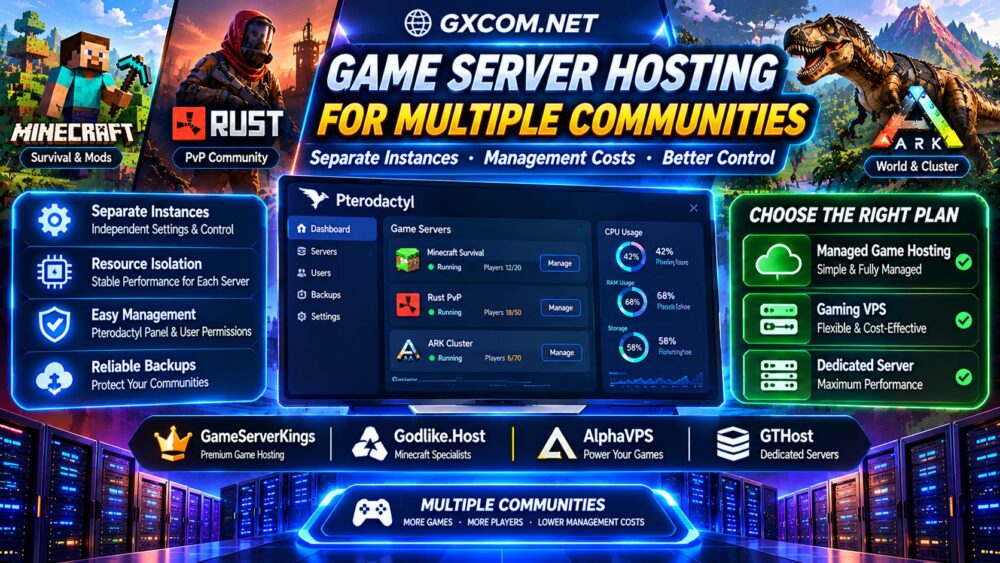
Game server hosting for multiple communities becomes complicated when one administrator manages several Minecraft worlds, Rust groups, or ARK servers. Each community may need different plugins, moderators, backups, player limits, and update schedules. Buying separate hosting plans is convenient, but running everything on one machine can appear cheaper.
The best approach depends on resource isolation, operational experience, and total management costs. This guide compares individual managed plans, multi-instance VPS hosting, and dedicated servers so community operators can scale without sacrificing reliability.
Why Multiple Game Communities Need Separate Instances
A game server instance is an independently configured server process or deployment. Separate instances allow administrators to maintain different worlds, game versions, configuration files, player permissions, and restart schedules.
For example, a Minecraft network might operate a survival world, a modded world, and a testing environment. A gaming organization might run Minecraft, Rust, and ARK simultaneously.
Separate instances improve administrative organization, but they do not automatically guarantee hardware isolation. Processes sharing one operating system may still compete for CPU, memory, storage, and network resources.
Three Ways to Host Multiple Game Servers
| Hosting Model | Main Advantage | Main Tradeoff |
|---|---|---|
| Separate managed plans | Simple administration and support | Multiple subscriptions |
| Multi-instance VPS | Flexible configuration and consolidated billing | Self-management responsibilities |
| Dedicated server | Greater control over physical resources | Higher operational responsibility |
Managed plans are often practical for independent communities with volunteer administrators. VPS hosting suits technically experienced operators, while dedicated hardware becomes attractive when several demanding workloads justify consolidated infrastructure.
Explore our Gaming VPS Guides before choosing a self-managed environment.
CPU Allocation and Performance Isolation
CPU contention is one of the biggest risks when hosting multiple communities. Game servers often depend heavily on timely simulation updates, so one overloaded instance can affect neighboring workloads.
Monitor per-instance CPU usage rather than relying exclusively on total machine utilization. A server may experience poor tick performance even when several processor cores appear underused.
Containers can apply resource limits, but those limits do not create dedicated physical CPU cores. Virtual machines provide stronger operating-system separation, although the underlying host still requires adequate capacity.

Leave headroom for world generation, backups, updates, and unexpected player activity.
RAM, Storage, and Network Planning
Calculate memory requirements for every game instance, the operating system, management panel, and supporting services. Avoid allocating all available RAM to game processes.
Storage planning should include active worlds, mods, logs, temporary update files, and backup retention. NVMe storage can help demanding workloads, but capacity and reliable backups remain equally important.
Assign unique listening ports to instances that share an IP address. Document firewall rules, query ports, and remote administration access to prevent conflicts.
For larger deployments, review our Game Dedicated Servers Guides.
Using Pterodactyl for Multi-Server Management
Pterodactyl is an open-source game server management platform that uses container-based isolation through Docker. It can help operators organize individual game instances, manage files, review console output, and delegate access.
However, installing a panel does not eliminate system administration. Operators remain responsible for securing the host, maintaining Docker, managing updates, and protecting panel credentials.
Assign separate users and permissions to each community. Limit administrative privileges and avoid sharing credentials across unrelated groups.
Where workloads require stronger isolation, consider separate virtual machines or physical hosts instead of relying entirely on containers.
Separate Backups and Update Schedules
Each community should have an independent backup and recovery plan. A single machine-level snapshot may help restore infrastructure, but it is not always the best way to recover one damaged world.
Schedule backups around game activity, verify file consistency, and store important recovery copies outside the production server.
Use separate maintenance windows where possible. A Rust update should not force unnecessary downtime for a Minecraft community running on the same hardware.
Our VPS Snapshot and Backup Recovery Guide explains why snapshots and application backups serve different purposes.
Comparing Four Hosting Providers
GameServerKings is worth evaluating when separate managed game hosting plans fit the needs of independently operated communities. Compare supported games, management controls, backup features, and pricing for each instance.
Godlike.Host may be relevant to administrators running multiple Minecraft communities. Verify available resource allocations, mod support, control panel features, and upgrade options for the specific packages under consideration.
AlphaVPS offers an infrastructure-oriented alternative for administrators comfortable configuring their own gaming environment. Check CPU policies, memory allocation, storage performance, and operating-system requirements before deploying multiple instances.
GTHost is another option to investigate when a dedicated server may support several workloads. Compare physical hardware, network specifications, data center locations, and the support included with the selected service.
These providers represent different hosting approaches, not a verified performance ranking. For managed options, consult our Game Hosting Comparisons.
Calculate the Total Cost of Multiple Servers
Monthly subscription prices do not reveal the complete cost of operating several communities. Include infrastructure, backup storage, control panel maintenance, security, monitoring, and administrator time.
For example, three independent managed plans costing $15 each would total $45 monthly. A hypothetical $35 VPS appears cheaper, but the comparison changes if administration, backups, and additional resources create extra costs.
These figures are illustrative, not current provider quotations.
Dedicated hosting may offer better consolidation economics at higher utilization, but unused capacity can make it unnecessarily expensive for small communities.

When Should Communities Move to Dedicated Hosting?
Consider dedicated infrastructure when several instances consistently consume substantial resources, operators need deeper configuration control, or separate managed subscriptions become difficult to coordinate.
Before migrating, measure peak CPU usage, memory consumption, disk activity, and network demand. Estimate operational responsibilities and identify who will respond to outages.
Compare physical servers and virtualization approaches in our Bare Metal Server Comparison.
Frequently Asked Questions
Can One VPS Run Multiple Game Servers?
Yes, provided the VPS has sufficient resources and each instance is configured correctly. Actual capacity depends on game workloads, virtualization policies, and peak activity.
Does Pterodactyl Provide Complete Isolation?
No. Containers provide useful process separation and resource controls, but instances still share underlying host resources.
Are Separate Managed Plans More Reliable?
They can reduce shared-host management complexity, but reliability depends on the provider’s infrastructure, backup policies, and support.
Final Verdict
Game server hosting for multiple communities should balance independence, performance, administration, and cost. Start with separate managed plans when simplicity matters most. Consider a VPS when technical control and consolidation become valuable, and move to dedicated hardware when measured workloads justify the investment.
The right hosting architecture protects each community’s experience without creating unnecessary operational complexity.