Your web hosting plan looked incredibly cheap when you signed up.
Then the renewal notice arrived—and suddenly the price was much higher.
This is one of the most common surprises in web hosting.
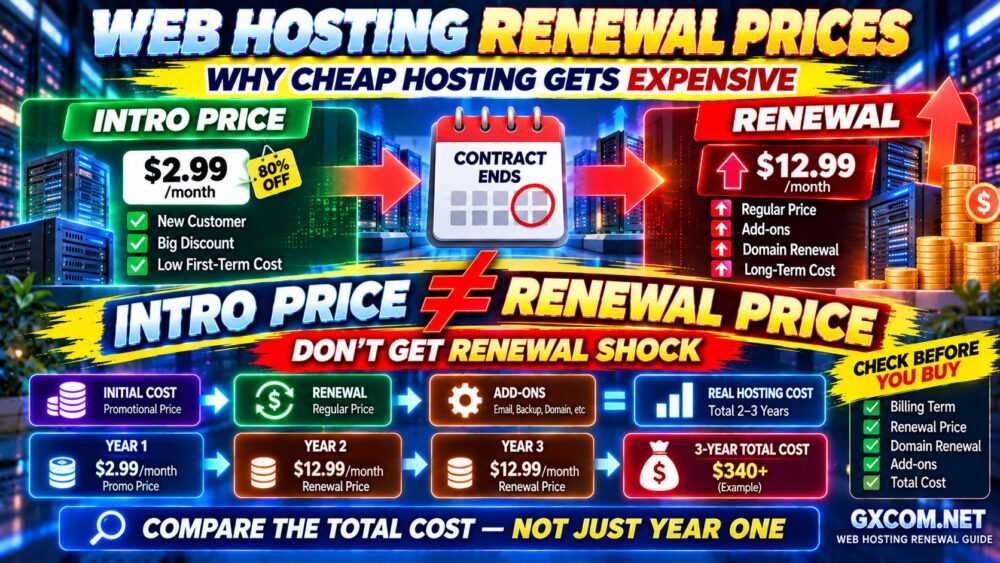
Many hosting companies offer heavily discounted introductory rates to new customers. These promotions can provide excellent value, but the discounted price usually applies only to the initial billing term.
When that period ends, the account may renew at the provider's standard rate.
That means the price you see when buying hosting is not always the price you will pay long term.
INTRO PRICE ≠ RENEWAL PRICE.
Understanding web hosting renewal prices before you purchase can help you avoid unexpected bills, compare hosting deals more accurately and calculate the real cost of running your website over several years.
In this guide, GXCOM.NET explains why hosting renewal prices increase, how introductory discounts work, what to check before buying and how to reduce your long-term hosting costs without sacrificing website performance or reliability.
What Is a Web Hosting Renewal Price?
A web hosting renewal price is the amount charged when your existing hosting subscription continues after its current billing term expires.
For example, a hosting company might offer a heavily discounted rate for the first contract period.
When that introductory period ends, the hosting account typically renews at the provider's regular rate unless another offer or pricing arrangement applies.
The basic structure looks like this:
NEW CUSTOMER
↓
INTRODUCTORY DISCOUNT
↓
INITIAL CONTRACT
↓
CONTRACT EXPIRES
↓
REGULAR RENEWAL PRICE
This pricing model is common across the hosting industry.
The problem is not necessarily that renewal pricing exists.
The problem occurs when buyers compare hosting companies using only the introductory rate and ignore what happens afterward.
Why Do Web Hosting Prices Increase at Renewal?
The simplest explanation is customer acquisition.
Hosting companies compete aggressively for new customers.
A large introductory discount reduces the initial barrier to signing up.
The provider may effectively say:
TRY OUR HOSTING AT A LOWER INITIAL COST.
Once the promotional period ends, the account moves toward the normal pricing structure.
This is similar to introductory pricing used by many subscription businesses.
Therefore, a large renewal increase does not automatically mean something improper happened.
What matters is whether the renewal terms were disclosed and whether the long-term cost still represents good value for your website.
Introductory Price vs Renewal Price
This is the most important distinction to understand when comparing hosting plans.
| Price Type | What It Means |
|---|---|
| Introductory Price | Discounted rate usually offered to new customers |
| Regular Price | Provider's standard price for the hosting plan |
| Renewal Price | Price charged when the hosting term renews |
| Monthly Equivalent | Total contract cost divided into a monthly-looking figure |
These numbers should not be treated as interchangeable.
A pricing page may prominently display a low monthly equivalent while the actual checkout requires payment for a much longer period.
Then, after that period ends, the account may renew at a different rate.
LOW ADVERTISED PRICE ≠ PERMANENT MONTHLY PRICE.
Why Hosting Renewal Prices Matter More Than the Discount Percentage
Suppose one provider advertises a huge introductory discount.
Another offers a smaller discount.
Which one is cheaper?
You cannot know from the discount percentage alone.
You need to calculate:
INITIAL CONTRACT COST
+
RENEWAL COST
+
REQUIRED ADD-ONS
=
REAL HOSTING COST
The provider with the smaller headline discount may ultimately cost less.
This is why GXCOM.NET recommends evaluating hosting deals based on total value rather than the largest promotional percentage.
Our Best Web Hosting Deals guide explains how to compare discounts, features, resources and renewal costs together.
How to Calculate the Real Cost of Web Hosting
The easiest way to understand hosting costs is to stop thinking only in monthly prices.
Instead, calculate several years of ownership.
Example
Imagine a hypothetical hosting plan:
| Period | Pricing Structure |
|---|---|
| Initial Term | Promotional Rate |
| First Renewal | Regular Rate |
| Second Renewal | Regular Rate |
Your calculation becomes:
YEAR 1 COST + YEAR 2 COST + YEAR 3 COST = 3-YEAR HOSTING COST
Then:
3-YEAR HOSTING COST ÷ 36 = EFFECTIVE MONTHLY COST
This number gives you a much better basis for comparing providers.
The Biggest Hosting Pricing Mistake: Comparing Only Year One
This mistake is extremely common.
A buyer sees two providers:
| Host A | Host B | |
|---|---|---|
| Initial Price | Very Low | Moderate |
| Renewal | High | Moderate |
| Backups | Extra | Included |
| Limited | Included | |
| Long-Term Value | Depends on Renewal | Potentially Better |
If you compare only the initial payment, Host A wins.
If you compare several years plus required features, Host B may win.
CHEAP FIRST YEAR ≠ CHEAP HOSTING.
How Contract Length Changes Your Renewal Cost
Hosting discounts often depend on billing period.
You may see options such as:
- Monthly
- 12 months
- 24 months
- 36 months
- Longer prepaid terms
A longer initial contract may provide a lower effective monthly rate and delay the first renewal.
For example:
12-MONTH PROMOTION
→ Renewal arrives sooner
36-MONTH PROMOTION
→ Promotional rate may remain locked for longer
But there is a tradeoff.
A longer contract means:
- More money paid upfront
- Longer commitment
- Less flexibility if service disappoints you
Therefore:
LONGER CONTRACT ≠ AUTOMATICALLY BETTER DEAL.
Monthly Equivalent vs Amount Due Today
This is another pricing detail that hosting buyers frequently misunderstand.

A provider might display a monthly equivalent prominently.
But that does not necessarily mean you will be billed that small amount every month.
The checkout may require the full contract payment upfront.
Before purchasing, identify:
- Advertised monthly equivalent
- Contract length
- Total amount due today
- Next renewal date
- Renewal amount
Those five numbers tell you far more than a promotional banner.
Do Hosting Companies Clearly Show Renewal Prices?
Many established hosting providers publish regular or renewal pricing somewhere on their pricing pages, checkout process, terms or billing documentation.
However, the promotional price is naturally more visually prominent because it is part of the sales offer.
Before entering payment details, actively look for wording such as:
- Renews at
- Regular price
- After initial term
- Introductory rate
- New customers only
- First term only
If you cannot determine what happens after the initial contract, contact the provider before purchasing.
Web Hosting Renewal Prices and “Free” Domains
Hosting renewal cost is only part of the equation.
Many hosting plans include a domain registration promotion during the first year.
After that period, the domain may renew separately.
Your real website cost can therefore become:
HOSTING RENEWAL
+
DOMAIN RENEWAL
+
EMAIL
+
BACKUPS
+
OTHER ADD-ONS
Always distinguish between:
FREE FOR THE FIRST YEAR
and:
FREE FOR THE LIFE OF THE HOSTING PLAN.
They are not the same thing.
Watch for Add-Ons at Renewal
A hosting plan can become more expensive even without a dramatic base-price increase if additional services are billed separately.
Potential add-ons include:
- Domain privacy
- Premium backups
- Email services
- Security products
- Malware protection
- Premium SSL
- Website builders
- SEO tools
Some of these services may be useful.
But you should know whether you actually need them.
Review your account before renewal instead of automatically renewing every optional product attached to it.
How to Avoid Expensive Hosting Renewals
You do not necessarily need to change hosting companies every time a promotional period ends.
Instead, use a structured renewal strategy.
1. Check the Renewal Price Before You Buy
The best time to investigate renewal pricing is before entering your credit card details.
Record:
- Initial price
- Initial term
- Renewal price
- Renewal frequency
Then decide whether the plan still makes sense without the introductory discount.
2. Set a Reminder Before Renewal
Do not wait until the hosting charge appears.
Set a reminder several weeks before the renewal date.
This gives you time to:
- Review the new price
- Check current hosting deals
- Contact support
- Remove unnecessary services
- Prepare a migration if needed
3. Review Your Current Resource Usage
You may be paying for more hosting than you need.
Check:
- Storage usage
- Number of websites
- Traffic
- Email usage
- Database usage
- CPU/resource requirements
If you are using only a small fraction of the plan, a lower tier may be enough.
4. Remove Unnecessary Add-Ons
Review every recurring service.
Ask:
DO I ACTUALLY USE THIS?
If the answer is no, determine whether it can be removed before renewal.
5. Compare Current Hosting Deals
Before renewing, compare your existing provider with the current market.
Our Cheap Web Hosting Deals guide focuses specifically on finding lower-cost hosting without sacrificing essential performance and reliability.
But remember that switching providers has its own cost.
6. Contact Your Existing Hosting Provider
If the renewal price seems too high, contact the provider before cancelling.
Ask whether there are:
- Different billing terms
- Alternative plans
- Lower-cost tiers
- Current account offers
- Options better matched to your usage
Do not assume the only choices are paying the displayed renewal price or immediately leaving.
7. Migrate Only When the Savings Justify It
Changing hosts requires work.
You may need to migrate:
- Website files
- Databases
- DNS
- SSL
- Backups
If changing providers saves very little, the migration effort may not be worthwhile.
If the long-term savings are substantial or the existing service is poor, migration can make much more sense.
Should You Switch Hosts Every Time the Price Increases?
No.
Constantly moving websites simply to chase introductory promotions can create hidden costs.
These include:
- Your time
- Migration risk
- Downtime
- Email configuration
- DNS changes
- Testing
- Potential compatibility problems
Think in terms of:
MONEY SAVED
minus
TIME + MIGRATION RISK
If the result is small, staying with a reliable host may be the better decision.
When Switching Hosting Providers Makes Sense
A higher renewal price can be a useful moment to reconsider your infrastructure.
Switching may make sense when:
- The renewal price is no longer competitive
- Performance is consistently poor
- Support is inadequate
- You need features the current host does not provide
- Your website has outgrown the plan
- Another provider offers significantly better long-term value
Do not migrate just because another host has a bigger discount banner.
Migrate when the complete value proposition is better.
When Paying the Higher Renewal Price Makes Sense
Renewing can still be the correct decision even if the price increases.
Suppose your existing host provides:
- Reliable uptime
- Fast website performance
- Useful backups
- Good support
- Stable email
- Strong security
If the website is important to your business, preserving a reliable environment can be worth more than saving a small amount elsewhere.
LOWER HOSTING BILL ≠ LOWER BUSINESS COST.
Cheap Renewal vs Good Long-Term Value
The goal should not be finding the lowest renewal price in the industry.
The goal is obtaining the required service at a sustainable cost.
Evaluate:
RENEWAL PRICE
↓
RESOURCES
↓
PERFORMANCE
↓
BACKUPS
↓
SUPPORT
↓
RELIABILITY
↓
VALUE
A cheap host that causes repeated performance problems can cost far more than a stable provider with a moderately higher renewal rate.
Should You Lock In a Multi-Year Hosting Deal?
A multi-year contract can sometimes reduce the effective cost by keeping an introductory rate active for longer.
But this strategy works best when:
- You trust the provider
- You understand the refund policy
- Your website is likely to remain suitable for the plan
- The initial discount is meaningful
- The upfront payment fits your budget
A long contract can delay renewal.
It cannot guarantee that the plan will remain appropriate for your website.
Don't Upgrade Just to Avoid a Renewal Price
Sometimes a hosting company may offer several tiers with different promotional structures.
Do not choose a larger plan simply because the discount looks better.
More storage, websites or marketing features provide no value if you do not need them.
Choose hosting according to:
WORKLOAD → RESOURCES → PERFORMANCE → COST
not:
DISCOUNT → BIGGEST PLAN → BUY.
Web Hosting vs VPS Renewal Costs
Moving from shared hosting to a VPS can provide more control and resources, but it can also introduce additional costs.
Depending on the service, these may include:
- Server management
- Control panel licensing
- Backup storage
- Security management
- Software licensing
Therefore, do not move to VPS infrastructure purely to avoid a shared-hosting renewal increase.
Upgrade when the website's workload actually requires more resources or control.
Renewal Pricing for Small Business Websites
Small businesses should think about hosting as infrastructure rather than a one-time promotional purchase.
A business website may generate:
- Leads
- Sales
- Bookings
- Customer inquiries
- Brand visibility
For these websites, the cheapest possible renewal is not necessarily the correct objective.
The better question is:
WHAT DOES IT COST TO KEEP THIS WEBSITE FAST, SECURE AND AVAILABLE?
That is a much more useful business metric.
Renewal Pricing for WordPress Hosting
WordPress hosting plans often bundle features such as:
- Automatic updates
- Backups
- Caching
- Security
- Staging
- WordPress support
When comparing renewal prices, determine whether those features are included or would need to be purchased separately elsewhere.
A lower-priced plan can become more expensive after adding equivalent functionality.
How to Compare Hosting Renewal Costs in 5 Minutes
Step 1: Find Your Current Renewal Amount
Check your hosting dashboard, invoice or renewal notice.
Step 2: Remove Optional Services You Don't Need
Separate the core hosting cost from additional products.
Step 3: Calculate the Next 2–3 Years
Do not compare only the next invoice.
Step 4: Compare Equivalent Hosting Plans
Make sure competing plans provide similar resources and features.
Step 5: Include Migration Cost
Account for your time and technical risk.
Step 6: Make a Total-Value Decision
Choose based on:
COST + PERFORMANCE + FEATURES + RELIABILITY + SUPPORT
Hosting Renewal Checklist
Before renewing your hosting account, check:
- ✓ Renewal date
- ✓ Renewal amount
- ✓ Billing period
- ✓ Automatic renewal status
- ✓ Current resource usage
- ✓ Website limits
- ✓ Storage usage
- ✓ Backup plan
- ✓ Email charges
- ✓ Domain renewal
- ✓ Security add-ons
- ✓ Other recurring products
- ✓ Current hosting alternatives
- ✓ Migration requirements
- ✓ Long-term total cost
Then ask:
IF I WERE BUYING HOSTING TODAY, WOULD I STILL CHOOSE THIS PLAN AT ITS RENEWAL PRICE?
If the answer is yes, renewing may make sense.
If the answer is no, it is time to compare alternatives.
Web Hosting Renewal Prices FAQ
Why did my web hosting renewal price increase?
Your original hosting price may have been an introductory promotion for new customers. After the initial billing period ends, the account may renew at the provider's standard rate.
Are hosting renewal prices higher than introductory prices?
They often are. Many hosting companies discount the initial contract and apply regular pricing at renewal. The exact structure varies by provider and plan.
How can I avoid expensive web hosting renewals?
Check renewal pricing before buying, set a reminder before the renewal date, remove unnecessary add-ons, review your resource usage, compare competing providers and contact your existing host about available options.
Can I negotiate my hosting renewal price?
You can contact the provider and ask about alternative plans, billing periods or available account offers. There is no guarantee that a lower rate will be available, but reviewing your options before renewal is worthwhile.
Should I cancel hosting before it renews?
Only if you no longer need the service or have already prepared an alternative. Do not cancel an active website before securing backups and completing any required migration.
Is it worth switching hosts to get a new-customer discount?
It can be when the savings are substantial and the new provider offers comparable or better service. Include migration time, downtime risk and long-term renewal pricing in the calculation.
Should I buy several years of hosting in advance?
A longer initial contract may keep a promotional rate active for longer, but it also increases your upfront commitment. Consider the provider's reputation, refund policy and your future resource needs.
What should I compare besides the renewal price?
Compare CPU and resource limits, storage, backups, email, SSL, security, support, website limits, migration, performance and upgrade options.
Final Verdict: Calculate Hosting Cost Before You Buy, Not When You Renew
Web hosting renewal prices should never be an afterthought.
The cheapest introductory offer can become much less attractive once regular pricing, domain renewals and optional services are included.
The smarter buying process is:
INTRO PRICE
↓
CONTRACT LENGTH
↓
RENEWAL PRICE
↓
ADD-ONS
↓
2–3 YEAR TOTAL COST
↓
REAL VALUE
If your current host provides excellent performance, reliability and support, paying a higher renewal rate may still be worthwhile.
If the renewal price no longer reflects the value you receive, compare alternatives before the billing date.
Most importantly, remember:
INTRO PRICE ≠ RENEWAL PRICE.
BIG DISCOUNT ≠ LOW LONG-TERM COST.
CHEAP RENEWAL ≠ BEST HOSTING VALUE.
Compare the total cost of keeping your website online—not just the promotional price that gets you through the door.