Finding worthwhile hosting deals for multiple websites involves more than choosing a plan that advertises unlimited domains. A hosting account might permit dozens of websites while imposing inode, storage, CPU, memory, or database restrictions that make running them impractical.
For WordPress publishers, freelancers, and small agencies, the best multi-website hosting deal balances account capacity, reliable performance, and predictable renewal pricing. This guide explains how to evaluate those limits before committing to a hosting provider.
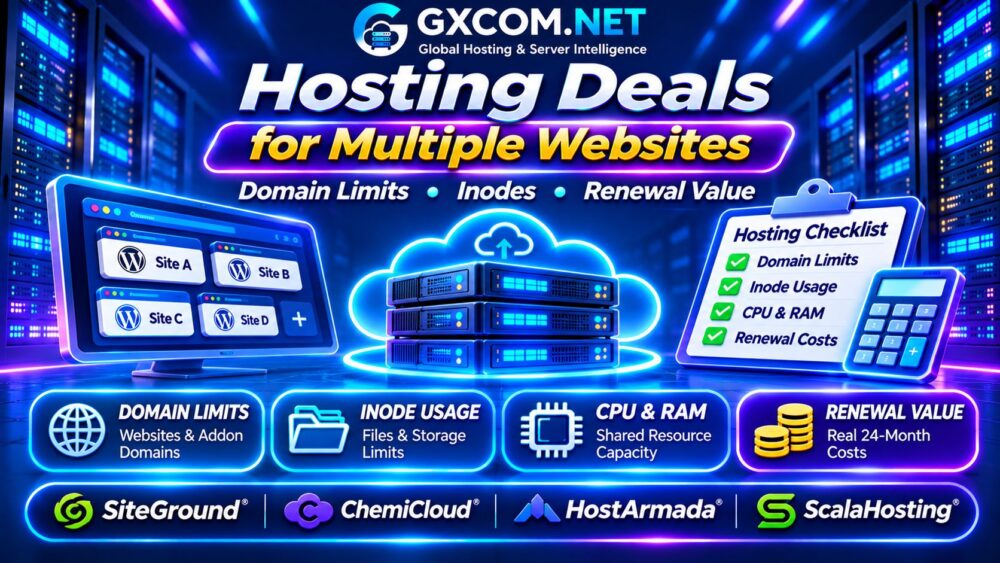
What Is Multiple Website Hosting?
Multiple website hosting allows several independent websites to operate under one hosting subscription. Depending on the control panel, you may add domains, create separate document roots, manage databases, and configure individual SSL certificates.
However, hosting several websites under one account is different from WordPress Multisite, which manages a network of sites through a shared WordPress installation. The appropriate configuration depends on isolation, maintenance, and administrative requirements.
Before buying, confirm whether the package supports separate installations, independent domains, and the applications your projects require.
Website Limits vs Addon Domain Limits
A provider may advertise support for multiple websites, but the actual allowance can depend on the hosting tier. Some plans permit only one primary website, while others allow additional domains or installations.
Also distinguish parked domains, aliases, subdomains, and addon domains. These features serve different purposes and do not necessarily represent additional independent websites.
| Hosting Feature | What to Check |
|---|---|
| Website allowance | Maximum independent installations |
| Addon domains | Number of additional hosted domains |
| Subdomains | Separate hostname restrictions |
| Databases | Count and storage limitations |
| Email accounts | Mailbox and sending restrictions |
| SSL certificates | Coverage for every hosted domain |
A plan supporting twenty websites is not necessarily suitable for twenty busy WooCommerce stores. Resource availability matters more than the advertised website count.
What Are Hosting Inodes?
An inode represents a filesystem object, such as a file or directory. Hosting providers may limit the number of filesystem objects an account can maintain, regardless of available disk space.
WordPress installations generate files through themes, plugins, uploaded media, caches, logs, and backups. Multiple installations can increase inode consumption rapidly.
For example, ten websites containing 25,000 filesystem objects each would require approximately 250,000 inodes, excluding additional account files. This is an illustrative calculation, not a typical provider allowance.

Ask whether inode limits are hard restrictions, soft warnings, or conditions affecting backups and account eligibility. Regularly remove obsolete caches and abandoned staging installations without deleting required data.
CPU, RAM and Entry Process Restrictions
Shared hosting resources are commonly allocated at the account level. Adding websites does not automatically multiply available CPU, memory, or concurrent processing capacity.
Entry process limits can affect how many simultaneous requests enter certain application processes. CPU throttling, memory exhaustion, and slow database queries may cause performance problems before storage fills up.
Dynamic WordPress sites, especially those using WooCommerce or demanding plugins, need more resources than simple static websites.
For resource-intensive workloads, our VPS vs Shared Hosting Comparison explains when dedicated virtual resources become worthwhile.
Four Hosting Providers Worth Comparing
SiteGround: WordPress-Focused Hosting
SiteGround is relevant to website owners seeking WordPress-oriented hosting tools and managed features. Compare eligible website allowances, storage capacity, account resource policies, staging availability, and renewal prices.
Confirm whether the selected tier supports your entire portfolio rather than assuming every package includes multiple websites.
ChemiCloud: Multi-Domain Hosting
ChemiCloud is a candidate for small businesses and publishers comparing multiple-domain hosting packages. Review addon domain eligibility, inode policies, backup coverage, email resources, and support conditions.
Calculate the cost of transferring existing sites separately from the recurring hosting subscription.
HostArmada: Shared Hosting Resources
HostArmada is worth investigating when comparing website allowances against CPU, RAM, storage, and other account limits. Check the current plan specifications and whether additional websites share the same resource pool.
Pay particular attention to renewal pricing and any restrictions affecting large collections of WordPress files.
ScalaHosting: Shared Hosting and VPS Growth
ScalaHosting offers a useful comparison path for projects that may eventually outgrow shared hosting. Evaluate its applicable shared hosting packages alongside VPS options when isolation and administrative flexibility become important.
Compare the total cost of upgrading rather than assuming that a larger shared plan will always resolve resource contention.
These providers are comparison candidates. Website limits, inode allowances, and promotional pricing must be verified for the exact plan being purchased.
Calculate the Real Cost of Hosting Multiple Sites
Introductory hosting prices can make a multi-website plan appear inexpensive. However, a substantial renewal increase may change its value over two years.
Consider two hypothetical plans supporting the same number of websites:
| Cost Item | Plan A | Plan B |
|---|---|---|
| First-year hosting | $48 | $96 |
| Second-year renewal | $180 | $108 |
| 24-month total | $228 | $204 |
| Average monthly cost | $9.50 | $8.50 |
| Cost per site per month, 10 sites | $0.95 | $0.85 |
Plan B costs more initially but saves $24 over twenty-four months. These figures exclude domain renewals, taxes, and optional services.
Our Shared vs Cloud Hosting Costs Guide provides additional long-term budgeting context.
Hidden Costs Beyond the Hosting Subscription
Check domain registration renewals, premium backups, email hosting, malware removal, migration assistance, and additional storage charges. A free SSL certificate does not necessarily mean every security or recovery service is included.
Multiple websites also increase maintenance responsibilities. Each independent WordPress installation needs updates, monitoring, and a tested recovery process.
If you are moving an established portfolio, review our Cloud Server Migration Guide for planning and validation principles.
When Should You Upgrade to VPS Hosting?
Consider a VPS when repeated CPU throttling, memory limits, database contention, or account-wide restrictions affect business-critical websites.

A VPS can provide greater resource control, but administration, licensing, backups, and security responsibilities may increase. Managed VPS hosting can reduce some operational work at an additional cost.
Compare available options in our Best VPS Providers Guide before upgrading.
Multiple Website Hosting Buying Checklist
- Verify independent website and addon domain allowances.
- Confirm inode, storage, CPU, and RAM restrictions.
- Check database, email, and SSL support.
- Calculate twenty-four-month hosting and renewal costs.
- Review backups, staging, migration, and support coverage.
- Identify a realistic VPS or cloud upgrade path.
Frequently Asked Questions
Does Unlimited Website Hosting Mean Unlimited Resources?
No. Providers may still enforce storage, inode, CPU, memory, and acceptable-use restrictions.
How Many WordPress Websites Can One Account Handle?
Capacity depends on traffic, plugins, databases, caching, and available resources rather than website count alone.
Is Shared Hosting Cheaper Than Separate VPS Servers?
Often for lightweight websites, but VPS hosting may offer better isolation and scalability for demanding workloads.
Final Verdict
The best hosting deals for multiple websites combine sufficient domain allowances, practical inode capacity, reliable resource limits, and transparent renewal pricing.
Compare SiteGround, ChemiCloud, HostArmada, and ScalaHosting using your actual website portfolio. Prioritize sustainable performance and total ownership cost over impressive but potentially misleading unlimited-site claims.
For broader purchasing guidance, explore our Best Cloud Hosting Solutions Comparison when your portfolio requires additional scalability.