Choosing managed hosting vs in-house server management is ultimately a business decision, not simply a technical preference. Hiring an internal administrator provides direct control, while managed hosting transfers defined maintenance responsibilities to an external provider.
However, comparing a $100 hosting plan with a full-time engineer’s salary is misleading. Businesses must consider existing staff, server complexity, after-hours coverage, backup responsibilities, and the financial impact of downtime.
This guide compares staffing requirements, operational responsibilities, and total cost of ownership (TCO) to help businesses choose the right management model.
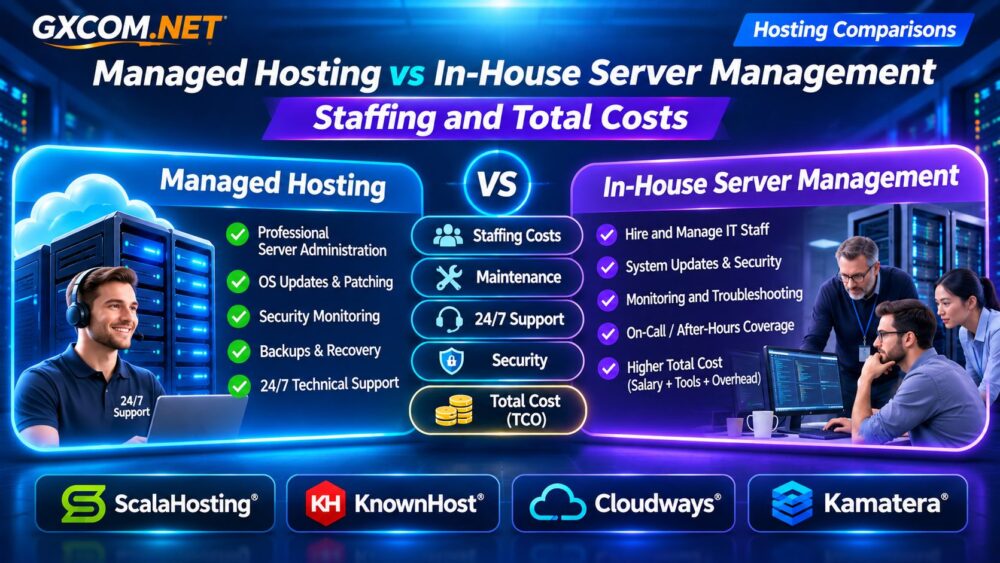
Managed Hosting vs In-House Server Management: Quick Comparison
| Factor | Managed Hosting | In-House Management |
|---|---|---|
| Server maintenance | Provider handles agreed tasks | Internal IT team |
| Staffing requirements | Lower routine administration workload | Dedicated or shared technical staff |
| Infrastructure control | Depends on service model | Greater direct control |
| 24/7 incident coverage | Depends on support agreement | Requires staffing or on-call arrangements |
| Software customization | May face support restrictions | Greater operational flexibility |
| Cost structure | Recurring service fees | Labor, tools, infrastructure, and overhead |
Neither approach eliminates operational risk. The key difference is who performs specific tasks and how those responsibilities are funded.
What Does Managed Hosting Actually Cover?
Managed hosting combines infrastructure with a defined level of technical assistance. Depending on the plan, providers may handle operating system updates, web server configuration, security monitoring, routine maintenance, and infrastructure troubleshooting.
Some providers also offer backup services and migration assistance. However, managed hosting rarely means unlimited support for custom applications, website code, or third-party plugins.
Before purchasing, request a written responsibility matrix identifying which tasks are included, excluded, or billed separately.
For a broader explanation, read our Managed vs Unmanaged VPS Comparison.
What Does In-House Server Management Require?
Internal server management places operational responsibility on employees or contractors. Typical duties include patch scheduling, monitoring, account permissions, firewall configuration, backups, capacity planning, and incident investigation.
Businesses also need documentation, escalation procedures, and coverage when their primary administrator is unavailable.
A small company might assign these tasks to an existing IT employee. Larger environments may require specialists in Linux, Windows, databases, networking, and security.
Hiring one administrator does not automatically create a resilient 24/7 operations team. Vacation, illness, turnover, and simultaneous incidents create additional staffing risks.
IT Staffing Costs: Salary Is Only the Beginning
An internal administrator’s total employment cost includes more than base salary. Benefits, payroll-related expenses, recruitment, training, software subscriptions, and management overhead also matter.

Consider an illustrative annual staffing model:
| Expense | Hypothetical Annual Cost |
|---|---|
| Base salary | $70,000 |
| Benefits and employment overhead | $17,500 |
| Training and operational tools | $3,000 |
| Total employment cost | $90,500 |
These figures are examples, not salary benchmarks. Actual costs vary significantly by country, experience, employment structure, and required coverage.
Importantly, the full amount should only be attributed to server management when the employee is hired primarily for that purpose. Shared IT staff require an allocated-cost calculation.
Managed Hosting vs Internal IT: Annual TCO Example
Suppose a small business operates several production websites. It can purchase managed infrastructure or use an unmanaged environment supported by an existing administrator.
| Annual Expense | Managed Hosting | In-House Model |
|---|---|---|
| Infrastructure and hosting | $3,600 | $2,400 |
| Allocated internal labor | $1,800 | $9,000 |
| Additional tools and backups | $600 | $1,200 |
| Total annual cost | $6,000 | $12,600 |
In this hypothetical scenario, managed hosting saves $6,600 annually. The difference comes mainly from administrative labor, not server hardware.
Results can reverse when a business already employs experienced administrators, manages many servers, or needs extensive customization that managed providers do not support.
Downtime, Security, and After-Hours Support
Downtime can generate lost sales, interrupted operations, customer complaints, and recovery expenses. However, the cost depends on the application’s business importance and actual outage duration.
Managed providers may offer around-the-clock infrastructure support, but response targets, resolution commitments, and application coverage vary.
Internal teams can respond quickly when staff are available and familiar with the environment. Maintaining overnight coverage, however, requires clear on-call procedures and adequate staffing.
Security ownership must also be explicit. Provider monitoring does not automatically include application vulnerability remediation or incident recovery.
Our Unmanaged Server Security Checklist helps identify operational responsibilities.
Four Hosting Providers Worth Evaluating
ScalaHosting: Managed VPS for Growing Websites
ScalaHosting is relevant to businesses seeking managed VPS infrastructure without building a dedicated server administration team. Evaluate its supported management tasks, control panel options, backup arrangements, and resource scalability.
KnownHost: Server-Level Management Support
KnownHost is worth comparing when technical assistance and established hosting workflows are priorities. Confirm which operating system, security, migration, and troubleshooting responsibilities apply to the selected plan.
Cloudways: Managed Cloud Hosting Workflows
Cloudways appeals to website teams that want a managed cloud platform rather than maintaining every underlying server component themselves. Compare its application-focused management model with your requirements for root access and custom configurations.
Kamatera: Configurable Cloud Infrastructure
Kamatera suits organizations evaluating flexible cloud resources alongside different administration arrangements. Confirm whether the selected configuration includes management services or requires a separate agreement.
These providers have different operating models. Compare equivalent resources and written service coverage rather than treating every managed offering as interchangeable.
When Should You Keep Server Management In-House?
Internal management may be preferable when an organization already maintains a capable infrastructure team, requires unusual software configurations, or operates complex systems spanning multiple environments.
Direct control can also improve coordination between developers, database specialists, and security teams.
However, businesses should account for employee availability, documentation quality, and the cost of maintaining operational expertise.
When Does Managed Hosting Make More Sense?
Managed hosting is often attractive when a business operates a limited number of websites, lacks dedicated infrastructure staff, or wants developers focused on product development rather than routine server maintenance.

It can also simplify predictable budgeting, provided the contract clearly defines support boundaries and additional charges.
Compare available models in our Managed Cloud Hosting Providers Comparison.
Consider a Hybrid Management Model
Many businesses benefit from combining managed infrastructure with internal application expertise. The provider handles agreed server-level maintenance, while employees manage website content, application deployments, database logic, and business-specific security policies.
This approach can reduce routine workload without sacrificing essential application control.
Before adopting it, document responsibilities for monitoring alerts, software updates, backups, and incident escalation. Our VPS Snapshot and Backup Recovery Guide explains why recovery planning needs separate attention.
Frequently Asked Questions
Is Managed Hosting Cheaper Than Hiring an IT Administrator?
It can be for smaller environments, but the comparison depends on allocated labor, server count, management coverage, and existing technical staff.
Does Managed Hosting Replace an Internal IT Department?
No. Businesses still need ownership of applications, access policies, vendor coordination, and technology decisions.
Can Managed Hosting Reduce Downtime?
Professional monitoring and maintenance may help, but availability depends on architecture, service commitments, and recovery procedures.
Final Verdict
Choose managed hosting when routine administration consumes valuable staff time and the provider’s support agreement matches your requirements. Retain in-house management when direct control, specialist expertise, and existing operational capacity justify the expense.
Evaluate ScalaHosting, KnownHost, Cloudways, and Kamatera against your actual workload. Calculate annual infrastructure, staffing, software, and incident-response costs before deciding. The best solution is the one that delivers sustainable operations at a defensible total cost.